pitching for the stars
Reviewed by Connie Ann Kirk
16 october 2013 archive
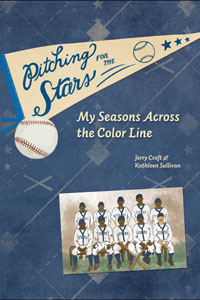
In the same year the PG-13 bio-pic of Jackie Robinson, 42, drew much attention, and discussions of race and baseball circulated in the air once again, perhaps serendipitously, Jerry Craft and Kathleen Sullivan's adaptation for young readers of Mr. Craft's 2010 memoir, Our White Boy, was published. While in college Mr. Craft pitched for a minor league baseball team. What is unique about his story is that Craft is white; the baseball team being described was all-black; and he pitched for this team in 1959 and 1960. In Texas. Later on, his story was called "Jackie Robinson in reverse" (38).
The publisher, a university press, targets this particular book to middle readers – those aged 9 and up, or readers in the neighborhood of grades 4-7. The book's design – cover, length, and size of print – puts it in this middle category as well; based on its appearance alone, this is a non-fiction book one might expect a fourth or fifth grader interested in baseball, for example, to pick up. Since the book's main "character," however, is college-aged when he plays ball and the stories within it are told as a memoir by a man later on his life looking back on his youth, the book's text and photographs inevitably pitch much older than readers in the 9-12 age range. This may pose a problem in the marketing or reception of the book.
In reviewing the parent book to this one for Arete, Scott Peterson writes:
Equal parts history and memoir, Our White Boy works on a number of levels while developing a wide range of themes. Operating as baseball history, the book chronicles two seasons of the Wichita Falls/Graham Stars, a black semi-pro baseball team. As a memoir, Jerry Craft tells his unique story as the only white man to play in the West Texas Colored League. On still another level, Craft and Sullivan follow the time-honored narrative strategy of illustrating how baseball can aid in the development and maturity process of a young man. With this range of themes and topics, the book is likely to appeal to a large number of readers with disparate interests.
In rewriting that book for young readers, Craft and Sullivan have composed, like innings in a baseball game, nine chapters: "An Interesting Experiment;" "Growing Up in Jacksboro;" "Experiences in Higher Education;" "Becoming a Star;" "Welcome to Our World, White Boy;" "Mr. Sedberry's Stars;" "Second Season;" "Lessons from a Black Man;" and "The Last Inning." The book also contains a Preface, Afterword, References, Acknowledgements, Index, and 17 black-and-white period photographs. Notably, to the point mentioned above, only one or two of the photos depicts people in the age range of the targeted younger audience.
The authors have chosen to present the reader with a series of anecdotes from Mr. Craft's experiences. Several of these are quite vivid, and one expects they would be memorable for young readers. For example, in the first chapter, Craft describes an accident in which a knife becomes lodged in his eyeball (4). This is the kind of stuff kids like. Not only that, the accident will forever change how the author pitches, and his altered vision becomes a metaphor for the chief experience of the book. Not only will he "see" race differently after what he lives through, but as his father says about his son's new impairment in relation to the athletic ambitions he has for him, "He will have to adjust" (4). Adjust he does, but in a way his father will not anticipate or necessarily find agreeable.
Another strong story in the memoir comes later on when Craft describes his entire black baseball team getting up and leaving a restaurant when he was not going to be served because he was white (54). "Jackie Robinson in reverse" comes to mind when reading scenes like this from the book; however, the author admits he was no Robinson. While the former player "let his playing skills speak volumes," Craft says he is "a talker and a social person" who "wanted the Stars to accept me not only as an athlete but also as a human being, a person worth knowing" (38).
One suggests that the book could have perhaps benefitted from a stronger narrative line to guide the reader. The anecdotes are rather disjointed from one another, making the lines between the story-bases sometimes difficult to run. School Library Journal, a key tool used by school librarians to help make choices of which books to purchase on a limited budget, describes the problem as: "a jumbled mess of anecdotes—one story follows another in a disorganized, confusing string of episodes." Along with the design and marketing of what might have been a young adult book to middle readers, the choice of the anecdotal structure may pose as problem #2 for this publisher and these authors. SLJ exerts a strong influence in the library marketplace. The regional appeal that these events took place in Texas, however, may help overcome these obstacles for that large reading audience in particular.
Whether he might accurately be described as "Jackie Robinson in reverse" or not, Jerry Craft's personal story of growing up in Texas, playing baseball, confronting the racial divide head-on, and helping move integration in the sport forward provides a first-hand account of an important era in mid-twentieth century America.
Craft, Jerry and Kathleen Sullivan. Pitching for the Stars: My Seasons Across the Color Line. Lubbuck, Texas: Texas Tech UP, 2013. 108 pp. $18.95. Hardcover. ISBN: 978-0-89672-787-8.
Copyright © 2013 by Connie Ann Kirk