our white boy
Reviewed by Scott D. Peterson, University of Maine
29 January 2011 archive
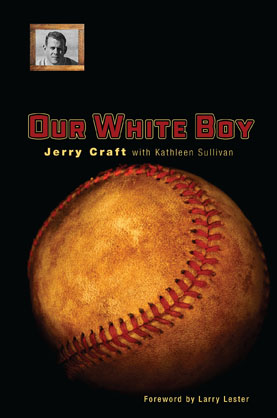
Equal parts history and memoir, Our White Boy works on a number of levels while developing a wide range of themes. Operating as baseball history, the book chronicles two seasons of the Wichita Falls/Graham Stars, a black semi-pro baseball team. As a memoir, Jerry Craft tells his unique story as the only white man to play in the West Texas Colored League. On still another level, Craft and Sullivan follow the time-honored narrative strategy of illustrating how baseball can aid in the development and maturity process of a young man. With this range of themes and topics, the book is likely to appeal to a large number of readers with disparate interests.
As baseball history, Our White Boy replays the lost era of semi-pro baseball when towns could boast teams that were associated with mills, factories, or military units. In a detail that is reminiscent of the earliest days of baseball history, Craft describes how he came to look forward to the West Texas Colored League's custom of socializing with the other team and more than once remarked how the custom was one of the many elements that differentiated black baseball from its white counterpart. The characteristics of the various teams that serve as opponents are also interesting as artifacts of semi-pro baseball. These teams range from black teams that travel from all over the region for the annual Juneteenth tournament to commemorate the ending of slavery in Texas in 1865 to white teams of immigrant German dairy farmers who had their own special substitution rules during milking times. Craft's careful observations note the differences in the demeanor of his black teammates during these games, from fear in Bowie, Texas, condescension against a weaker team of Hispanics, and genuine affection while battling the German team. One quibble from this aspect of the book is the parenthetical notations in the middle of Craft's narrative. Even though these citations document the sources of the history he's relating, footnotes might have been less distracting.
While the history/memoir hybrid is not always an easy marriage, the book effectively recaptures Craft's experiences. He tells us early on that integration means more to him now than it did then, which rings true since few of us realize the greater significance of what we are living through at that moment. The civil rights movement of the early 1960s provides another key component to the memoir element of Craft's book. When his friends ask him whether or not he's becoming an "activist," they use the term in a pejorative sense (162). When he discusses civil rights with Mr. Sedberry at the end of the book, the discussion chronicles aspects of personal history and baseball history alike. Mr. Sedberry characterizes the differences between black baseball and white baseball, brands the black players who signed with the major leagues as traitors to Negro League baseball, and notes how those players were merely "warehoused" in the minor leagues while only a select few made it to the top level in the early days of segregation (207-12). Another minor quibble comes from the title: while Craft makes it clear that "Our White Boy" became an affectionate nickname used by his black teammates, the syntax of the phrase would seem to herald a narrative voiced by those same teammates instead of Craft himself.
Running underneath the history and memoir elements is a Bildung narrative that tells the story of how Jerry Craft came of age through the agency of playing semi-pro baseball. The reverse discrimination that he experienced in eating establishments frequented by blacks furthered that education (137-9). The book is also filled with little revelations that opened his eyes to an entire other existence, including Christmas cards that pictured black families and how his complete ignorance of the death of the team's catcher proved that he moved in a completely different world than his teammates. One quibble in this area of the book is marked by a desire for more examples to illustrate how he adjusted and developed as a person while growing accustomed to his black teammates.
Taken together, the historic, memoir, and Bildung narrative elements all prove that Jerry Craft has a unique story to tell and by and large he tells it very wellno doubt with Kathleen Sullivan's help. If anything, he understates the importance and significance of his willingness to pitch for a black team in the West Texas culture of 1959 and 1960. Even if it goes against Michael Oriard's cardinal rule of treating just a single season in a sports narrative, Craft's story captures the times and embodies the experience of coming of age on baseball fields that were becoming segregated. In the end, his narrative will appeal to fans of baseball, memoirs, and coming-of-age stories.
Our White Boy, Jerry Craft with Kathleen Sullivan. Lubbock: Texas Tech University Press, 2010, cloth, $29.95.
Copyright © 2011 by Scott D. Peterson