football and manliness
Reviewed by Pam R. Sailors, Missouri State University
8 january 2018 archive
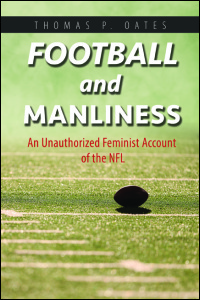
There is no shortage of criticism of the National Football League (NFL) these days. Player protests, sinking television ratings, recurrent episodes of domestic violence, and mounting awareness of player safety issues (which have contributed to a plunge in youth participation numbers), increasingly dominate media coverage. Thomas P. Oates's Football and Manliness adds to the criticism by shining a light on the sexism and racism underlying the narratives of professional football.
Against a backdrop of white male anxiety, Oates posits the NFL as a defense against those (women and black men) who threaten their power. The league, he claims, provides "an especially important site for recuperating and reasserting powerful (if often conflicted) visions of manliness" (19). To make his case, Oates directs his gaze beyond the playing field to the various auxiliary enterprises that surround it, following Suzanne Walters in organizing his analysis around the "symptomatic texts" of the NFL. Symptomatic texts are narratives that convey attitudes and beliefs already held by the larger culture. The goal is to determine the origins and implications of the particular texts. That is, how these narratives come to hold sway and what possibilities are opened (or forestalled) by them. While Oates assumes that patriarchy and white supremacy are "ordinary, everyday, and routine," he seeks to highlight their contingency through a kind of Foucauldian uncovering of "where the fissures, contradictions, and other possibilities for resistance might be" (20-21). His examination of narratives is organized around four groups of NFL stakeholders: teams, players, coaches, and fans.
Chapter one, "This Game Has Got to be About More Than Winning": Football Melodramas and the Defense of the Homosocial Enclave, looks at narratives about professional football teams. Oates offers a close reading of the film, "Any Given Sunday," and two television series, "Playmakers" and "Necessary Roughness," pointing to examples in which black players and women threaten the homosocial unity of the football teams through selfishness and greed.
The second chapter, "We Ought to See What We're Buying": The NFL Draft and Regimes of Visibility, focuses on coverage of the NFL draft to illuminate narratives surrounding the players. The story told by the draft reduces the players to interchangeable bodies that can be bought and sold like commodities. Again echoing Foucault, Oates refers to the athletes as docile bodies enmeshed in "a spectacle of surveillance" (89), with "black male bodies available for erotic perusal under the cover of the due diligence of a careful shopper" (92).
Narratives surrounding coaches are the subject of chapter three, Male Order: Masculine Authority, Professional Football, and Enterprising Culture. Oates analyzes books by NFL coaches that both express and challenge the hyper-masculine ethos of professional football. The coaches couch their self-development and managerial texts in attitudes of care and nurturing, yet also contain a prescription for what Don Sabo calls "meritocratic pain," or the willingness to endure pain that is required for a football player to be celebrated as a real man's man.
Chapter four, Man Management: Football Gaming and the "Financialization of Daily Life," moves to consideration of football fans, centered on fantasy football leagues and the Madden NFL video game. Both the fantasy leagues and the game allow fans to take the position of the coaches and engage in commodification of players akin to that which Oates discussed in the chapter on the NFL draft.
The final section of the book presents a question asked more and more frequently: have we come to Postgame: The End of Football? Highlighting growing concerns about the connection between football and chronic traumatic encephalopathy (CTE), Oates discusses Mark Fainaru-Wada and Steve Fainaru's 2013 book, League of Denial, as a counter-text to those examined in the preceding chapters. "While mainstream narratives frequently position white women and black men as forces intent on destroying football for their own greed and self-aggrandizement, here, they are courageous and selfless protectors of player well-being" (165). Oates does a nice job of situating Bennett Omalu, the Nigerian forensic pathologist who discovered CTE in former player Mike Webster's brain, and Ann McKee, the white woman neurologist at the Boston University School of Medicine, who has led the investigation into the prevalence of CTE, as alternatives to the prevailing narrative.
In the end, Oates hopes that he has not only uncovered the problematic nature of the existing narratives surrounding the NFL, but also offered a vision for improvement. He says, "I hope that this work can contribute to the much larger, ambitious, and perhaps utopian project of remaking the culture of the NFL into one that fosters radical compassion for its players, its fans, and everyone else. In any case, I hope it contributes in some small way to a future where the politics of misogyny, racism, and corporatization are a little less viable" (3). This is an ambitious aim, and one for which I must say I see little reason to hope. I found Oates's arguments regarding racism in football entirely convincing; unfortunately, on many occasions, they overshadowed the issue of sexism. Oates could also have extended his claims, since most of the narratives he identifies with professional football also exist in college football, some of them even in youth football. It's not clear exactly how the NFL could be rehabilitated, particularly given the CTE problem, but if unveiling problems is the first step toward solving them, Oates has made a laudable contribution.
Oates, Thomas P. Football and Manliness: An Unauthorized Feminist Account of the NFL. Chicago: University of Illinois Press, 2017. 213 pp. Notes, Index. $25.93 (paperback).
Copyright © 2018 by Pam R. Sailors