the forgotten legacy of stella walsh
Reviewed by G. Louis Heath, PhD, Emeritus Professor, Ashford University, Clinton Iowa
14 december 2017 archive
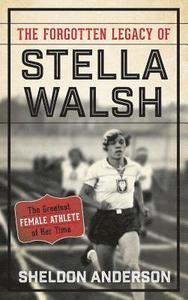
I read the AP's report of Stella Walsh's untimely death in Cleveland in 1980. It struck me then as quite odd that I had not heard of such a famous athlete. When I began this book, that report flashed back and I marveled this time how I had completely forgotten her. Certainly her name had never surfaced in my three decades' teaching a Sociology of Sport class, during which I had read widely about sports.
Stella Walsh became famous at age 21 on August 2, 1932 at the Los Angeles Olympics, winning the 100-meter race in world record time, not for the United States, but for her native Poland. She went on to dominate women's track and field for the next 25 years. In addition to her Olympic gold medal, she set at least 50 world records and won 41 U.S. Track and Field National Championships. She was the first woman to run the 100-yard dash in under 11 seconds. At the Polish American Olympic Games in Pittsburgh in 1938, she won 9 of 10 events. At the AAU Championships in Dallas she won in javelin and the baseball throw. The Cleveland Indians' "speedometer" later timed one of her throws as the fastest ever in the Indians' stadium.
Stella Walsh was born Stanislawa Walasiewicz in 1911 in Russian Poland. She came to the United States as an infant with her mother, who immigrated to join her husband who had arrived earlier. Stella would not become a U. S. citizen until 1947. But she could not compete in the Olympics for the U. S. because of an Olympic rule barring an athlete from participating for two nations. She would compete in the 1936 Berlin Olympics for Poland, placing second in the 100 meters to her principal rival, Helen Stephens of Missouri. (Chapters 4 and 5 are devoted in large measure to Walsh's ongoing competition with Stephens.) Much later, a 1956 amendment to the rules allowed that a woman who once competed for her native country could be granted the right to compete for her adopted country "through marriage." So, Stella entered a marriage of convenience with longtime Cleveland acquaintance Harry Olson on August 15, 1956 in order to compete for the U.S. in the Melbourne Games. However, at age 45, she failed to qualify in any event at the Olympic trials at American University. (Her specialties were the 100 meters, the javelin, and the pentathlon.) She never lived with Harry Olson and they never divorced.
Polish American newspapers conducted a poll in 1950 that voted Walsh the greatest Polish American athlete for 1900-1950. St. Louis Cardinal slugger Stan Musial finished second. Notre Dame Heisman Trophy winner and Chicago Bears quarterback Johnny Lujack placed third. In 1951, the Helms Athletic Foundation of Los Angeles named her the greatest female athlete for the first half of the twentieth century over Babe Didrikson Zaharias, Helen Wills, and Helen Stephens.
So, how did Stella Walsh become forgotten when Babe Didrikson and other distaff athletes are well remembered? Professor Anderson (Miami University, Oxford, Ohio) finds the reasons embedded in her complex identity (nationality and gender). Walsh is revered in the Polish American community in Cleveland today where there is a recreation center named after her in the Slavic Village neighborhood where she grew up. But nowhere else does her memory live. This owes in part to her winning gold in 1932 for Poland and her subsequent failure to qualify to compete for the United States. Anderson's book goes into this odyssey in great detail. The account is quite compelling and dramatic in places.
The second layer of her identity that contributed to the world forgetting her is gender. After she was murdered at age 69 by two thugs attempting to rob her as she shopped one night at a Slavic Village strip mall, an autopsy revealed she had no female genitalia or reproductive organs. She suffered from a rare condition known as mosaicism where both male and female chromosomes are present. Though she did have a small, nonfunctional penis and testicles, those did not make her a man. Yet several columnists had a field day writing that Walsh had been a man who masqueraded as a female athlete. What is true is that she lived her life as a female although her sex chromosomes were male dominant. Her Cleveland Polish American neighborhood knew she was different as a little girl. Other children teased her and as she grew up and achieved fame, malicious remarks abounded about her sexuality. So, she lived mostly apart with few friends and did not leave her parents' cramped frame home on Clement Avenue till 1952 when she departed to live in Los Angeles where she could capitalize on her fame.
In LA, Walsh became a minor celebrity and a major one in the sports community. She even appeared on Groucho Marx's TV quiz show, "You Bet Your Life." A transcript of the hilarious dialogue between the two appears on pages 142-143. These pages point up the author's assiduous pursuit of all available information about this forgotten sports icon of the 20th century. The 27 pages of Notes underscore how exhaustively Professor Anderson labored in this much deserved revival of Stella Walsh's memory.
Stella Walsh became one of the first athletes to compete widely in global venues, becoming a proud, confident, sophisticated globe trekker who always dressed nattily. She competed in events in such cities as Vienna, Prague, London, Warsaw, and Moscow. In 1935 in Osaka she recorded an unofficial world record in the 200 meters and in Tokyo established another in the 500 meters. As she grew older, she began to train and compete in longer distances, racing regularly in the 800 meters.
This book includes a good deal on modern Polish and Polish American history, including Leon Czolgosz's assassination of President William McKinley in 1901 and the career of Pola Negri, one of the foremost Polish American silent film stars as well as Rudolph Valentino's lover. (He died at age 31 from peritonitis. Negri wept openly at his funeral.) This work also covers some Cleveland city history and women's sports history, including Japanese athlete Hitomi Kinue, whom Walsh competed against and befriended, and who died tragically at age 24. Walsh claimed Kinue was one of the best ever of the women athletes.
All the female athletes Professor Anderson discusses are noteworthy for their challenge to conventional gender norms, most particularly Stella Walsh. In an era of few opportunities for women outside the household, Walsh and her cohort fought to enlarge access. The few events open to women in the Olympics in track and field increased. Yet it was not until the 1972 addition of Title 9 to the 1964 Civil Rights Act that girls and women began to make significant headway. Part of the impetus for Title 9 lay in the great opportunities in sport that Soviet bloc athletes had enjoyed in sports for years. Title 9 was thus inspired in part by Cold War competition. All this came along too late for Walsh who turned 61 in 1972. Another change that would have helped her and others was the new Olympic rule allowing athletes to make money in their sports and still compete in the Olympics. That would have helped Walsh avoid dependency on her railroad clerk job (which she lost in early July, 1932 during the Depression) and the thrift measure of living with her parents. It would have also made it possible for her to compete in the August, 1932 Los Angeles Olympics for the United States, not Poland. How all that played out in July, 1932 when she was literally on the way out the door to get her U.S. citizenship papers is thoroughly recounted in this book.
To make ends meet, Walsh even ran for a beauty queen title in Cleveland to win a car. The trophies in her room were all she had to show for her athletic achievements. She wanted the car. By canvassing for votes for weeks in her Polish American neighborhood, she easily amassed the largest tally of votes to win the car. That story and others just as compelling contribute to making this book a good read.
In 1964, Walsh returned to Cleveland after a dozen years in Los Angeles. She had tired of the smog and congestion and missed her friends and family. She lived the rest of her life in her childhood home on Clement Avenue until she was murdered in 1980. In 1983, two men were convicted and sentenced for the murder.
This book is well worth reading. Stella Walsh excelled in running at the Olympic gold level and she set many records and broke barriers throughout her career. She deserves a place in our memory and she can teach us valuable lessons. No other female athlete of her era traveled the world as much, not even the tennis great Helen Wills. No other athlete combines the issues of ethnicity and gender into such a compelling, teachable opportunity. That opportunity is this book. Every library should acquire a copy and everyone should read it. Purchasing your own copy will enhance the sports collection on your shelves. It will also make a great gift for your daughter or niece. This is not just a great sports story. It is a gripping and moving narrative of a unique woman who endured much to achieve her dreams.
Sheldon Anderson, The Forgotten Legacy of Stella Walsh: The Greatest Female Athlete of Her Time (Lanham, MD: Rowman and Littlefield, 2017), 229 pages.
Copyright © 2017 by G. Louis Heath