one nation under baseball
Reviewed by Joseph L. Price, Whittier College
19 october 2017 archive
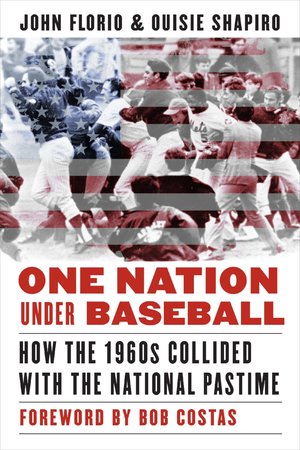
In One Nation under Baseball John Florio and Ouisie Shapiro provide an enlightening and stimulating cultural history of baseball during the turbulent decade of the 1960s. Rather than focusing on statistical records, pennant races, or World Series games during that period, they concentrate on the decade's developments in baseball's interaction with two distinct challenges: racism and player compensation. Throughout their narrative, the authors trace how African American players experienced discrimination not only through their subjection to Jim Crow laws but also through their suffering slights in the number and prominence of opportunities for promotional appearances and product endorsements. And with regard to baseball players' compensation, the authors recount the shifts in the contract negotiation process that players annually pursued.
Florio and Shapiro initiate and personalize their trek through race relations in the 1960s by contrasting a personal exchange between presidential candidate Kennedy and Jim "Mudcat" Grant with a communication to Vice President Nixon by Jackie Robinson, and by describing the systemic injustice experienced by MLB All Stars—including Grant, Elston Howard, Bill White, and Bob Gibson. Among the most pervasive practices of racial discrimination experienced by African American players was their exclusion from team activities outside the ballparks during Spring Training in Florida. Focusing on the struggles of Yankees and Cardinals in St. Petersburg in 1961, Florio and Shapiro describe in detail how African American players were routinely separated from their teammates. They were denied housing at team hotels, causing them to find alternate accommodations in the home of the local president of the NAACP. They were also relegated to an outsider status during travel to away games, getting sequestered on the bus while teammates entered restaurants that refused to serve African Americans and being forbidden access to restrooms at gas stations during rest stops on bus trips. And they were initially excluded from a celebratory breakfast hosted by the St. Petersburg Chamber of Commerce.
In an effort by some teams to avoid these prejudicial problems that were then protected by law, the authors point out that a few years earlier the Dodgers had purchased and renovated "Dodgertown" in Vero Beach, Florida, in order to provide team housing and meals on site, thus defying local segregationist statutes; and that Bill Veeck, the only (former) team owner who would testify on behalf of Curt Flood in his suit against MLB, threatened to move the White Sox from their Spring Training home in Sarasota unless the team hotel abandoned its segregationist policy.
Noting the complexity of responses to the ongoing racial discord, Florio and Shapiro chronicle the impact of the decade's civil rights movement and protest marches on players, who notably were absent from most of the public events like the March on Washington or Birmingham rallies, not because of their disapproval of the demand for equal rights but because of the possibility of retribution by baseball's hierarchy of general managers, team owners, and the Commissioner's office. In multiple ways the authors analyze the impact of the decade's discord on players. In particular, they contextualize the baseball fight between John Roseboro and Juan Marichal in the violence of 1965, noting that Roseboro's home stood within the smoke of the Watts conflagration while Marichal's family remained incommunicado during the civil war that had erupted in the Dominican Republic. The authors also point to the bungling by MLB Commissioner Eckert in response to the assassination of Martin Luther King, Jr. and the roles of players, particularly Roberto Clemente and Bob Gibson, in prompting the Commissioner to change his initial ruling that home teams would control the decision about whether to play on the day of MLK's funeral.
Certainly, as the authors recognize, the passage of the Civil Rights Act (1964), the Voting Rights Act (1965), and the Fair Housing Act (1968) established a legal foundation for African American players to secure equal rights and fair treatment. Even so, the abuse of African American players by managers and GMs persisted, including the process of salary negotiations, a demeaning process also engaged and endured by most players, many of whom were so modestly paid that they had to work other jobs during the off-season to meet living expenses.
While the decade began with Mickey Mantle and Willie Mays breaking the salary ceiling of $100,000, it ended with Curt Flood's suit over the reserve clause. In the years between, the uniform practice of players negotiating their contracts in person and alone with general managers shifted dramatically. Shackled by the reserve clause and an ineffectual players' association at the start of the decade, players were routinely financially flogged by GMs and owners. Two of the authors' examples suffice: Dodgers general manager Buzzie Bavasi was known to deceive players during their bargaining meetings by allowing the player to see the copy of a false contract of the team star whose salary, identified on papers conveniently exposed on his desk, appeared to be less than the proposed salary by the negotiating player. And Calvin Griffith, owner of the Minnesota Twins, suggested that American League Pitcher of the Year Mudcat Grant consider his World Series check as part of his annual compensation when his 1966 contract was being negotiated. Griffith's initial offer was merely a $2,000 raise over Grant's previous salary for the year in which he had won 21 games and had notched two of the three World Series victories by the Twins.
But, according to Florio and Shapiro, the process of players' contract negotiations was empowered in the last half of the decade by three events: the tandem hold-out of Sandy Koufax and Don Drysdale before the 1966 season, the election of labor relations specialist Marvin Miller as the Executive Director of the MLBPA, and Flood's suit against MLB challenging its reserve clause. Each of these developments marked a radical departure from tradition. Following independent meetings with Bavasi, who had suggested to each pitcher that the other wanted less than the amount being requested, the two pitchers met for lunch and agreed to employ Ginger Drysdale's Hollywood agent to represent them as a duo in their negotiations with Bavasi. Before then, agents had not been involved in a player's bargaining process. The decade's developments in contract negotiations culminated with Miller's introduction of collective bargaining—the strength of a union—and Flood's sacrificial stance that initiated the process to revise the reserve clause.
To provide background for these early steps in players' collective bargaining, the authors describe the case of Giants outfielder Danny Gardella who, in 1946, had chosen to play in Mexico for twice the salary that he had made in New York. Yet when he tried to return to the major leagues following his season south of the border, no team would sign him, prompting him to file an antitrust suit against MLB, which settled the case by establishing a minimum salary for players among other modest concessions. Even so, Gardella's action effectively ended his major league career since, thereafter, he appeared in only a single game for St. Louis in 1950.
While the authors primarily attend to issues about race relations and compensation that affected players, teams, their front offices, and even the MLB Commissioner and his staff, they effectively interweave information about baseball's interplay with political leaders and civic organizations; its reactions to the assassinations of President Kennedy, Martin Luther King, and Robert Kennedy; its responses to the Vietnam War; and its handling of shifts in journalism about the game, particularly the impact of the New York newspaper workers' strike in 1962-1963 and the publication of memoirs by Jim Brosnan, The Long Season, at the beginning of the period and by Jim Bouton, Ball Four, at decade's end.
Harmonizing the voices of major league players with the insights of sports journalists and historians, Florio and Shapiro tightly craft their narrative, which often reads with the fluidity of popular fiction. While they devote most of their attention to major league teams in the Northeast and while they focus their analysis of racial discord on the discrimination against African American players, the authors nonetheless present a compelling account of how many of the major cultural challenges and social upheavals during the 1960s interacted with Major League Baseball. Surprisingly absent from significant consideration, however, were the experiences of Latin American players, particularly Cubans (notably Minnie Minoso, Camilo Pascual, Pedro Ramos, Mike Cuellar, Zoilo Versalles, and Tony Oliva,) during the Bay of Pigs invasion at the start of the 1961 season and the Cuban Missile Crisis during the World Series the following year. Although one might quibble with points here and there in the authors' argument, the strength of their work lies in their creative and astute evaluation of the trauma of racism that affected and afflicted Major League Baseball during the 1960s.
John Florio and Ouisie Shapiro. One Nation under Baseball: How the 1960s Collided with the National Pastime. Lincoln: University of Nebraska Press, 2017. ix + 221. 32 photographs. $29.95 (hardcover).
Copyright © 2017 by Joseph L. Price