the black migrant athlete
Reviewed by G. Louis Heath, Emeritus Professor, Ashford University, Clinton IA
29 september 2017 archive
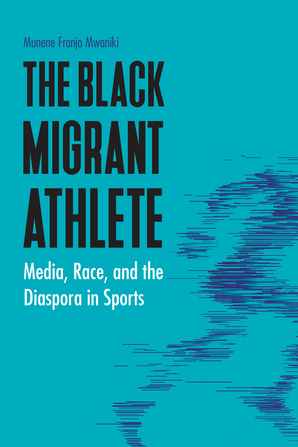
This book looks at how the media portray black African athletes who play mostly in the USA and Europe (predominantly in the NBA, WNBA, MLS, and the European soccer leagues as well as running in American marathons). It is about how the fourth estate has relied on stereotypes and selective facts to construct the public personae of African athletes abroad. The author, Dr. Mwaniki, Assistant Professor of Sociology, Western Carolina University, a Kenyan-American who was raised in North Carolina, has rendered his University of Illinois Ph.D. dissertation into this very sociological book that employs for analyses such constructs as alterity, othering, and marginalization.
The social distance the media impose on migrant African athletes owes to the American racial animus that harvests "strange fruit" as well as rampant, perverse stereotypes of African nations as backward and corrupt. These are the broad themes the author/researcher explores with his sociological methodology. His sample is comprised of ten African pro athletes (Hakeem Olajuwon, Dikembe Mutombo, Tegla Loroupe, Christian Okoye, Tamba Hali, Catherine Ndereba, Mwadi Mabika, Tirunesh Dibaba, Didier Drogba, and Mario Balotelli) whose biographies and careers he details by delving into news media archives. He selected these ten, not as a representative sample (they are not), but as one that "allowed me an entry point into the conversation about being foreign and black in sport. … So, while this book is about the individuals listed above, it is in some ways not really about them at all."
Mwaniki's book scrutinizes the big picture of how media "marginalize blackness" whether in individuals, cultures, or nations. To do so, he draws eclectically from discourse analysis, cultural studies, and social learning theory (subsets of sociology). My criticism here is that he could have enhanced his book by adding the interdisciplinary insights of subaltern studies, a specialization that focusses on once-colonialized peoples.
The book begins with an overview of the Atlantic slave trade, the history of US immigration policy (esp. the Hart-Celler Immigration Act), the collapse of many African states in the 1970s and 1980s, shifting post-WWII global demographic patterns (including the impact of the British Nationality Act), the #BlackLives Matter movement, black African athletic labor migration, and the globalization of sport. He proceeds to document how prejudice, aka white supremacy, exerts a profound influence on our perceptions; for example, Kenyan distance runners. After they won a ton of medals at the 1968 Mexico City Summer Olympics, the media discounted their success, citing the "altitude advantage" they enjoyed growing up in Kenya. Nevertheless, in the 1970s and 1980s, U. S. universities intensively recruited Kenyan runners (esp. the University of Richmond, Iowa State University, Washington State University, and the University of Texas at El Paso). The rush to Africa was not limited to Kenyan runners as US universities wooed large numbers of African athletes in a number of sports. Here, an interesting facet of Mwaniki's analysis is that he draws on Frantz Fanon's work as encapsulated in Black Skin, White Masks and The Wretched of the Earth.
The reader will find on offer discussions of the networks by which African prospects are recruited. For example, current NBA center Joel Embiid of Yaoundé, Cameroon was invited at age 16 to the Basketball Without Borders camp in South Africa. From there he attended Montverde Academy and the Rock School, both in Florida. Unfortunately, not everyone fares as well as Embiid. Many fail and are left homeless with little or no money for food. These impoverished youth the media chooses to neglect, for they do not support the American success story narrative.
The author claims the recruiting networks are tantamount to human trafficking. (It would have been nice if Mwaniki had asked some African athletes manqués if they felt trafficked, lest he become willy-nilly complicit with the media he so thoroughly excoriates.) The responsible parties, according to Mwaniki, are scouts, coaches, and host parents. For him, it all amounts to a kind of Ponzi scheme of young athletes whose rare winners both mask and justify the larger exploitation. Mwaniki advocates more regulation of recruiting networks that exploit vulnerable, young Africans, many unfamiliar with the cultures and languages of the societies where they are placed.
Here I must quibble with the author. Professor, what you write about begs the questions: How did you get interested in sports for your dissertation? It certainly is not a random choice. How did you make the decision? Was part of it that you were once a young athlete yourself? This reader wants to know.
Lots of data are to be found here on athletes who make up the black African migrant diaspora. For example, in 2016, twenty-eight Nigerian women played pro sports in the USA, and 122 Nigerian men competed in nations other than the US, predominantly Spain, Italy, Germany, and the UK. (A few played in China, Bahrain, Chile, Finland, Iran, and Qatar.) For more on the far-flung scope of the diaspora, you will find plenty in this fine University of Nebraska Press publication.
The book covers how the media's coverage of African athletes owes heavily to how blackness has been constructed through history. It examines the popularization of "Muscular Christianity" in relation to Social Darwinism, eugenics, and white supremacy as well as how society and media constructed the "foreign black other." Also, there is an in-depth consideration of "boundary making and maintenance" and "model minorities."
Here you will find inquiry into the stereotype of the excellent though temperamental "natural athlete." For example: NBA centers Hakeem Olajuwon and Dikembe Mutombo's careers are analyzed as to how the media inject prejudice, often obliviously, into their depictions of the two. The media represent soccer stars Didier Drogba (an Ivoirian who plays in France) and Mario Balotelli (who plays in Italy where he was born to Ghanaian parents) as mentally unbalanced, even insane. They do another sort of number on Kenyan marathoners Tegla Loroupe and Catherine Ndereba that you need to read in order to appreciate. Unfortunately, positive media for the black African athlete depends on his or her "perceived good behavior." Of special note is the NBA's fear it is losing audience because the league is dominated by blacks, particularly a few Africans, for whom the Lion King's advice, "Hakuna matata" (Don't worry) does not apply.
The Black Migrant Athlete finishes with an account of "identity construction" of black immigrants, some of whom gain American citizenship for their own strategic reasons. For example, eight pages are devoted to how Houston Rockets' center Dikembe Mutombo acquired US citizenship as part of his campaign for a new hospital in his native Democratic Republic of Congo. The author draws on interviews, autobiographies, and news articles about Mutombo to support his analysis. Then he draws from the same sources to look at the other nine pro athletes in his sample in order to examine the gulf between their real personae and the ones put forward by the media. The antinomy between the two provides much fuel for the false images of black African athletes abounding in our media.
Read this excellent book and you will learn much more, including what "generation 1.75" is and the role of global capitalism in dispersing these athletes all over the world. However, The Black Migrant Athlete is not for the sports fan who wants a good read on a day off. It is a scholarly book from the discipline of sociology that is most appropriate for sports scholars and fans who have an intellectual bent. It is a good choice for them, and because it is, it should be considered for accession by libraries everywhere.
Munene Franjo Mwaniki, The Black Migrant Athlete: Media, Race, and the Diaspora in Sports (Lincoln, Nebraska: University of Nebraska Press, 2017), 276 pages, including a ten-page bibliography; Appendix A, nine pages on "Methodology and Data-Gathering Procedures;" and, Appendix B, ten pages on "Individuals in the Study."
Copyright © 2017 by G. Louis Heath