lefty o'doul
Reviewed by Amy Essington
8 september 2017 archive
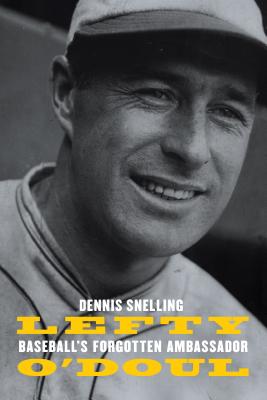
In Lefty O'Doul: Baseball's Forgotten Ambassador, Dennis Snelling, author of The Greatest Minor League: A History of the Pacific Coast League, 1903-1957 and Johnny Evers: A Baseball Life, traces the life of Lefty O'Doul, major league pitcher, minor league manager, and international ambassador of baseball. Snelling successfully recounts the professional career of O'Doul and places it in context of a changing international world.
Born in 1897 in San Francisco, Francis Joseph O'Doul would die there in 1969. He maintained a connection to the city from his early professional years, through his playing days in major league baseball, his coaching days, which included managing the home town team for seventeen years, and his post-baseball life when he founded a sports bar which became a legend.
Lefty O'Doul's baseball career began at Bay View School in 1912. He credited Rosie Stoltz, the school's baseball coach with teaching him the fundamentals of baseball. "She taught me to pitch, field, and hit … Miss Stoltz alone is responsible for my success in baseball." (p. 6) After some time on semi-pro teams, he joined the San Francisco Seals in 1917. His major-league career lasted fifteen years and included stints with the New York Yankees (1919-22), Boston Red Sox (1923), New York Giants (1928), Philadelphia Phillies (1929-30), Brooklyn Robins/Dodgers (1931-33), and New York Giants (1933-34). He was the National League batting champion in 1929 and 1932. In 1933, he participated in the All-Star Game and the World Series. As a major leaguer, O'Doul hit 113 homeruns and his batting average was .349. In 1935, Lefty O'Doul returned to San Francisco to manage the Seals, a position he held until 1951. In 1945, Sporting News named him minor league manager of the year. He did manage other PCL teams including San Diego Padres (1952-54); Oakland (1955); Vancouver (1956); and Seattle, (1957). Through his years as a manager, O'Doul instructed players such as Joe and Dom DiMaggio, Ted Williams, Willie Mays, and Willie McCovey. For readers interested in O'Doul's playing career, the information is well covered.
An interesting aspect of Lefty O'Doul's career centers on his relationship with Japan. Lefty O'Doul played a role in helping to develop professional baseball in Japan. From his first trip to naming the Tokyo Giants after his final major league team, to viewing the building of Korakuen Stadium in Tokyo, O'Doul supported the growth of baseball in Japan. That country recognized his efforts with his induction in the Japanese Baseball Hall of Fame in 2002. While building his successful career as a player and manager, Lefty O'Doul built a relationship with professional baseball in Japan. He would not be the first American baseball player to travel there, but his connection to Japanese baseball would establish his legacy. This aspect of O'Doul's life also demonstrates the connection of baseball and the society around it. In the fall of 1931, shortly after the Japanese invasion of Manchuria, O'Doul and other players traveled to Japan, the Philippines, and China as part of an exhibition tour. O'Doul returned to Japan in October 1932. Tens of thousands of fans cheered during exhibition games and local officers arrested O'Doul for breaking espionage laws and instructed him not to take any photos of the area. He returned after the 1933 season to tour Japan with players from the American League. In 1935 and 1936, O'Doul helped bring professional baseball players from Japan to the United States. Increasing international tensions forced the cancelation of an American tour of Japan in 1938.
After World War II, the trips would take on a new meaning. In 1947 and 1948, Lefty O'Doul attempted to take the San Francisco Seals to Japan, but the military denied the requests. When his request was approved in 1949, the Seals arrived in an occupied country. General Douglas MacArthur, Supreme Commander for the Allied Powers, was supervising military, political, economic, and social reforms. At the first game of the tour, Lefty O'Doul gave a one-word speech, "tadaima" or "I am home." (p. 108) The opening ceremonies included the playing of the national anthems and the flying of the flags of both the United States and Japan. Snelling describes these events as "of secondary importance to the event itself." (p. 109) This is the how baseball can become more than a game. The 1949 tour tells us much about O'Doul and Snelling uses it to open each chapter of the book.
Lefty O'Doul retired from managing in 1957. He then established the sports establishment Lefty O'Doul's in San Francisco. In 1964, he saw the debut of Mananori Murakami, the first Japanese player in the major leagues. O'Doul traveled to Japan several more times, with his last trip in the summer of 1969. After suffering a stroke, Lefty O'Doul died on December 7, 1969.
In this biography, Dennis Snelling has successfully recounted the professional life of a man whose contributions statistics cannot capture. Lefty O'Doul was a bridge between two countries across a world war. The legacy of O'Doul is that baseball is an international sport and one that can bring people together.
Dennis Snelling. Lefty O'Doul: Baseball Forgotten Ambassador. Lincoln, NE: University of Nebraska Press, 2017. 392pp. $29.95.
Copyright © 2017 by Amy Essington