bloomer girls
Reviewed by Lisa Timpf
25 august 2017 archive
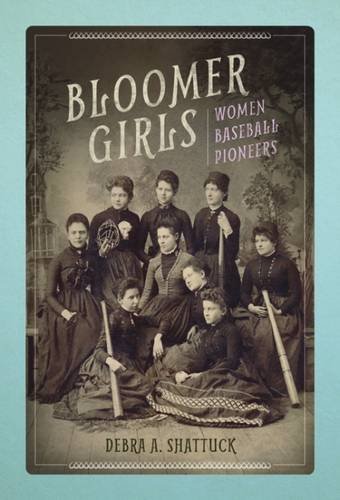
Right up front, author Debra Shattuck makes one thing clear: there's a degree of personal motivation behind the exhaustive research and analysis that led to the finished work Bloomer Girls: Women Baseball Pioneers.
In the preface to Bloomer Girls, Shattuck talks about her experience of being "ostracized on the youth baseball diamond" (p. x), due to a "deep-seated antipathy to girls and women playing baseball" (p. x).
Why, she wondered, are girls and women still faced by resistance when they opt to play a sport that started out as a pastime enjoyed by both boys and girls?
Through exhaustive research, including references to primary resources such as newspapers, college and university publications, diaries, and even records of court proceedings, Shattuck follows the trail left by baseball's women pioneers in an attempt to answer this question.
Shattuck's persistent research enabled her to unearth the facts surrounding women's involvement in baseball—including the game's non-gendered origins in bat-and-ball pastimes enjoyed by generations of children, both male and female.
Shattuck's book focuses on baseball's history prior to 1900. Recounting the chronology of women's involvement in baseball at the school, college, civic, and professional levels forms part of the tale. But Shattuck doesn't stop there. She also weaves in information about the history of men's baseball, particularly professional baseball, to provide context. As well, she helps us understand how women's involvement did, or did not, fit within the framework of societal expectations.
In Shattuck's own words, the book helps to fill historical gaps left by previous works, because "no published resource to date thoroughly quantifies the numerical, temporal, and geographic scope of nineteenth-century women baseball players" (p. 4). In fact, Shattuck argues that many of the existing resources re-shape reality, either by ignoring women's involvement or deliberately attempting to erase it—a process Shattuck alludes to as "disappearing."
Bloomer Girls covers the time frame from just prior to the Civil War to 1900. At the macro level, the book is organized chronologically, with each chapter dealing with a particular time period. Within each chapter, different levels of involvement (school, college, etc.) are addressed separately. It's a complex undertaking to do this and at the same time weave in the background information about men's baseball, as well as the societal pressures that influenced both genders and still maintain some sense of narrative flow. Shattuck makes judicious use of sub-headings to help the reader keep track of where they are.
Shattuck forwards a number of theories as to why a focussed effort was made to masculinise baseball. Part of the motivation, she believes, was to overcome objections to men themselves continuing to play the game once they reached adulthood. Though industrialized society granted people more leisure time, actually utilizing this time for pursuits seen as idle or childish ran counter to societal expectations. Convincing people that baseball was a "manly" pastime and therefore a worthwhile activity for adult men was one strategy to work around societal mores. However, "if women could excel at a sport or game, it could not be considered a 'manly' pastime" (p. 17). And so, "as increasing numbers of men persisted in characterizing baseball as 'manly' (in contrast to childish or womanly), they wove a narrative that gradually distorted the gender-neutral narrative of the sport" (p. 18). Shattuck argues that as a result, women's participation was both "discouraged and marginalized" (p. 20).
Against this backdrop, it's surprising that we find any evidence of women playing baseball. And yet, play they did—in schools, in civic leagues, on college campuses, and even as members of professional barnstorming troupes. Some girls and women simply enjoyed the game. Others benefitted from the growing realization that exercise was important for women—if for nothing else, to prepare them for their role as mothers. Women who opted to play baseball had another choice to make: should they conform to societal expectations, or flout them? Those who chose the former route sported gender-appropriate attire such as corsets and long dresses, and adapted the field of play, for example by shortening the distance between the bases. Those who chose to defy custom experimented with less confining attire, such as bloomers, and played using the regulation rules and fields.
Despite both societal pressures and the fear that baseball might prove too strenuous for the female physique, female enthusiasts insisted on playing, although "baseball was never the most popular sport on college campuses" (p. 51). To minimize criticism, female collegiate baseball players played in secluded fields, hidden from public view.
Shattuck's recounting of women's involvement in baseball is interesting in its own right, but from a reader's perspective, it seemed to me that the sections dealing with women's professional baseball were the ones where the manuscript really came to life. Societal changes influenced by industrialization, immigration, and urbanization "created a mass audience with leisure time and expendable cash for entertainment entrepreneurs to woo" (p. 66). It was only natural that some of these entrepreneurs might seize upon women's baseball as a product to be peddled. Shattuck notes that "the earliest professional women baseball players performed baseball" (italics in original, p. 72), with the games bearing a closer resemblance to "theatrical productions" (p. 72) than exhibitions of athletic prowess. While the promoters touted a competitive match, the sad reality was that the women's teams often "lacked the practiced, athletic skills to deliver … at a level the men did" (p. 72). Thus, as Shattuck notes, the games represented a form of burlesque rather than baseball.
Barnstorming troupes were formed to travel the United States. August 1875 saw the formation of the first professional women's teams, one team called the Blondes and the other, the Brunettes. Players were drawn, not from the ranks of athletes, but from the pool of local actresses. When these teams and others finally performed before a live audience, spectator and media response ranged from support to extreme negativity. Players were accused of immorality due to their scanty attire, and they frequently found themselves the targets of verbal abuse from fans.
Sadly, many of the late nineteenth century managers of professional women's teams were "unscrupulous charlatans who exploited young women for personal gain" (p. 80). Key among them was a man named Sylvester Wilson, who was arrested multiple times for fraud. Shattuck describes him as "a serial scam artist who tried to swindle the baseball-loving public the same way he swindled countless other marks over the course of his three-decades-plus criminal career" (p. 82). Some of Wilson's players were "veteran entertainers and street-wise teenagers" (p. 82). Runaways, trapezists, and dancers were also included among his team members. Some of Wilson's players were as young as 14. Most had never played baseball, and became "so sore and lame that they could only practice twice a week" (p. 84) as they tried to develop even a modicum of skill. Often, they were cheated out of their promised salaries, cut loose in the middle of a season and left to find their own way home, and even taken advantage of in less savoury ways by their manager. They faced rough crowds, which in one case "surged onto the field and pelted the players with stones and mud as they made their escape in a wagon" (p. 88). Why, then, did women play at all? Professional baseball, for many of the women, provided "their ticket to adventure and a livelihood away from mind-numbing factory work, demeaning domestic service, or life in the gilded cage of feminine propriety" (p. 92).
As if societal backlash wasn't enough, female professional players faced resistance from another quarter—the power-brokers behind the men's version of the sport. The men's teams were fighting each other tooth and nail to eke out a living, and had little desire to share an already-small potential pool of gate receipts with women's teams. Media also jumped into the fray. Shattuck notes that "some newspaper editors—particularly those whose fortunes were tied to the success of men's professional baseball—made it their personal mission to use their publications to shape public attitudes about women baseball players" (p. 95). Among those vocally opposed to the women's game was Francis C. Richter, who launched The Sporting Life. Richter used his publication as a springboard for relentless criticism of women's professional baseball at every opportunity.
Verbally abused and at time threatened by fans, derided by critics in the media, pressured by family members—female baseball players must have wondered if it was all worth it. And yet, in the final chapter of the book, which covers the 1890's, Shattuck notes that things gradually started to change for the better. During this decade, "girls and women were organizing baseball teams in unprecedented numbers" (p. 138). More than forty professional women's teams barnstormed the country at various times. More encouragingly, perhaps because of increasing acceptance of physical activity for women, "many female baseball players of the 1890s demonstrated impressive skills on the diamond—so much so that some were hired to play for men's teams as a way to attract spectators" (p. 138). That didn't mean that female baseball players were no longer the target of ill-will. Women's baseball continued be viewed by some as an assault on female dignity, and skilled female athletes were decried as "freaks of nature" (p. 142). Critics argued that "athleticism and femininity are incompatible" (p. 143).
Even with female baseball players' increasing aptitude for the game, the relationship between the athletes and their spectators remained emotionally charged at times. Shattuck provides a colorful description of a game in 1890 in which spectators encroached on the field and harassed players and players in turn "began punching offenders, setting off a series of fights among the crowd" (p. 157). One of the athletes went so far as to grab a baseball bat and flail it about "to clear a safe haven for her teammates" (p. 157). It wasn't just the fans that created headaches for the players. For the barnstorming teams, travel itself proved an ordeal, as "players traveled thousands of miles on trains, wagons, and other conveyances during the season, often not knowing when and where the next game would be held" (p. 168).
Shattuck enriches her text in a number of ways that also demonstrate the depth of her research. To help the reader understand societal viewpoints, she provides examples of disparaging jokes about women baseball players. The book includes examples of how female baseball players were depicted on cigarette cards, and provides samples of illustrations from newspapers that show both realistic and not so realistic portrayals of female baseball players—the latter being intended to disparage or sensationalize their involvement. It is this sense of how things really were, this ability to go behind the facts and figures, that makes Shattuck's book so interesting.
Shattuck's meticulous research is evidenced in the Appendix, which runs for 40-plus pages, and includes an outline of what types of team (civic, school, etc.) played where and when, as well as illustrative quotes or comments. She also provides source notes for each of these snippets of information. Close to 60 pages of reference notes follow, providing Shattuck's sources for the book, which range from newspapers, books, and magazines to scrapbooks and letters. A selected bibliography and an index round out the book.
Bloomer Girls makes an important contribution to our understanding of women's baseball, and women's sport, in the United States prior to the turn of the century, particularly in the context of societal pressures. By using primary sources, Shattuck shakes us free from the tyranny of those who might prefer to slant the story of women's involvement to suit their own motives. We might cringe, at times, at the picture that is painted, but based on Shattuck's extensive research we can at least rest assured that it's an authentic one. And that in itself is worth something.
Shattuck, Debra A., Bloomer Girls: Women Baseball Pioneers (Urbana: University of Illinois Press, 2017), pp. 307.
Copyright © 2017 by Lisa Timpf