urban shocker
Reviewed by Tim Morris, University of Texas at Arlington
21 august 2017 archive
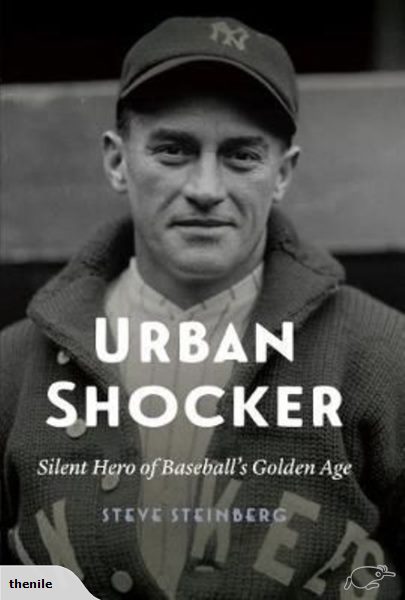
Steve Steinberg's biography Urban Shocker, beautifully produced by University of Nebraska Press, is an astonishingly thorough book. It contains more detail about its subject – a major-league baseball pitcher of the 1920s – than many a biography. There's more detail here about Shocker's playing career than one finds about Ty Cobb's in Charles Leerhsen's 2015 biography, or than one finds about Cobb, John McGraw, Rogers Hornsby, and Tris Speaker in Charles Alexander's biographies. And it's not just a drab listing of box-score achievements. Steinberg's prose is elegant. He gives intricate off-the-field context for Shocker's career.
For all that, Steinberg never establishes any exigence for the project. We are left knowing more about a nearly 90-year-dead athlete than we know about a lot of living celebrities. But the famous "who cares" question is never addressed.
Or rather, Steinberg addresses it in a brief personal introduction. He became fascinated with Urban Shocker as a way of coping with personal problems. He soon became the world's expert on the pitcher. At one point, he had written a 200,000-word semi-fictional dialogue between himself and Urban Shocker. When Steinberg himself was diagnosed with a kind of heart failure similar to the illness that killed Shocker, the personal importance of the project mounted. He became determined to bring his vision of the pitcher to the public.
Steinberg's work in redrafting a 200,000-word personal-philosophical novel into a 245-page academic biography is a very impressive feat. The resulting book is rigorously presented and exhaustively documented. Though traces of Steinberg's engagement with his subject pervade the book, one never senses that one is tracking a private obsession. Steinberg treats Urban Shocker with the seriousness that Arnold Rampersad gave Langston Hughes, or A. Scott Berg devoted to Charles Lindbergh.
Except, again, we know why we're interested in Hughes or Lindbergh. Why exactly should we care about Urban Shocker?
Shocker's story is poignant, for sure. A Midwestern kid who got a somewhat late start in organized baseball, Shocker became a star for the St. Louis Browns in the early 1920s, after noteworthy service in the Canadian League. He won 24 games for the best Browns team ever, in 1922. He would win 18 for an even more famous club, the 1927 New York Yankees. But he did not pitch in the 1927 World Series, because he was already suffering the symptoms of the heart ailment that would kill him late in the 1928 season.
Steinberg deduces that Shocker was prey to a mitral valve problem (155). Such a condition would not be a death sentence today, or even in the 1960s. But in 1928 it was untreatable. Shocker died a few days before his 38th birthday. This story makes for affecting reading, and for affecting photographs that show an athlete beset by physical decay.
Yet (I'm almost sorry to keep reporting) there is little sense in Urban Shocker that we need to know about this personal tragedy at book length. Unlike Leerhsen in Ty Cobb, Steinberg makes no larger claims about his subject's cultural importance. He doesn't even make much of a case about Shocker's importance in baseball history. He was one of the last legal spitball pitchers. Though a dying man in the spring of 1928, Shocker learned to fly an airplane to keep his spirits up. Aside from these stray odd facts, we are just treated to recounting of everything now recoverable that Urban Shocker ever did in his life.
Steinberg makes a case for Shocker being a truly great pitcher. I was initially skeptical about this, but he may have a point. Baseball-Reference.com sees Shocker as the equal of Hall of Famers like Mordecai Brown and Whitey Ford in terms of career Wins Above Replacement. Shocker is a perpetual candidate for Baseball Think Factory's Hall of Merit. He has about the same number of career starts, at the same level of quality, as recent stars like Carlos Zambrano and Jon Lester. (Shocker was more valuable than Zambrano or Lester, because star pitchers in the 1920s went deeper into games, and would play the role of relief ace on days when they weren't starting.)
Shocker was one of the better pitchers of the 1920s. It is difficult to see why we should pay more attention to him than to Eddie Rommel or George Uhle, except for the circumstances of his death – and even those, while sad, are not particularly haunting. Nevertheless, thanks to Steve Steinberg, we now know as much about Urban Shocker as we are likely to know about anybody who played the game so long ago. All athletes should be so lucky in their biographers.
Steve Steinberg. Urban Shocker: Silent Hero of Baseball's Golden Age. Lincoln: University of Nebraska Press, 2017. 352 pp. $32.95 cloth.
Copyright © 2017 by Tim Morris