making my pitch
Reviewed by Dave Buchanan, English Department, MacEwan University
1 august 2017 archive
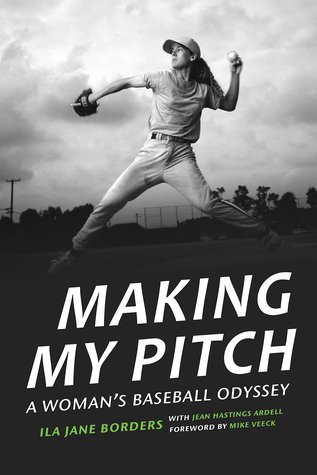
Thousands of girls and young women play baseball in North America every year, often as lone females on boys' teams. They do it for the same reasons boys do: because they love the game and/or because their parents encourage it. Most of the time, however, even the most accomplished young women players eventually see baseball as a dead end for female athletes and shift to softball or just quit in their teens. Ila Jane Borders, however, never thought that way.
Her story is extraordinary: she was the first woman awarded a baseball scholarship, the first woman to play men's professional baseball since the Negro Leagues era, and the first woman pitcher to win a game in professional baseball. In all, she played four seasons in the independent Northern League for the St. Paul Saints, and later for Duluth and Madison, compiling solid career statistics, earning respect from her peers, and experiencing a taste of fame along the way. (The book's cover photo was taken by her friend Annie Liebovitz.) Borders belongs to that select group of female athletes so exceptional and dedicated—Hayley Wickenheiser, who played professional hockey with men in Finland in 2003, also comes to mind—that she truly could hold her own against high-level professional male athletes.
That alone makes for a compelling and affirming story, but there's much more to this memoir. While Borders' story is remarkable for her accomplishments in the face of adversity, it's also, at times, troubling, raw, and heartbreaking—though it ends with a flourish of hope.
As a Little Leaguer in southern California, Borders was a terrific all-round player, the best hitter, hardest worker, and mentally toughest player on every team she played on. As she got older, pitching became her focus, and she forged a reputation as a crafty, Jamie Moyer-esque lefty, throwing only in the high 70s but with pin-point control, a signature screwball, and baseball smarts to burn.
Borders' complicated relationship with her troubled father—a former competitive player himself, who was Ila's "first and best" coach—is the emotional heart of the first half of the book. (Her mother is barely mentioned at all.) Her dad is both mentor and a kind of nemesis. To his credit, mostly, he always assumed his daughter could play with the best, male or female, and he pushed her and molded her into the "warrior" who was capable not only of excelling as a player but also tolerating some appalling treatment at the hands of other players, parents, coaches, and fans. "Win your way in" was one of her father's mantras. (She did.) The other was "Never let them see that they got to you." (Even though they did.) The obvious comparison with Jackie Robinson is mentioned by Ila and several others familiar with Ila's story.
But Ila's father was also responsible for much of her heartache. While he insisted on her warrior mindset on the field, he was a harsh disciplinarian and alcoholic who sent mixed messages about gender roles. On the field, he expected Ila to play like a man; off the field, he wanted her to be "feminine," to wear heels and lipstick. But that wasn't easy for Ila. As a teenager, she realized she was gay. But her father's strict Baptist doctrine held that homosexuality was an abomination. So her natural reaction was, of course, denial of her sexual identity and self-loathing. Her recollections of praying to God to make her not be a lesbian are heartbreaking. Her dad's inability to accept Ila's sexual identity leads to more tension and, eventually, betrayal.
Ila's struggles with her sexual identity are the emotional core of the second half of the book, and, for me, the saddest part of her story. The name "Ila" means island dweller, and it is apt, given how incredibly isolated Borders feels almost all the time in her baseball life—excluded from dressing rooms, eyed warily by teammates' girlfriends and wives. There are a few supporters and allies but for so much of her journey, Borders was just so incredibly alone, disconnected from any kind of female, never mind lesbian, community.
The final chapters of the book look at Borders' post-baseball life: her acceptance of her sexual identity and her first genuine romantic relationships with women, her coping with devastating personal tragedy, her reconciliation, of sorts, with her father, her coming to terms with her baseball legacy, and her moving on to a new career. She realizes, rather poignantly, that for her, baseball was, in the end, her alternate religion and a place to hide from her real self. But it was a perverse hiding place, one that could only compound her isolation.
Co-author Jean Ardell structures the book logically, even elegantly, but the voice of the athlete-author Borders has a certain flatness and literalness to it—a kind of artless authenticity that's stereotypical of so many athletes, male or female. In the end, however, it's Borders' singular story that compels.
Some readers may wonder why Borders, in her teens, didn't shift over to competitive softball, if only to be part of a community of women. Wouldn't she have been happier in the end? Maybe. But Borders really was good enough to compete with men, and her satisfaction on the competitive front needs to be balanced against her apparent sacrifice of personal fulfillment.
Looking back on her career in baseball, Borders must take satisfaction in how her legacy is helping other women baseball players now, like 19-year-old lefty Claire Eccles, in the news these days, currently playing for the Victoria HarbourCats in the West Coast League. Borders is mentioned in many of the articles about Eccles, and rightly so, for Borders forged the path, which 20 years later, must surely be smoother for Eccles and other exceptional women athletes to follow.
Making My Pitch: A Woman's Baseball Odyssey. By Ila Jane Borders with Jean Hastings Ardell (U of Nebraska P, 2017).
Copyright © 2017 by Dave Buchanan