home team
Reviewed by G. Louis Heath, Ph.D., Emeritus Professor, Ashford University, Clinton, Iowa
5 june 2017 archive
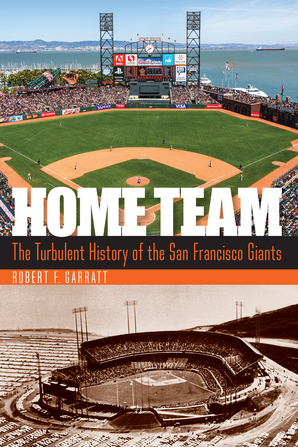
I was a 14-year-old growing up in a small Northern California town (Oroville) when Horace Stoneham moved his New York Giants to San Francisco in 1958. I had just two years earlier played on our local Little League All-Star Team that advanced out of regionals to play for the state championship in Southern California, in Santa Monica. Over the years my Dad had taken me to several Pacific Coast League San Francisco Seals games, especially after our semi-pro Oroville Olives folded. Accordingly, I was more than a little primed to become a loyal San Francisco Giants fan, particularly during my years in the Bay Area while a student at the University of California at Berkeley.
Although the Giants are rated by Forbes today as one of the top five most successful MLB franchises, their road to success was far from smooth. "Turbulent" is the word the author uses. (The reader will likely agree well before he or she reaches the final page that his diction is spot-on.) It is this more tumultuous and largely neglected era of the Giants' San Francisco franchise that is the focus of this book. Garratt did his research in six archives, including those at the San Francisco History Center, the University of the Pacific, and MLB headquarters. Beyond these primary sources, he has also drawn on many secondary ones, especially newspapers and magazines, cited in 28 pages of notes. (pages 201-228.)
In 1954, San Francisco or any place other than New York was far outside the ambit of Horace Stoneham's keen business mind. His team, with superstar Willie Mays, had just won the World Series, sweeping the mighty, highly favored Cleveland Indians, winner of 111 games. Attendance had surpassed the total for the previous five years and the future looked bright. Yet, unexpectedly, attendance slumped dramatically in 1955 when the Brooklyn Dodgers ran away with the pennant, finishing 18½ games ahead of the third-place Giants. The Bums of Brooklyn would go on to win their only World Series title.
The wheels began to turn. Only small-market Pittsburgh and Cincinnati had posted worse attendance figures. The dilapidated Polo Grounds, leased by the Giants and located in an increasingly blighted neighborhood, had become unpopular among fans. Automobiles looked to become increasingly important for fans to get to MLB parks. And the Giants had a minor league team, the Millers, in Minneapolis. Soon, Stoneham 99% decided to move his team to the Twin Cities where he would renovate the Millers' stadium to accommodate more fans in greater comfort with easier auto access. Yet, in his accustomed cautious, deliberate manner, he waited to go public with his imminent deal. And indeed, it would eventuate that there would be more grist for the wheels to grind.
The chapter, "Dawning in the West," recounts San Francisco's passage of Proposition B on November 2, 1954 authorizing $5 million in bonds to pay for a new stadium, provided an MLB team would commit to the city within five years. The clock was ticking by the Bay. If no team, Prop B would become null and void. Thus, when George Christopher became mayor in January, 1956, he immediately appointed a committee to search for a team. He felt the time was ripe to bring in a team. After all, the Brooklyn Dodgers had already announced they were moving to Los Angeles, fueling optimism for San Francisco's efforts.
After negotiating lots of twists and turns and political roadblocks, recounted in the book in great detail, the Giants announced on August 19, 1957 they would end their 74-year tenure in Gotham City and transit to San Francisco for the 1958 season. The East Coast sports world had been turned upside down, truly stunned.
San Francisco fans quickly warmed to the team, especially as new players who had never played in New York were added to the roster, including Willie McCovey, Orlando Cepeda, Felipe Alou, Juan Marichal, Matty and Jesus Alou, Tito Fuentes, and Masanori Murikami, the first Japanese player in the Major Leagues. The Giants became the most diverse MLB team, acting wholly in the spirit of the May 17, 1954 Supreme Court Brown v. Board decision that ruled school segregation violated the equal protection clause of the 14th Amendment. The Giants had taken it upon themselves to lead in the integration of pro baseball. All of this, according to San Francisco Chronicle columnist Herb Caen, was part of the long-term historical process of the city he called "Baghdad by the Bay" reinventing itself following the great 1906 earthquake.
The new ball park that Prop B funded, Candlestick, opened for the 1960 season. It seated over 42,000 (versus refurbished Seals Stadium's 22,900), with parking for 10,000 cars. Unfortunately, it soon became evident that the new park was a miserable place to play or watch a game. Strong winds knocked down balls off the bats of right-handed power hitters such as Willie Mays and Orlando Cepeda. Sports writer Jim Murray opined it was like "trying to hit homers through a wall of wind that could turn back bullets." Night games often brought intense cold and dense fog, providing an experience "akin to an Aleut rite of passage," particularly for fans who sat largely immobile, numbing to the elements. Outfielder Willie McCovey said he felt sorry for the fans who could not move around on the field as he could. To provide fans a scapegoat for their ire, the Giants' front office even introduced an anti-mascot, Crazy Crab, that fans lustily booed and threw stuff at, lots of stuff, including golf balls and flashlight batteries, endangering the occupant of the crab outfit. After an experiment with armor inside Crazy Crab's garb, this promotion had to be dropped.
Even entering the stadium, nicknamed "Scandalstick," posed hazards. To get from the parking lot to their seats, fans had to walk a steep incline, nicknamed "Cardiac Hill." During the park's inaugural season, seven fans died of heart attacks precipitated by their climb. Soon, Candlestick got stuck with a reputation as one of the worst venues to play or spectate a game in the MLB. Forty years would pass before the Giants got to play in a new, more accommodating facility, Pac Bell Park (later renamed A T & T). A more congenial play space was rewarded with a resurgent Giants. In the 16 years after 2000, the team went to the postseason six times, winning four National League pennants and three World Series championships. Attendance soared.
There is a good deal of inside baseball and trivia in this book. For examples, you will learn: 1) Giants backup catcher, Brad Gulden, got traded for himself, one of MLB's "Believe-It-Or-Nots." 2) Prior to the October 17, 1989 Loma Prieta earthquake on October 17, 1989, the World Series between the Oakland A's and the Giants was dubbed "Bays Ball." 3) The 1986-1992 Giants' teams played under the sobriquet, "Humm Babies." Read the book to get the back stories.
Over the nearly six decades since the Giants decamped to San Francisco, the team came close to leaving twice, yet was prevailed upon to stay. The details of these near messes are rendered in a superbly written narrative that make for a good, informative read (as does the rest of the book). Additionally, the author covers the efforts of post-Stoneham owners Bob Lurie (1976-1993) and Peter Magowan (1993-2008) in building the Giants into a MLB powerhouse, revealing the often less-than-fluid inner dynamics of the iconic franchise through numerous ups and downs. Especially noteworthy are: 1) Lurie's hiring of Al Rosen as president of the Giants and Roger Craig as manager and their impact in turning around the fortunes of a mediocre, demoralized team; and, 2) Magowan's signing of slugger Barry Bonds to a $43.75 million six-year contract.
Robert Garratt concludes that the Giants have finally become a "home team." The erudite Emeritus Professor of English and Humanities (University of Puget Sound) employs the word omphalos, Greek for "rooted center or hub," to make his point. For him A T & T Park has become that omphalos, where fans experience "a long-term connection with their team," a relationship players, staff, and management have done much to cultivate. Today the Giants are now warmly embraced by San Franciscans as their team, as much a part of the city as cable cars, Nob Hill, and Fisherman's Wharf.
Professor Garratt has given baseball literature a significant, authoritative history of the Giants. Baseball fans should read it. Libraries should acquire it.
Garratt, Robert F., Home Team: The Turbulent History of the San Francisco Giants (Lincoln, Nebraska: University of Nebraska Press, 2017), 264 pages, 27 photographs.
Copyright © 2017 by G. Louis Heath