winning the race?
Reviewed by Donald Chris Risker
28 february 2017 archive
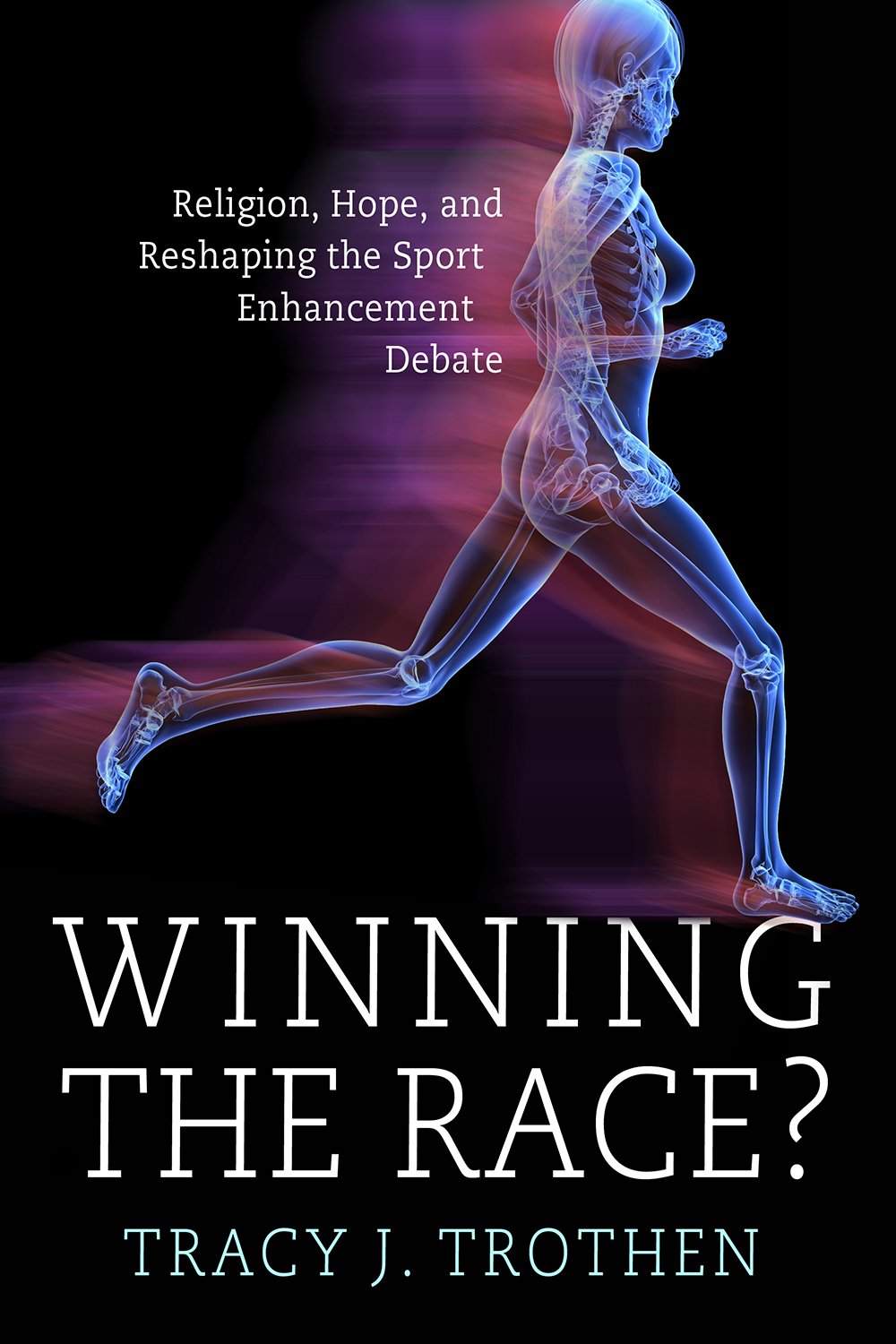
In "Fat Chance," an episode of Inspector Morse, Morse asks after a chain smoking female priest. Lewis, his sergeant, responds, "She's a bit, you know, holier than thou." Morse replies, "She IS a bit holier than thou, Lewis." So might it be for Tracy Trothen, Associate Professor of Theology and Ethics at Queen's University, though her Christian feminist theology would probably reject it. The subject she addresses is transhumanism in sport, the application and use of techno-science to improve sport performance. She argues that viewing transhumanism in sport through Christian theology bares issues that might otherwise go unexamined. She concedes that applying a Christian theological perspective is not new, except if one holds sport to have religious or spiritual dimensions as Trothen does. She demonstrates her case by way of a well-researched essay. Winning the Race? is a smoothly written and well-supported academic work. But as they say "The devil is in the details."
Central to Trothen's argument is imago Dei, the belief that humans, in their embodiment, are made in the image of God. Anything that is done to alter this likeness, according to Trothen, is open to question. She offers an array of the many ways that athletes can enhance their performance. And of course, Lance Armstrong makes more than a cameo appearance here, as does Michael Phelps for his natural anthropometric advantages, including muscles that produce half the lactic acid of 'normal' human beings. Eero Mantyranta, the Finnish athlete who won seven Olympic medals in cross country skiing also receives mention. His rare gene mutation resulted in a 25 to 50 percent increase in his oxygen carrying capacity. Trothen is interested in all performance advantages, and asks if we try to regulate one, why not the other? She leaves one to wonder how she would approach Nascar where the alleged ethos is "If you ain't cheatin,' you ain't tryin.'"
Sport, Trothen observes, because of its ritualized behaviors has insinuated itself within Western culture as a secular religion. And this secular religion arouses a beneficial sense of hope among fans, the hope of winning, especially a championship, or the hope of a transcendent performance, and maybe something akin to perfection itself. For Trothen, this hope runs parallel to Christianity's redemptive sense of hope. Although Trothen supports her hope thesis initially with a single citation, she eventually advances the relevance of hope by using both sport and theological references. Still, she never mentions hope's often attendant twin, fear. We hope 'we' will win, but 'we' fear we will not.
But hope remains important to Trothen's thesis, for it is here that she creates the space to interrogate what sport fans want from sport, an important, even vital question for today's sporting culture. She feels that much of what is anticipated in sport is winning, either by a team or single athlete. However, Trothen also goes to great lengths and many references to question the obsession of winning at all costs. Winning at all costs includes the physical risks that are taken in sport training and competition requisite to winning. Trothen is concerned that sport, and specifically masculinity, is too much identified with physical punishment and pain, that stoic performances are too often conflated with virtue. She concedes the Christian belief that Christ's suffering was the salvific event in his ministry adds to the glorification of suffering. But she counters that feminist Christianity interprets Christ's love and caring as the salvific event of his ministry, not his suffering on the cross. She would prefer, it seems, that sport be a gentler endeavor.
But here is the deal. Athletes know (now both male and female) that if they want to perform at their limits, they will likely become injured at some point. They hope not, but it is a risk that they accept. Moreover, transcendent performance can only be achieved through a massive amount of hard work and practice. The very experience the athlete seeks and that the fan wishes to see is built upon the physical rigors Trothen cautions against. As a self-avowed Maple Leafs fan, she must know that victory at the Stanley Cup level does not occur as a result of mediocre play, but hard work and training. And as a self-confessed slow distance runner, she must know intuitively that she could run faster with hard training.
For all the intelligence expressed in Winning the Race? there are a few matters that are troubling. Trothen raises more questions than can be answered, or for that matter, alas, than can be coherently reviewed. She deplores a sport culture that equates pain and bodily violence with masculinity, but she seems not to recognize that this Rubicon was crossed long ago. Trothen also offers a questionable argument in a lengthy discussion of the flow phenomenon from the work of Csikszentmihalyi. The flow phenomenon is essentially a sense of intense concentration and timelessness, as all other life concerns fall away. Trothen convincingly applies flow to high athletic performance or the state of athletic transcendence. After all, there is explicit support for athletic flow in Csikszentmihalyi's work. She also suggests but does not fully endorse the notion that flow is also experienced by the fan or spectator through a religious or quasi-religious experience. To make her point, Trothen stiches together sport and religious studies of the fan experience. She presents philosophic speculation that suggests both the athletic experience of flow and the fan experience are equivalent, but are these two really the same? Is the athlete performing at his or her biomechanical and genetic limits and the spectator sitting in a crowd hoping to be a part of an extraordinary performance, and/or win, really the same thing? Perhaps flow for the athlete and flow for the spectator are qualitatively different experiences.
Trothen's closing argument is that unregulated transhumanism in sport may cause society to lose its communally held and sport generated sense of hope, lose its secular religion and sport's open sense of possibility. If the perfect moment or performance is assured, reasons Trothen, then sport performance becomes nothing more than display or entertainment, it loses its authenticity, and therefore its ability to inspire. She succeeds in making us ask with her, what is it that we want from sport, and why?
Tracy J. Trothen. Winning the Race? Religion, Hope, and Reshaping the Sport Enhancement Debate. Macon, Georgia: Mercer University Press,
2015, 209 pp.
Copyright © 2017 by Donald Chris Risker