six minutes in berlin
Reviewed by G. Louis Heath, Ph.D., Emeritus Professor, Ashford University, Clinton, Iowa
6 february 2017 archive
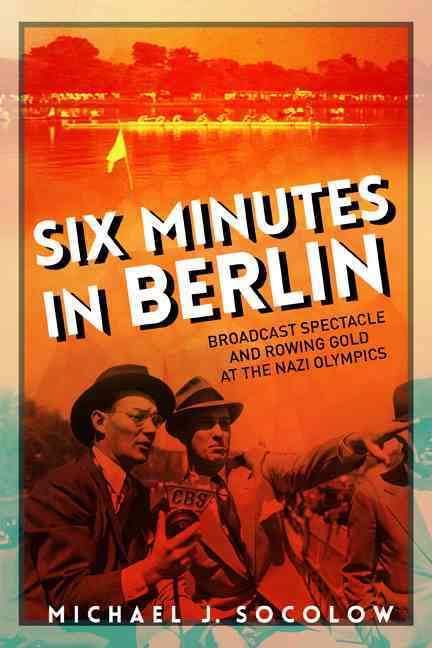
The stage for the 1936 Olympiad was set formally, with great attention to patriotic detail, for a display of German national and racial superiority. Unfortunately for Hitler, the unfolding of athletic events did not conform to the Nazi script. This book is largely about the University of Washington rowing squad's role in writing a better script, owing to their athletic prowess and gritty team spirit. The author's long-term interest in the UW team and rowing generally stems from his undergraduate years as an oarsman at Columbia University. As to his interest in media, his résumé includes serving as information manager for the host broadcast organizations at the Barcelona and Sydney Olympics. He is currently associate professor of communication and journalism at the University of Maine.
While Jesse Owens, German film maker Leni Riefenstahl, US sprinter Helen Stephens, and Sam Stoller and Marty Glickman (a pair of Jewish athletes removed from the US 400-meter relay team) are well-known '36 Olympiad figures, few are familiar with the important rowing event the author painstakingly researched and recounts here. Michael Socolow's book seeks to correct an oversight in modern sport history by relating human interest stories about the crews interspersed with detailed asides on the Olympiad. His narrative brings eight UW rowers and their coxswain out of obscurity into at least the middling contemporary renown they deserve, for they were indeed quite famous in their time, subjects of a national breakfast advertisement and frequent headlines. (For the uninitiated, a coxswain shouts through a megaphone the rhythm for the crew of eight, one of whom, called the stroke, leads a kinetic translation of the cadence into a forward, forceful glide.) Their martinet, yet compassionate coach, Alvin Ulbrickson, synchronized the nine into a winning crew through a regimen of harsh practice and a communal life style. (They lived in a campus boathouse-cum-residence overlooking Union Bay and contiguous waters, including Lake Washington, that made for the best rowing in America). They sculled in an era of high popularity for boat racing, especially eight-oared shells. The New York Herald even employed a rowing columnist, James Gordon Bennett, Jr.
Until the final race in Berlin, the German oarsmen had won five gold medals and one silver in six regattas (aka sculling races). They expected to demonstrate Aryan superiority in the final Olympic race of eight-oared shells. Pure, winning Germanic poetry on water, or so they thought.
The BBC, to its eternal credit, sent Harold Abrahams, the 1924 Olympic 1,000 meter champion, as the network's premier commentator, though it might perchance seem "discourteous" to Hitler for a Jew to broadcast the games. American Olympic Committee (AOC) chair, Avery Brundage, a thorough anti-Semite, squelched the US boycott movement of the Nazi Olympics. He blamed Jews and Communists for the effort. (He would later vent his racism at the 1968 Mexico City Summer Games on gold and bronze medal-winning 200-meter African American sprinters, Tommie Smith and John Carlos. He banned them from the Olympics for displaying clenched fists of protest on the victory podium.)
The entire narrative builds toward Chapter 5, "Six Minutes in Grunau: The Olympics Regatta as the High Spot of the Berlin Games." On August 14, 1936 the six-boat race started at 6:02 p.m. on a rainy day over the Grunau course, with Hitler, Goering, and other top Nazi officials spectating from grandstands, damp Third Reich flags and bunting hanging limply about them. The event was a very big media spectacle, covered by the American press along with NBC and the junior network, CBS. The race was a miracle of electronic journalism extending its voice live over the globe. Three hundred million listened with rapt attention. Microphones along the Grunau water course recorded the cheers of the crowd of 75,000 as well the exertions of muscular athleticism and the coxwains' commands emanating from the sculls of six nations. Cameras were stationed strategically to film every segment of the event. Iconic sports writer, Grantland Rice, termed the race of eight-oared boats "the high point" of the Berlin Olympic Games. Celebrity coverage of the German and UW squads, served as prelude to the world of intense global sports media we know today.
This book provides a wealth of compelling, contextual detail throughout the narrative. Persons critical to the Huskies' success were British boat builder, George Pocock, who built the UW boat Husky Clipper, and Hiram Conibear who had been the trainer for the 1906 World Series champion White Sox. Victories over the likes of the powerhouse California Golden Bears and top Eastern schools qualified the University of Washington oarsmen to scull in the Berlin Olympics. And, in the realm of inside-rowing trivia, the number five seat in a boat is the "heart of the engine room."
The author makes a bullet point of the poor funding that dogged the Huskie oarsmen due to strict adherence to the amateur ideal. No corporate sponsors and ads provided money because crass commercialism was taboo. Avery Brundage, chair of the AOC in 1936, was vigilant in enforcing this proscription.
GE, Westinghouse and Nikola Tesla's roles in transmitting radio waves are noted in a sidebar. It highlights the significance of emerging communications technology. Shortwave won.
This volume offers 32 pages of black-and-white photos placed in relevant text throughout. A team photo of the UW team appears on page 44 (mostly young men of working-class origin, most the first in their families to attend an institution of higher learning).
These Games featured athletics and ideologies that would tragically segue into World War II with a big assistance from the growing power of media. Propaganda became the Nazis' King Charles's head, a transfixing idée fixe energizing the self-styled Aryan construction of the Reich Reality that bedeviled and destroyed much of Europe in a war whose reach and evil still defy belief.
Operating as a kind of wry counterpoint are riveting anecdotes, including: 1.) Five of the Huskie crew wore Indian headdresses for a news photo (p. 173, photo), presumably to cater to the Germans' fascination with the American West. (Hitler bought a set of German author Karl May's novels on Indians for his niece's birthday. Ironically, May never set foot in America. Accordingly, his characters are in 2-D and stereotype.); and, 2.) Two of the UW crew sat in a Berlin café, wondering aloud why the Germans did not revolt against Nazi tyranny. We certainly would, they reflect. Soon three armed Nazi guards entered and sat at the next table, sending a deathly chill over everyone. That was their answer.
The advent of several Olympic traditions is recounted, including the incipient professionalization of "amateur" sports by some nations, the torch relay from Mt. Olympus in Greece, and radio broadcasting worldwide. However, images, not audio, have come to dominate our memory of the games. Iconic photos of Hitler, the torch relay, and Jesse Owens' long jump are vivid in our collective consciousness. Leni Riefenstahl's film, "Olympia," has evolved as more central to the construction of what we remember over the decades. The adjectivization of her surname—Riefenstahlesque—epitomizes the towering, visual grandeur of Nazi propaganda.
Pages 147-151 detail some of the top female athletes competing, They include Hideko Maehata, the first Japanese woman ever to win Olympic gold, and Marion Lloyd, an American fencer who entered the men's Olympic village without permission, causing an uproar and prompting a re-affirmation of the rules of strict gender segregation.
That this is a well-researched book is underscored by the Notes section extending over 46 pages on pages 217-262. Though dense with bibliographic citations and references to interviews in Seattle as well as to various archives, including those at Occidental College, the US Holocaust Memorial Museum, and Deutsches Rund funkarchiv in Frankfurt am Main, some entries are annotated to good effect.
So, what is the point of this academic book? It is this: The Berlin Olympiad bore witness to the early outlines of what we have seen in more recent Olympics: the media glorification of athlete celebrities such as Dorothy Hamill, Bruce (Caitlyn) Jenner, Mary Lou Retton, and the 1980 "Miracle on Ice" hockey team of the Lake Placid Winter Olympics. The Huskie rowing team of Don Hume, Joseph Rantz, George Hunt, James McMillin, John White, Gordon Adam, Charles Day, Roger Morris, and coxswain Robert Moch were precursors of today's superstars. They themselves were superstars avant la lettre. The media has feasted on athletes increasingly, ever since. In 1936 we can see the beginnings of the trinity of Olympic fame, telecommunications technology, and spectacle in nine young men, all from the State of Washington, who only wanted to row the fastest. And by doing so, they became premier sports heroes of the Berlin Olympics, on a plane with the most famous athlete celebrity of the Nazi Games, Jesse Owens.
Michael J. Socolow, Six Minutes In Berlin: Broadcast Spectacle and Rowing Gold At The Nazi Olympics (Urbana, Illinois: University of Illinois Press, 2016), 288 pages. $24.95, paper; $95.00, hardcover.
Copyright © 2017 by G. Louis Heath