a single happened thing
Reviewed by Mark Noe, Pennsylvania College of Technology
4 january 2017 archive
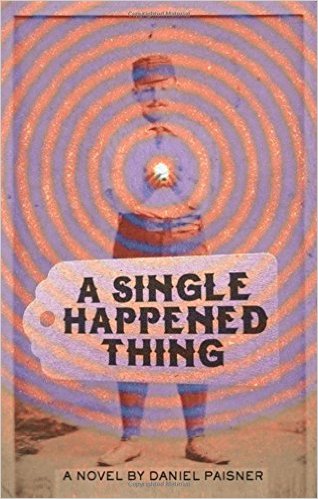
Finney to Kinsella to Twain doesn't have the cachet of Tinker to Evers to Chance, but it does suggest the progression of Daniel Paisner's new novel. A Single Happened Thing opens with his main character, David Felb, competing with a retired ballplayer from the nineteenth century for a Scott Rolen foul ball in the right field upper deck in Veterans Stadium in Philly in August 1998. It morphs into a buddy trip to Cooperstown, where Felb and his baseball-mad middle school daughter, Iona, chase down information on the life of the migrating soul who was Fred Dunlap, whose one great season had been the only season of the ill-fated Union Association in 1884. The book concludes with a lament about the difficulties of growing up, of finding one's own self, one's own place in the world.
The baseball version of a Jack Finney-esque Time and Again starting point is exciting and enticing; it pulls in the reader, who anticipates what might follow. The shift to a W. P. Kinsella-style search, a la Shoeless Joe and Field of Dreams, for details on the life of an obscure, long-dead baseball player, marries well with the time travel beginning, but the searchers find less information on this one-time star than Ray Kinsella and J. D. Salinger (or Terence Mann) do on Moonlight Graham. By this stage, the focus has moved from Dad and the ballplayer to Dad and the daughter, who may have learned a new pitch from Fred Dunlap and who has her own stellar season of middle school softball. The story ends with daughter, and maybe Dad, poised like Huck, on the verge of lightin' out for the Territory. Or of growing up.
In fact, though, and without giving away too much, the ending smacks more of Tom Sawyer than of Huck Finn. As far as his family is concerned, including even his renegade daughter, David Felb is a bit off his rocker (or, to keep to the baseball theme, a little too far off base), and a long round of psychoanalysis has done much less than lots of baseball to help him remain tethered to the world of even quasi-reality that he senses is normal for the vast run of humanity. As much as Nurse Nellie, his loving but ever-more-doubtful wife, does to reel in that tether, it's daughter Iona who secures a worldly base as an anchor for her father. And here, we're far—fortunately—from both Annie and Karin Kinsella.
Still, if all this makes the reader of this review think the novel a bit (or more than a bit) derivative, allow me to "Ease his [or her] pain." (Sorry.) There are many references that recall other fiction, but the book ultimately develops its own place, its own world, its own story, and its own reason to be read. And, while I'm sure the author and publisher feel the audience is meant to be adult readers—a broad grounding in fiction is a requirement if the reader is to catch all these literary references—the book ought also to appeal to young adult readers, as the most developed character is Iona. By the end, while I came to appreciate Fred Dunlap, and I cared little about where David Felb's mind might meander next, it was Iona whose potential got my attention. She offers hope for a future—hers, her family's, the world's. Though her father is the one who says, early in the book, that "A conclusion reached by leaps offers less haven that one reached by reason; wouldn't you agree?" it is Iona who embodies that practical approach. She—and Fred Dunlap, I'll add—make the book worth reading.
Paisner, Daniel. A Single Happened Thing. Falls Church, VA.: Relegation Books, 2016. 236 pp. Paper.
Copyright © 2017 by Mark Noe