farewell to football?
Reviewed by Matt Teutsch
22 december 2016 archive
Every day, I walk past a massive concrete edifice that can house 87,451 fans eager to watch young men engage in the weekly ritual of SEC football. I cannot escape, even when I reach my office, Jordan-Hare Stadium because I can look out of the window and see into the cavernous innards of the coliseum. While teaching classes, I can gaze furtively at the edifice, getting excited about the upcoming Saturday as I teach students writing and research methods. On Saturday, I, along with 87, 450 other fan(atic)s stream into the stands to see LSU quarterback Danny Etling hit D.J. Chark in the back of the end zone for an apparent game-winning touchdown. But, wait a second, Etling and the Bengal Tigers failed to get the snap off before the 0:01 ran off the clock to end the game. Instead, the stadium erupts in unison as the navy and orange Tigers from Auburn come away with the win.
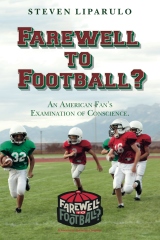
This past year, like Steven Liparulo, I attended my first SEC football game—Auburn vs. LSU, and like Liparulo, I have been on a journey over the past couple of years to try and understand why I should even care about a sport that appears to have so much going against it. In Farewell to Football?: An American Fan's Examination of Conscience, Liparulo tasks himself with an examination of conscience to determine the role of football in his own life, and by extension its role in the American consciousness. He states his mission as follows, "seek to understand the Good and the Bad of football, judge for yourself what is Good and Bad, right and wrong, decode the game's myths and illusions and fairy tales to discover the truth and the lies behind them, to discern why football is such a big deal, such a quintessentially American big deal" (18).
Liparulo conducts his examination of America's favorite pastime (as much as I love you, sorry baseball) by introspectively looking at his own life and by investigating the relationship that others have with the sport. Relating each chapter to a specific football game that he experienced, Liparulo traces his life from childhood, high school, college, the military, graduate school, his spiritual awakening, and other events through the lens of football. In doing so, he encounters many of the same probing questions that I have recently been asking myself about the game: Why do we so closely link the military and patriotism with the spectacle of football? Why do I cheer for student-athletes who are being exploited by the universities they play for and other entities? Why do I still watch professional football when at any moment I can see a player like Luke Kuechly lying on the field dazed and confused because he just suffered another concussion?
Throughout his memoir, Liparulo calls the theatrics of football games (professional and college) the "excess of illusion," an excess that needs to be purged to revel the purity of the game on the field. Part of this superfluous layer comes in the form of the interconnectedness between "patriotism" and the gridiron. While he draws upon his own military experience, the most pointed indictment of the U.S. military and football occurs when Liparulo chronicles the start of the Gulf War in 1991 and Super Bowl XXV. He writes, "The Super Bowl in January 1991 was this great moment of American unity and patriotism, with Whitney Houston belting out a national anthem so heartfelt and patriotic and powerful that it officially kicked off the war in Iraq" (133). The heightened nationalistic emotions converging with the war created the illusion of American exceptionalism on the field of play, with football serving as one facet. Immediately following the national anthem on that fall day when Auburn beat LSU, a group of fighter planes flew over the stadium leaving an echo that reverberated within the concrete bowels of the coliseum and the recognition of military personnel during a television timeout brought everyone to their feet. These displays have gotten more and more elaborate, as Liparulo himself even notes when he attended his first SEC game at the University of Georgia in the aptly named Athens.
This confluence of the military and football, as Liparulo notes, has some substantive connective tissue, especially in the ways that each requires discipline, training, execution, and allegiance to those in command. It also provides opportunities for players like Jack Loonam who played tight end as a walk on at UGA. Mark Richt invited Jack's father, Tim, to join him and the team on the field before a 2004 game against South Carolina. Elven-year-old Jack received the blue-chip treatment, and years later, that experience helped him become a walk on at UGA. However, even though Jack dressed, his career was different than that of other athletes. Liparulo goes into detail about the exploitative nature of college football, showing the excess in facilities and the pressures on high profile and scholarship players. Even with this critique, Liparulo does note that if student athletes know how to take advantage of the opportunities provided by scholarships, using Kentric Sanford and Rufus Cormier as examples. While college football may exploit athletes, it provides them with "tremendous opportunities" if the player can navigate the waters.
Perhaps the most pressing question regarding our love of football arises from the issue of repeated head trauma, concussions, and CTE to players on the field. Continually comparing the gridiron to the Roman Coliseum and the NFL to the Roman Empire, Liparulo questions why we watch individuals endure continual physical and mental pain for our enjoyment. Even with all of the attention being brought to the issue, there are still questions about the long-term effects of football, and Liparulo notes this. However, he ultimately questions why we still choose to indulge in the spectacle when we know enough to understand that the game has long-term detrimental effects on individuals. On November 11, 2012, Jay Cutler left the game against the Texans with a concussion, and as Liparulo ironically notes after spending the day ministering at a jail and making it home to watch the second half that Cutler exits on Veterans Day, a day where we "commemorate the end of the ghastly trauma of World War I" as we watch men endure "ghastly trauma" on the field of play (291).
While Liparulo's Farewell to Football addresses our love of football, it essentially serves as Liparulo's memoir, a text that traces his spiritual awakening and draws upon that awakening to question more existential and divine questions that move way beyond football. It is because of the integration of his personal journey that Liparulo's book needs to be read, especially if considered in conjunction with something like Richard C. Crepeau's NFL Football: A History of America's New Pastime.
Even though I have focused on the "negatives" that Liparulo encountered during his quest, he provides multiple positive aspects to the sport, most notably in regards to education, discipline, desegregation, and community connections. These aspects provide a counterbalance to the multitude of inquires that I, myself, have also been dealing with. For all his questioning, and my own, Liparulo does not leave us with a conclusive "yes" or "no" regarding whether or not we should leave football. Strip away the "excess of illusion" and we are left, in Super Bowl XLIV with 22 men on the field in a goal line situation. We are left with Malcolm Butler intercepting Russell Wilson to clinch the game for New England. "The story," according to Liparulo, "is whatever happens" (331).
Farewell to Football?: An American Fan's Examination of Conscience. By Steven Liparulo. n.p.: Amazon CreateSpace. 2016. 362 pages. $16.99. (Paperback.)
Copyright © 2016 by Matt Teutsch