fight for old dc
Reviewed by G. Louis Heath, Professor Emeritus, Ashford University, Clinton, Iowa
19 december 2016 archive
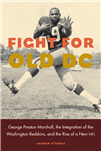
This book is about George Preston Marshall, a Trump-like entrepreneur, owner of a DC chain of laundries who also owned the Washington Redskins. The reader will soon notice his similarities to our President-elect, Donald J. Trump. Many of Marshall's statements I quote in this review sound very much like Donald Trump. More important is the story of Marshall's role in a segregated District of Columbia and its NFL franchise, the Washington Redskins, the focus of this fine University of Nebraska 2016 release.
In 1932, Marshall bought the Pottsville, Pennsylvania NFL franchise, the Braves, which he immediately moved to Boston and re-named the Indians (later the Redskins). His idea was to bring entertainment and pageantry to the game, including halftime shows featuring the Redskins' Marching Band wearing "war paint." This and other innovations, such as modifying playing rules to allow more scoring, were executed in the pursuit of maximizing profits (which were thin to nonexistent in the early years).
After the 1933 season, Marshall convinced league leaders, including George "Papa Bear" Halas and Pittsburgh's Art Rooney, to dump black players from their rosters. He promoted his Redskins as "Dixie's team" and added the line "Fight for Old Dixie" to the team fight song. In 1937, he relocated the team to Washington, D. C., a city closer to Dixie that hewed closely to the South's Jim Crow racial policies and practices. Here he felt much more at home.
It was not till after WWII in 1946 that blacks resumed play in the NFL. By 1961, every NFL team had employed at least one African American player, except the Redskins. Mr. Marshall proclaimed, "I believe in states' rights, both in government and football." Accordingly, sixteen years after black players Marion Motley and Bill Willis stepped onto the gridiron for other NFL teams, the Redskins remained staunchly all-white. They represented the capital of the USA, leader of the free world, but could have very comfortably fitted into the apartheid regime of South Africa.
Despite protests by civil rights activists, especially after the 1954 Brown v. Board decision outlawing segregated public schools, the NFL stood behind Southern-born segregationist George Preston Marshall as a "great asset" to the league. Perhaps this support was, in part, due to the fact that Marshall's prejudice was rather indiscriminate and consistent. He refused to hire Jews, Germans, blacks, or Native Americans for any job, including peanut peddler or ticket taker at home games.
Marshall had a volcanic personality. He severely criticized his coaches, front office personnel, and players. He regularly fired coaches and went berserk at games when losing. He became the most interesting sight in DC after the Washington Monument and Lincoln Memorial, according to journalist Thomas Sugrue. He would pace the sidelines, haranguing coaches and players, and making forays onto the field. Journalist Shirley Povich (yes, a man named Shirley) wrote that Marshall came close to getting his team penalized for "having eleven and one-half men on the field." Marshall soon retorted on his televised "Redskin Show" that "Povich is one guy, when he was circumcised, the wrong piece was thrown away." He stated on that same show, "Men who don't like football are no good for America" and "Communism never affects men who play football." These sentiments were expressed in 1953 during the height of the Cold War.
The quotes in this lively book give insight into Marshall's cast of mind. He did not seem to have a clue as to any ethical or legal problems with his segregationist stand. For example, he reasoned, "All the other teams we play have Negroes. Does it matter which team has the Negroes?" He seemed content that such black players as the Cleveland Browns' Jim Brown "integrated" his Redskins' defense by slashing through it for touchdowns. This sort of integration was clearly acceptable to him.
In the long run, even George Preston Marshall could not resist the new Kennedy Administration's Secretary of the Interior, Stewart Udall. In 1961, Udall ruled that Marshall and his Redskins were in violation of regulations governing the use of areas under jurisdiction of the National Capital Parks, in particular in the matter of hiring practices that discriminated against African Americans. Marshall fought this with all the resources at his command, but eventually he had to acquiesce. Later in 1961, he hired star black running back Bobby Mitchell from the Cleveland Browns, his first hire from anywhere other than all-white Southern college football teams. Finally, after many years of defiance, the last NFL football bastion of Old Dixie segregation, fell to the tide of social progress and inclusion.
You need to read this book to appreciate all its drama, gamesmanship, and tension, and to learn important back stories and facts. You will become familiar with the likes of Commissioners Bert Bell and Pete Rozelle, star Redskin running back Bobby Mitchell, and coach Ray Flaherty, as well as historical highlights on such icons as quarterback "Slingin" Sammy Baugh. The biggest surprise is Mr. Marshall's last testament and will. (He died on August 9, 1969). The disclosure and elaboration of his last wishes in the final chapter completes in dramatic fashion the life and times of one of the major figures in the history of the NFL.
This excellent, highly readable book would make an excellent acquisition for libraries of every sort. It belongs on the bookshelves of NFL fans, especially those interested in the impact of the civil rights movement and anti-discrimination law on pro football. And especially, Redskins' fans and the team's front office, concerned about the future (including its current controversial name), might find something in the career of owner George Preston Marshall to inform their thinking for a positive path ahead for their team.
Addenda
This book is intensively documented. Pages 215-229 comprise the Notes for author Andrew O'Toole's research sources. The helpful and substantial Index runs from page 230 to 240.
The title of the book comes from the last line of the Redskins' fight song, which reads simply: "Fight for Old DC."
Andrew O'Toole, Fight For Old DC: George Preston Marshall, the Integration of the Washington Redskins, and the Rise of a New NFL (Lincoln: University of Nebraska Press, 2016), 240 pages.
Copyright © 2016 by G. Louis Heath