sports business unplugged
Reviewed by G. Louis Heath, Professor Emeritus, Ashford University, Clinton, Iowa
16 december 2016 archive
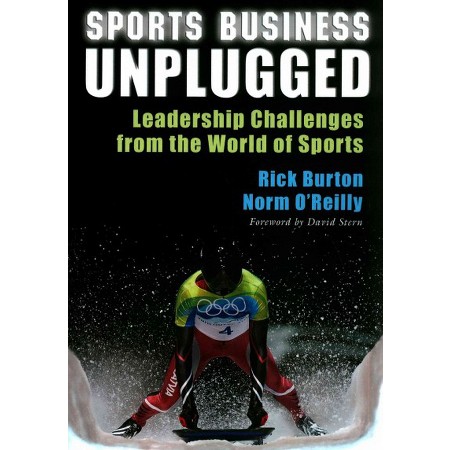
This book consists of a selection of Rick Burton and Norm O'Reilly's monthly co-authored columns in the Sports Business Journal. Over the years 2009 to 2016, they wrote over sixty 3-4 page "insight pieces" on sports management and its attendant economics, mostly of the macro sort. Both are professors (Burton at Syracuse and O'Reilly at Ohio University). The word "World" in the title is particularly apt as Dr. Burton served as Commissioner of the Australian National Basketball League, 2002-2007 and Dr. O'Reilly worked several years as a staff member for the Canadian Olympic Committee. Their principal aim in this volume is to provide students with their writings for instructional purposes, presumably as a supplement to an assigned textbook. The title, Sport Business Unplugged, is a play on the long-running MTV series, "MTV Unplugged." where small pop bands perform in laidback venues on un-electronically amplified (acoustic) instruments. Though "unplugged" is a bit of a descriptive reach for this book, most of the columns convey opinion and information with a certain informal, pop panache.
As with any anthology of writings, this one suffers coherence issues. To create some semblance of order out of their columns, the co-authors organize them into four sections but, alas, without an introduction to any. This reviewer would have appreciated one to lead off each section. Students would especially find one helpful. A plus here is that the uniformity of style and the consistency of topics on a few central themes account for this volume suffering less from weak coherence than those amassed from a widely diverse range of sources.
My review reports some of the major highlights in each section in order to give the prospective reader a good idea of what the book offers. I conclude with my summative assessment.
Part One, Marketing and Sponsorship (14 columns)
Here the co-authors make clear they are "professors of sponsorship" over marketing. Accordingly, what is on offer includes:- Sponsorships will continue as the fastest-growing sports sector worldwide, outpacing gate revenues, media rights, and merchandising.
- International Olympic Committee (IOC) sponsors, including most recently Dow Chemical and Procter & Gamble, spend at least $100 million each on an Olympic Games.
- In Russia, Volkswagen, MegaFon, Rostelcom, Aeroflot, and Rosneft, combined to spend nearly $1 billion on the Sochi 2014 Olympic Games.
- Dozens of academic studies and hundreds of evaluations by professionals show that sponsorship works. It is "an effective tool to reposition brands, alter consumer perceptions and increase sales." (page 39) There are more than 150 marketing goals that a sponsorship serves.
- Sponsorship works better than advertising, especially because it is multi- dimensional and ties the fan personally over the long-term to a team and its sponsor's brand. Problem: One team's fans don't like rival teams' sponsors and tend not to buy their products.
Part Two, The Olympics (13 columns)
- In June, 2015, the IOC, from its Lausanne, Switzerland offices, announced a plan for its own Olympic global TV channel, based in Madrid.
- Some Olympic sponsors produce "sympathy ads" in the event of a terrorist attack.
- After residents voted down any public funds for the Olympics, the 1984 Los Angeles Summer Games became the first to be totally funded by private sponsorships (12 in number). Peter Ueberroth, chief organizer, kept costs down by staging events in 29 cities, 9 counties, and 3 US states. Subsequent Olympics have learned lessons from the LA experience.
- Evaluations of Olympic Games should not be predicated exclusively on costs and cost overruns but on "the holistic outcomes generated." (page 100). For what that means, Burton and O'Reilly take you into the realities of sports macro-economics, away from the accustomed micro focus of most business professors.
Part Three, Looking at How Things Are Done in Canada and around the Globe (9 columns)
- In a time of globalization, the market is not the Canadian market and the US market but the North American sports market.
- US investors tried to build an 8-team, NFL-style football league in India in 2013. You won't find any scores from the Goa Swarm and Hyderabad Sky Kings in your sports section today.
- The knowledge and research of professors of sports management programs (over 1,000 globally) need to be more aligned to the needs of the sports industry. One of the suggestions here is a clearinghouse to apply academic research for practitioners.
Part Four, Making the Sports World a Better Place (14 columns)
- Of particular interest to the sports management major—my university's is the Sports and Recreation Management degree—is the column, "The Growing, Changing Nature of Sports Management Instruction" (page 100). Here you will find a consideration of MOOCs (massive open online courses) and the role of digital universities in sports management instruction.
- NFL's Play 60, MLB's Urban Youth Academy (with its Pitch, Hit and Run program), NHL's Hockey for Everyone, and NBA Fit are active in promoting healthier living and more exercise through sports. Long-term "holistic" results will include a bigger fan base for each league.
- "Gender Equity, Best Served by Creativity, Not Loopholes" (page 174) discusses both the US and Canada, especially at Halifax's St. Mary's University. Australian football gets a few paragraphs, too.
- Reebok's Crossfit Games have been televised on ESPN. The authors believe they will succeed in the mold of Tough Mudder, Warrior Dash, Spartan Race, and Ironman events. They may well even shatter the mold.
- NBC covered a record 52 hours of the Paralympics at the Rio Games.
Missing in this book is a final section where the authors draw their opinions and information presented in 50 columns into some sort of coherence for the reader. They punted on the opportunity to put a fine point on their work. However, overall, this book is a valuable source for students in sports management programs as a supplement to a core textbook.
Sports Business Unplugged would be a fine acquisition for companies in the sports industry as well as for academics teaching in any program linked to sports. Libraries should consider accessioning a copy. It will be checked out at least as much as your book on the Albigensian Heresy and will likely rival the how-to paperback on beekeeping.
Addenda
- Co-author, Professor Rick Burton, published a first novel, a World War II/Cold War historical thriller, The Darkest Mission, in 2011. The book under review here would have been enhanced if he had written an introduction to each section as well as a summation to conclude the anthology. His superior narrative skills could have made this book a more compelling read. He might have even taken the mud out of such terms as "contra provisions" and "self-liquidating variable/dynamic ticket sales promotions."
- NBA Commissioner Emeritus, David Stern, wrote the Foreword. He knows the co-authors and his official photo is in color.
Rick Burton and Norm O'Reilly, Sports Business Unplugged: Leadership Challenges from the World of Sports (Syracuse, New York: Syracuse University Press, 2016), 203 pages.
Copyright © 2016 by G. Louis Heath