british sporting literature and culture in the long eighteenth century
Reviewed by Mark D. Noe, Ph.D., Pennsylvania College of Technology
15 december 2016 archive
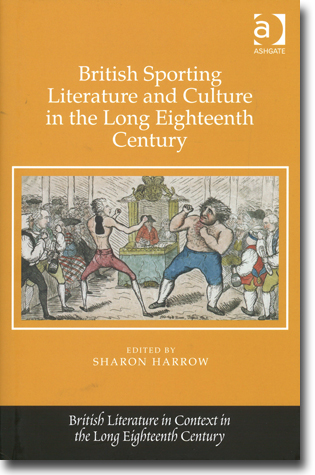
It's nice to be part of an organization acknowledged for improving an academic field of study. In a note to her introduction to British Sporting Literature and Culture in the Long Eighteenth Century, Sharon Harrow claims that, for too long, our understanding of sport has been limited because "the largest body of work on sport has been produced by historians, and they tend to view literary works skeptically." She argues for an opening up to a broader collection of sources from across the field of popular culture, sources that provide a greater spectrum of interdisciplinary perspectives. This would include the contemporary books and periodicals read by the everyday citizen (well, the literate citizen). Harrow calls the Sport Literature Association "A notable exception" for breaking the taboo and instead stressing the need to expand the historical view of sport by expanding the acceptable sources used in developing that broader view. She argues that disallowing such sources leads to a too-narrow approach and fails to provide a complete picture of sport in any culture. Too often, work on the long 18th century ignored sources that showed a period during which free time became somewhat more available, during which a broader spectrum of people (by class and by gender) made organized use of that additional free time, and during which printed newspapers and magazines chronicled that free time. Harrow credits the SLA with stretching the resource base, thus legitimizing a wide variety of more popular materials. In their own ways, each contributor to the volume she edits here makes use of this expanded research base and "offers the words and images of players, spectators, commentators, moralists, journalists, historians, literary critics, artists, and enthusiasts, in the hope that readers will continue to explore the evolution of sport over the course of the long eighteenth century and into their own."
Not only did the whole concept of sport change during the period known as the long 18th century, but so also did the cultural role of sport, certainly in England. The idea behind the book is that considering a variety of fairly narrow topics (individual sports or sporting phenomena) will lead to an expanded understanding of not only each individual topic but also of the broader culture and society. Over decades, sporting activities became more common and better documented, with far more people participating as either competitors or spectators. To show this, editor Harrow breaks the topic into three parts: contexts, sports, and people.
Part I: Contexts
Emma Griffin, in "'Wholesome recreations and cheering influences': Popular Recreation and Social Elites in Eighteenth-Century Britain," focuses on the benefits of recreation among the working class, considering the differences in views between the elites and the workers, or between the rulers and the ruled. Following the Restoration, the possibility for recreation among the lower classes opened up significantly. The stereotype has been that their "betters" frowned upon the everyday citizens' engagement in such activities, usually citing moral reasons but meaning economic ones, as the wealthy were concerned about employees' lost work days. Griffin's deep research into primary documents, however, shows at most an ambivalence toward such recreation by most elite chroniclers, whether moral or economic. In more than a few instances, she actually finds evidence of elites' interest in and support for the diversions of the lower classes.In "Olympism and Pastoralism in British Sporting Literature," Jean Williams describes the emerging literature of sport in the late 15th century, during which time the angler replaced the shepherd in pastoral writings. She considers Izaac Walton's The Compleat Angler to be pretty much a direct descendent of Dame Juliana Berners' Treatyse of Fisshynge wyth an Angle (about 1486), a book that "advocated angling primarily to cultivate a good spirit," suggesting the advantages of fresh air and light physical activity. Walton's book (published in 1653, during Puritan rule) shifted the angler out of the political turmoil of his period and into a pastoral setting—clearly a time requiring "a good spirit." In between, certain sporting activities had become increasingly acceptable, even on Sundays (after morning church services), up to the time of Cromwell. Walton's book offered a little escape for (mostly) the individual from politics and its fallout, but the Restoration broadened that escape to greater segments of society. Williams sees that, by the end of the 17th century, newspapers and a greater sense of freedom had opened sport to a far larger audience. This move to the mainstream actually lent "sport," by definition, "a range of moral, religious, and aesthetic attributes."
With a focus on a single artist, Patricia Crown, in "Sporting with Clothes: John Collet's Prints in the 1770s," suggests women were more involved in sport than the limited official documentation otherwise shows. Whether depicted through transgressing or cross-dressing, these prints reveal a more open and equal society, in gendered terms, than the history books present. Amply illustrated, this essay captures a variety of sporting activities across a rather broad class spread. Sport, in Collet's prints, showed little concern for boundaries of any sort.
Part II: Sports
Alexis Tadié's "The Uses and Transformations of Early Modern Tennis" traces the history of the sport, from its early manifestation as a royal game, jeu de paume, to the version we're more familiar with today. Arguing that the game evolved in a parallel way in France and in England, Tadié describes the essentially indoor sport that prospered from the early 18th century through its virtual demise by the end of that century. He singles out a number of instances of the literary use of tennis to describe life or conflict over the century.Linda V. Troost's "Archery in the Long Eighteenth Century" covers not only the major competitive societies of, roughly, the late 1770s to the end of the century, but also (once again) the significant role played by women as participants. Though many of the most elite groups were male only, there were often parallel women's groups, as well as private competitions involving male and female competitors. Virtually all such archery groups looked back to historical successes—Crecy and Agincourt—for a rationale for existence, though they also looked back to mythical sources, especially the stories of Robin Hood, for competitive rules and prizes. It was the real world, though, that intruded once again and brought the societies to an end, as sport shooting gave way to real shooting, in the war with Napoleon.
A rollicking essay on equestrian sport, "Jockeying for Position: Horse Culture in Poetry, Prose, and The New Foundling Hospital for Wit" by Donald W. Nichol, rounds out the Sports section. Nichol combines a study of various horse racing clubs (the Jockey Club is his main reference point) and satirical periodicals (The New Foundling Hospital for Wit is his focus) as he considers the role of horses in society during the last half of the 18th century. Opening with a review of Restoration and early 18th century literary references to horses (many involving Swift's Houyhnhnms), he shows a gradual shift in attention by mid-century to horses and gambling. While he doesn't short the use of horses in war or their role in causing the death of riders or passengers in horse-drawn carriages, Nichol's emphasis ranges more from the philosophical (those Houyhnhnms) to the sexual (Cleland's Fanny Hill). It's eventually the political, though, that garners more of his attention, as the satirical periodical in his title, along with similar publications, uses the world of the horse track as a means of critiquing the contemporary political world.
Part III: People
The final section opens with the editor's own essay, "Boxing for England: Daniel Mendoza and the Theater of Sport." Mendoza, an early and respected boxer, as well as a boxing theorist and promoter, was one of two boxing "others" who helped open English society to people of color. Along with Tom Molineaux, who boxed his way out of American slavery at the turn of the nineteenth century, the Jewish Mendoza represented a world foreign to the typical citizen. Harrow sets up her discussion with a brief history of the parallel realms of boxing and theater, both weaving back and forth across "the line between legitimate and illegitimate" during the 18th century, both ultimately regulated by governmental licensing. At a point in the 1790s, when boxing appeared to be moving to the legitimate side of that line, Mendoza (or a ghost, though many argue for Mendoza's own authorship) published The Art of Boxing, advocating a more methodical approach that clearly separated the sport from mere fist-fighting. While Harrow credits Jack Broughton's efforts a half-century earlier with introducing a previously unknown level of safety to the ring, she sees Mendoza's "celebrity" as providing the finishing touch fully legitimizing the sport. Along the way, Mendoza—bolstered by his support of Molineaux, as advocate and as trainer—"helped to shape public discourse about important issues, such as ethnicity and nationalism."Jack D'Amico's "Rehearsing Leander: Byron and Swimming in the Long Eighteenth Century" closes the volume. D'Amico, like Harrow, looks at the intersection of the literature and the sport. While Mendoza's authorship may be questioned, Byron's is not. The literal connection between the event (swimming the Hellespont) and both the poem about it and the literary antecedents of that poem is of more interest here. The classical story of Hero and Leander, Byron's actual swim (and those who swam with him), and more recent such crossings, a commemorative one in 2010 and annual competitions too, all provide a layered view that makes for a sort of intertextual reading of the various literary renderings.
British Sporting Literature and Culture in the Long Eighteenth Century offers a refreshingly different take on the period. Reasonably well illustrated, with notes and an extensive bibliography, the book is certainly a worthy addition to any library on early sport. On top of it all, the editor is a believer in the Sport Literature Association, a high compliment indeed.
Harrow, Sharon, ed. British Sporting Literature and Culture in the Long Eighteenth Century. Burlington: Ashgate (Routledge), 2015. Xvi & 232 pp. $85.60.
Copyright © 2016 by Mark D. Noe