the road to madness
Reviewed by G. Louis Heath, Professor Emeritus, Ashford University, Clinton, Iowa
14 december 2016 archive
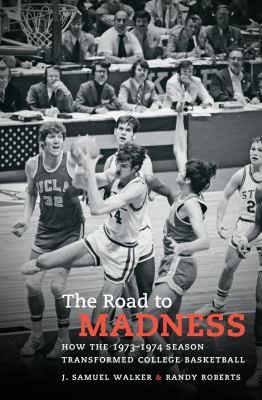
The co-authors' thesis is that the 1973-74 season was pivotal in morphing college basketball toward the "March Madness" it has become today. The two historians make a strong, effective case. Although it is always dicey to argue a particular year or years as the turning point for anything, this book advocates well. Other books could be written advancing a brief for other years; for example, 1975, when the National Collegiate Athletic Association (NCAA) tournament field expanded to 32 teams. Perhaps the bottom line for Walker and Roberts' choice of 1973-74 is that that particular season offers the advantage of a high drama that culminated on Saturday, March 23, 1974 with North Carolina State's 80-77 defeat of UCLA at the Greensboro Coliseum in a Final Four contest. NC State then defeated Marquette for the national championship. Thus ended the UCLA Bruins' decade-long "dynasty," coached by the iconic John Wooden (though he would win the crown one more time in his final game as coach in 1975). His team had won 38 straight NCAA tournament games since 1964 prior to the Wolfpack's thrilling late-game comeback from an 11-point deficit. For his victory that redounded to the glory of the Atlantic Coast Conference and the entire South, a rising region, Coach Norm Sloan received a $1,000 bonus. The team he coached was a squad of close friends, a major reason they won. African American star David Thompson even deferred his NBA dreams to continue at NC State for his senior year because he wanted to graduate and play more ball with his friends, most of them white, a telling indicator of great change in the South, for it was in Greensboro, where they won their crown, that the first lunch counter sit-ins had begun only 14 years earlier on February 1, 1960.
The book details three key factors that led to March Madness in the aftermath of UCLA's defeat: 1) Expansion of the number of teams to 32, a 1972 decision implemented in 1975. (The field would later be expanded to 40 in 1978, 48 in 1979, 64 in 1985, 65 in 2000, and 68 in 2010.); 2) Allowing more than one team per conference, a policy established soon after the 1974 tournament; and, 3) The rapidly rising popularity of collegiate basketball on TV. (In 2011, CBS and the Turner Broadcasting System paid $10.8 BILLION to carry March Madness for 14 years.) The authors' research delved into the NCAA's reasons for the changes. They report their findings in a well-written, heavily documented book that draws on archives at a number of institutions, including those at NCAA headquarters in Indianapolis and at several universities. Included is their meticulous chronicle of the pivotal games of the 1973-74 season and the behind-the-scenes maneuvering that would lead to March Madness.
At the end of the 1972-73 season, Wooden's UCLA teams had won seven consecutive national championships and nine of the previous ten. Their reign had been long and they were prohibitive favorites to remain on their throne. More importantly, they had become one of the few institutions Americans could believe in. The authors go into considerable detail placing the team in the US context of flagging faith in government, stagflation, the Vietnam War, Watergate, rising solipsism, and increasing pessimism over the American future. We were losing our confidence, but we could always rely on UCLA to win. (I was a student at Berkeley during part of UCLA's reign. Though I cheered for my Bears in Harmon Gym, I knew the Bruins would always win.) And, more important to sports history, collegiate basketball was about to embark on a road toward inadvertently creating a supreme national event we could rely on to unify us each year—"March Madness" with its upsets, surprises, fan mania, and betting pools.
The Road to Madness provides a wealth of detail on UCLA and the four teams challenging it in 1973-74: North Carolina State, Notre Dame, Marquette, and Kansas. We learn a lot about NC State's coach Norm Sloan, a very colorful character; Marquette's Al McQuire, even more colorful; Notre Dame's Digger Phelps, who wore a boutonniere on his lapel each game and used technical fouls to motivate his team; and, Kansas's Ted Owens, the superlative heir to James Naismith, 1891 creator of basketball, hired in 1898 as Kansas's first PE Department Chair, with attendant duties including coaching the basketball team. (Naismith had a losing record. He believed his game was mostly for exercise and entertainment.) Each of these coaches offered special qualities of leadership that made their teams serious contenders for the throne.
This book looks in depth at the history of the competition between the National Invitation Tournament (NIT) and the NCAA tournament. The NIT began in 1938 (Temple defeated Colorado). In swift response, the NCAA initiated its tournament in 1939 (Oregon defeated Ohio State). For over a decade, top teams preferred to compete in the NIT over the NCAA. (As late as 1970, Marquette chose the NIT.) Some appeared in both tournaments. In 1951, a point-shaving scandal, involving most significantly New York City colleges, badly damaged the Manhattan-based NIT, giving the upper hand to the NCAA. Soon the NCAA announced it would play no more tournament games in Madison Square Garden. And, in 1953, it ruled that, if a team accepted an offer to play in their tournament, they could not play in any other post-season tournament. The upshot was that the NCAA tournament grew in size and prestige to match the American tsunami of popularity for college basketball as the NIT's tide ebbed.
Two little-known features in the emergence of March Madness are detailed here: 1) The crucial role of TV sports programming syndicator, Sport Network Incorporated (SNI), in expanding televised college basketball; and, 2) The vital role Davidson College's Tom Scott played in expanding the NCAA's field to 32. No spoiler alert here. Read the book for the why and how of their importance.
As the NCAA tournament grew, so did the possibility of low-ranked underdogs staging shocking upsets. Notre Dame coach Digger Phelps is quoted: "It's tournament time, so the two R's (records and ranking) don't mean a damn." By reading Chapter 5, "Bracketology 1974," you will learn how this was so in '74. Even Austin Peay (rhymes with 'glee") State University in Tennessee got into the tournament, mounting a valiant bid (failed) to upset Notre Dame in the first round. (Their star player, James "Fly" Williams, inspired one of the most memorable student sports cheers ever, "The Fly Is Open—Let's Go Peay!") You can get more of this sort of anecdote as well as sheer substance (pun not intended) in the final chapter, "Creating March Madness—Inadvertently."
The Road to Madness belongs in libraries everywhere. It meets both the needs of fans as well as scholars. It is a good lively read for the most part though this reviewer experienced a bit of ennui in the few pages that were both heavily fact and stat based. If you are a member of your local library's book club, this is a good one for you to recommend in the non-fiction category. Should anyone falter in their read, you can refresh your eyes on 14 pages of photos that include John Wooden, Bill Walton, Al McGuire, Digger Phelps, and ten others. They can't compete with the Sports Illustrated annual swimsuit edition, but, hey, this is the University of North Carolina Press with standards to uphold. For the more scholarly, turn to the 16 pages of Notes that precede the Index. You can strain your eyes for hours there.
J. Samuel Walker and Randy Roberts, The Road to Madness: How the 1973-1974 Season Transformed College Basketball (Chapel Hill: University of North Carolina Press, 2016), 172 pages.
Copyright © 2016 by G. Louis Heath