barbarian days
Reviewed by Jim Coby, University of Alabama in Huntsville
13 december 2016 archive
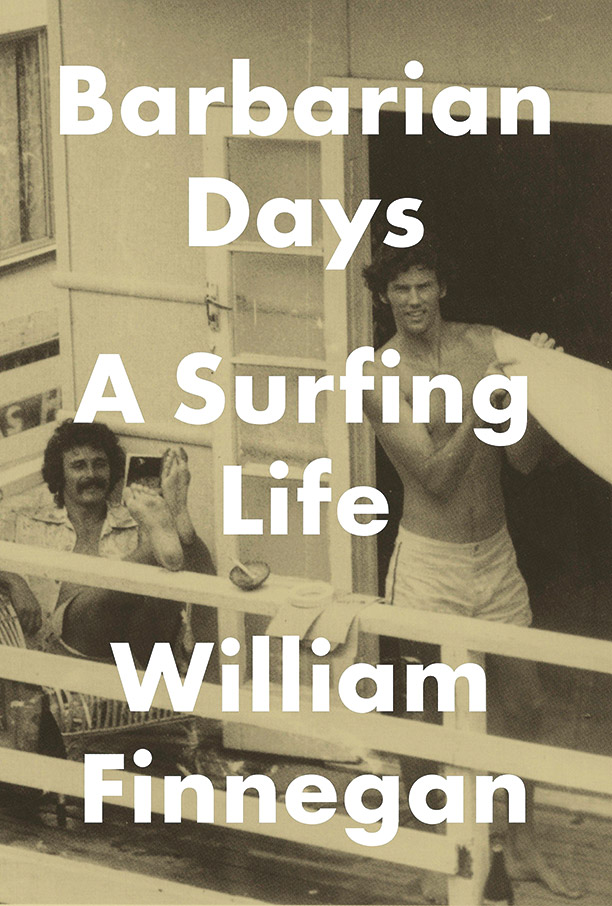
All too frequently have popular media portrayals of surfers and surfing retreat to stereotypes: the inarticulate stoners, slackers, Jeff Spicolis living out of Volkswagen buses that populated ideas about the sport in the 80s and 90s, or the happy-go-lucky, saccharine shtick of Elvis and Co.'s Blue Hawaii. Which is to say, with few notable exceptions, surfers remain largely on the margins and often at the mercy of whatever narrative is crafted about their sport. Comes now New Yorker staff writer William Finnegan and his magnificent, Pulitzer Prize-winning Barbarian Days: A Surfing Life to remedy these ills and to provide perhaps the most cogent and fascinating look at surfing yet published.
Although born in New York, Finnegan's story begins in earnest as a middle-schooler in Honolulu, Hawaii, where we see him in equal parts as a timid (but scrappy) young man desperately searching for belonging and as an adventurous and ambitious surfer. From his earliest memories, a nomadic lifestyle informs Finnegan's opinions on both surfing and the world around him. As Finnegan matures, he spends time in Australia, Fiji, South Africa, Guam, and any number of locales – so long as they have water. Travel memoirs, and this is in large part a memoir of travel, often veer toward two extremes: they allow rose-tinted lenses to shade memories of place, or they act with decided virulence toward locations that did not meet expectations. Finnegan's book does neither. His prose remains lucid and sober throughout, describing honestly and fairly the successes and failings of the countries his visits and of the people with whom he interacts.
As our peripatetic narrator bounces across the globe, few things remain constant: Finnegan's love of people, his obsession with waves, and his desire to write. Notably, time spent working as a brakeman on the Southern Pacific railway inspires Finnegan to try his hand at a "railroad novel" (277). By two-thirds of the way through Barbarian Days, the railroad novel becomes something of an inside joke, popping up infrequently as a source of anxiety for Finnegan whenever he begins to worry that his globe-hopping is distracting him from more pressing "real world" concerns. The railroad novel, too, underscores an important aspect of Finnegan's composition. In describing this novel, he writes, "The few interested editors wanted me to unpack the technical language, the railroad jargon, for the general readers, but that was where the poetry was, I thought" (277). In turn, much of Barbarian Days' poetry lies in the esoterica of surfing, which Finnegan does unpack, but only enough to provide readers with a basis for understanding, while leaving much of the intrigue and, yes, poetry alone.
Some of the most impressive aspects of Finnegan's book are his descriptions of the waves themselves. There's a platitude common to every athletic pursuit that no two endeavors, even when they involve the same sport, will ever genuinely be the same. Wind conditions change when playing tennis. The road may be slick or peppered with loose gravel when cycling. The fish may not be biting that day. Perhaps it's because of their pseudo-religious and highly contemplative preoccupations, but surfers seemingly carry this idea to its logical limits. We're told that the swells, breaks, wind, and myriad other conditions affect a ride on any given day. And while I have no doubt that's true, to a novice whose only experience surfing involves a gloomy day marked by a constellation of minor humiliations in Gulf Shores, Alabama, it's sometimes difficult for me to understand how waves breaking at the same point, which appear so similar from my beachcomber's vantage, might possess manifold personalities and possibilities to the surfers who ably approach them.
As if responding directly to my incredulousness, Finnegan provides ample descriptions of the waves he chases. These descriptions are Faulknerian in length and scope – sometimes stretching for pages at a time – but they never feel superfluous. Each definition is crisp, engaging, and very often thrilling. With this, Finnegan underscores the notion that, indeed, each wave is a universe unto itself. Particularly thrilling are the author's descriptions of the behemoth San Franciscan waves that simultaneously excite and terrify him, descriptions that recall nothing so much as accounts of war from the likes of Tim O'Brien and Norman Mailer. "Being out in big surf is dreamlike," Finnegan writes, "Terror and ecstasy ebb and flow around the edges of things, each threatening to overwhelm the dreamer. An unearthly beauty saturates an enormous arena of moving water, latent violence, too-real explosions, and sky" (345).
The best memoirs, of course, don't simply detail the author's life, but engage with a broader landscape – whether local or global – to help situate the author's experience against a backdrop of others'. In this light, Finnegan's memoir proves nothing short of an encapsulation of a (fractious) piece of latter twentieth century world history. Too rhapsodic? Perhaps. But let's consider the events to which Finnegan serves as witness and, often, active participant: he experiences an often overlooked scene of racial tumult in 1960s Hawaii, he teaches at an all-black school in Cape Town during the waning days of Apartheid in South Africa, he tussles with (and fairly has his ass kicked by) second-wave feminism on Australia's east coast, and rides secluded waves in Fiji before global capitalism snatches up the property and markets the once isolated island as an exclusive retreat for "wealthy Republican contractors from Florida, with their hard-charging sons" (431).
By the book's conclusion, we find ourselves not only enthralled by Finnegan's stories, but by his gripping command of language, and his ability to craft so fluent and accessible a narrative from so many disparate parts. Barbarian Days is, naturally, a worthwhile addition to any saltwater enthusiast's library, but it is equally valuable to those of us who know little about surfing, but who crave a masterfully told story.
Finnegan, William. Barbarian Days: A Surfing Life. New York: Penguin, 2015. 447 pp. Ill. $17.00
Copyright © 2016 by Jim Coby