bike lanes are white lanes
Reviewed by Duncan Jamieson, Ashland University
18 november 2016 archive
In the immortal words of Malvina Reynolds, higher education is good at putting students (and faculty) in "Little Boxes." While we speak glowingly of the value of the liberal arts and a core curriculum, students (and all too often their advisors) seek the easiest path to avoid that general education requirement that might broaden their horizons. The end result is educated people knowing more and more about less and less. This is certainly true of my department, which takes as its mission the goal of having students "think like historians." More to the point, my colleagues are currently debating a proposal to increase the major by fifteen percent. While I try to instill a sense of the importance of history in all students who wander into my classes, I believe that unless their goal is graduate school in history, they might be better served by taking additional courses in other disciplines rather than more courses in history.
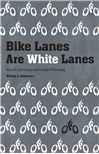
Melody Hoffman's Bike Lanes are White Lanes flies in the face of "Little Boxes" thinking. She combines bicycle advocacy, neighborhood history, gentrification and black lives matter through case studies of Milwaukee, Portland and Minneapolis. She examines how bicycle lanes all too often appear at least to be precursors of gentrification. She notes that despite the League of American Bicyclists statistics that African Americans represent one of the fastest growing segments of bicycling, they are still a very small percentage of riders. Over hundreds of organized rides, I rarely see many bicyclists of color. The one exception would be the Great Five Boro Bike Ride, held each May in New York City, but even there African Americans make up a small percentage of the thirty thousand participants.
Bike Lanes is as much about urban planning, gentrification and attempts at making cities more livable as it is about bicycling. Clearly, the more people who bicycle to do light shopping, or to commute to work, or to school represent that many fewer cars on the already overcrowded, congested city streets. However, as she points out, it is not usually people of color in the hood who are the ones on the cycles, but rather people passing through on their way from Point A to Point B. A bicycle lane tends to make the neighborhood friendlier to young, white, upwardly mobile professionals who bicycle by choice, not necessity. If the poorer residents ride a bicycle it is because they cannot afford a car and all its associated costs. To them, the question is "why bicycle if you have the means to drive?" Those in the hood who do bicycle do so by necessity, not for leisure, and they are generally invisible to the cycling culture and society at large. These invisible cyclists are the poor, African Americans and illegal immigrants. They are only invisible because the mainstream bicycle culture ignores them, creating an "us vs. them" environment.
Urban bicycling advocacy, according to Hoffman, is connected among other ideas to radical, environmental politics. Bicycling for transportation is a counter culture activity, which means that now it's the young, upwardly mobile whites who work in cubicles who are getting the attention. Not everyone who rides a bicycle does so by choice rather than necessity, but it is those who ride by choice who are pushing for bike lanes. Rather than bicycle lanes making it safer for cyclists, the poor want an automobile to escape the city.
The first of three case studies involves a ride that began in 2008 with a couple of hundred participants and has caught on so dramatically that now approximately five times that number participates. Repeating five mile loops through the Riverwest neighborhood in Milwaukee on the last weekend in July, mostly males on high end bicycles and the occasional bicycle messenger are joined by casual riders of both genders on big box store bicycles. Riders stop at four mandatory checkpoints while completing each loop. The winner is the one who completes the most laps in twenty-four hours. Riders can earn bonus laps by stopping at bonus checkpoints, which might entail a visit to a tattoo parlor, playing softball or attending a yoga class. Residents of this integrated working to middle class neighborhood began the event to build community spirit and fight the image of the neighborhood as crime ridden.
Portland, Oregon's Albina district is the focus for the second case study. A bike lane connecting a distant neighborhood populated by young urban professionals with the downtown was proposed to traverse the historically black neighborhood. The residents saw this as a means for young white people to bicycle through their area on the way to downtown without offering the Albina residents any advantage. Obviously, not all of Portland is as enamored of bicycles as the rest of country believes. A major concern involved the fear of gentrification, which would result in high taxes and the displacement of both neighborhood businesses and the residents who frequent them.
Minneapolis is the last case study. Because bicycles are representative of the creative class, and because such individuals pick a city to live in based on its amenities and then find a job there, Minneapolis has made greenways and bicycle paths a high priority. While to the city, these clearly are an advantage both economically and aesthetically, they do cause displacement. An abandoned railroad corridor was used by homeless and drug dealers, but its revitalization as a bike path has caused those people to move on. This type of green development is environmental gentrification. Since these amenities are available to all, and since they create new business opportunities, the city's position is favorable because this pulls up those in the service class. One such opportunity might be the bike share programs but are proliferating in American cities; unfortunately access is generally limited to those with credit cards, a clear disadvantage for the urban poor.
Hoffman, Melody. Bike Lanes are White Lanes: Bicycle Advocacy and Urban Planning. Lincoln: University of Nebraska Press, 2016. XII + 196 pp. $40.00
Copyright © 2016 by Duncan Jamieson