iron mac
Reviewed by Duncan Jamieson, Ashland University
16 november 2016 archive
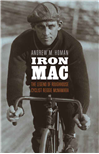
When considering early 20th century sports heroes, Reggie McNamara's name is not usually included, while Babe Ruth, Red Grange or Jim Thorpe among others, come immediately to mind. When considering the most popular sport of the first half of the 20th century, baseball is likely to be the one most named. However popular these athletes, and however many fans and press coverage baseball had, popular memory overlooks the reality that six day bicycle racing and Australian born Reggie McNamara needs to be included in any top sports list. A bicycle racer himself, Andrew Homan has done a good job bringing both to the fore with his biography of Iron Mac, whose career spanned nearly three decades.
Both road and track cycling races had great popularity in the United States during the first half of the 20th century, with tens of thousands of fans coming out to watch stars from around the world compete. The first six day race in the United States was held in Madison Square Garden in 1891. With no racing on Sunday, teams of two riders would rack up two to three thousand miles on relatively small, highly banked indoor wooden tracks needing several laps to make a mile. Much of the time riders would lazily circle the track, singing, joking or reading newspapers until a bell started a sprint where the speed would be increased to as much as thirty miles an hour while teams attempted a breakaway to gain a lap or more on the field. Throughout the course of the six days fans would offer a premium to lend some excitement. Once announced the riders would race to see who could win the lap and pick up the prize money. Other premiums were a regular part of the promoters' package adding to the amount of money riders could earn. In 1926, when Babe Ruth earned $50,000 with the New York Yankees, and jockey Earl Sande $100,000, the thirty-nine year old McNamara took home $75,000, one of the highest paid athletes at the time.
McNamara won his first road race at age 18 and then quickly realized if he turned pro he could make a decent living. Neither a gifted nor great sprinter, his phenomenal strength allowed him to sustain high speeds for long periods of time. He did well in road and track racing as well as pursuit rides, where riders would start at opposite sides of the track in an attempt to catch one another. In each type of race McNamara raced against the best Australia had to offer, and soon realized he needed to journey to the United States. In Australia the six day races took place outdoors, riding on asphalt and grass. While they stopped riding during thunderstorms they rode in temperatures of more than 100 degrees and they rode through hailstorms. While bicycle racing, both road and track, took place around the world, at the turn of the twentieth century Newark, New Jersey was the epicenter. Here McNamara encountered his first indoor, steeply banked wooden track. Reggie McNamara earned the sobriquet for his incredible ability to endure pain and injury that would have crippled lesser men. Throughout it he rarely stopped racing. In Melbourne he crashed which resulted in a stomach abscess severe enough to keep him off the track for five hours; despite the injury he returned to racing and his team took third place. It was on his first training ride at Newark that he crashed, resulting in a fourteen inch gash on his right thigh which required hospitalization and multiple stitches. It was this injury that earned him the nickname "Iron Mac." Undoubtedly far more important to him, he fell in love with and married his nurse. Over the course of his career he rode in 122 six day races, completing in excess of 150,000 miles. He also sustained 180 injuries. He retired after he was knocked unconscious in December, 1935 on day two of a six day race in Buffalo, New York.
More than just a biography of Iron Mac, Homan includes a variety of fascinating facts about six day races. The Madison Square Garden track, for example, was built new for each race, sixty carpenters using 35,000 square feet of spruce lumber and nearly 87,000 nails. The races attracted the biggest names in American society, from politicians to actors to singers and gangsters, as well as tens of thousands of ordinary fans. It was not unusual to see Ty Cobb, Babe Ruth, Knute Rockne, Will Rogers, Knute Rockne, Will Rogers, Bing Crosby or Al Capone at a race, and oftentimes such a big name celebrity would start the race. He offers brief biographies of many of the greatest names in six day racing, legends such as Alf Goullet, Cecil Walker, Harry Horan, Eddie Seufert, Bobby Walthour Sr. and Jr., Tom Eck, Floyd MacFarland, Frank Kramer, and Ernest and Hans Ort to mention a few. While he explains some of the strategies and rules that comprise six day races, clearer explanations in this regard would help. Specifically, how for example did a jam work, or what strategies did riders use to go up a lap or more on the field.
Homan includes sufficient detail to flesh out McNamara's personal life, which included a drinking problem that caused both financial and marital issues. It was on his return to race in Australia that alcohol abuse became serious, though he credited Alcoholics Anonymous with saving his life. For anyone interested in bicycle racing, and especially six day races this is a good read. While they are still popular in Europe, six day races faded in the United States during World War Two. Despite attempts to revive them in the 1950s they failed to catch on.
Homan, Andrew M. Iron Mac: The Legend of Roughhouse Cyclist Reggie McNamara. Lincoln: University of Nebraska Press, 2016. XIV + 218 pp. Ill., Notes, Index. $26.95
Copyright © 2016 by Duncan Jamieson