the mechanical horse
Reviewed by Duncan Jamieson, Ashland University
15 november 2016 archive
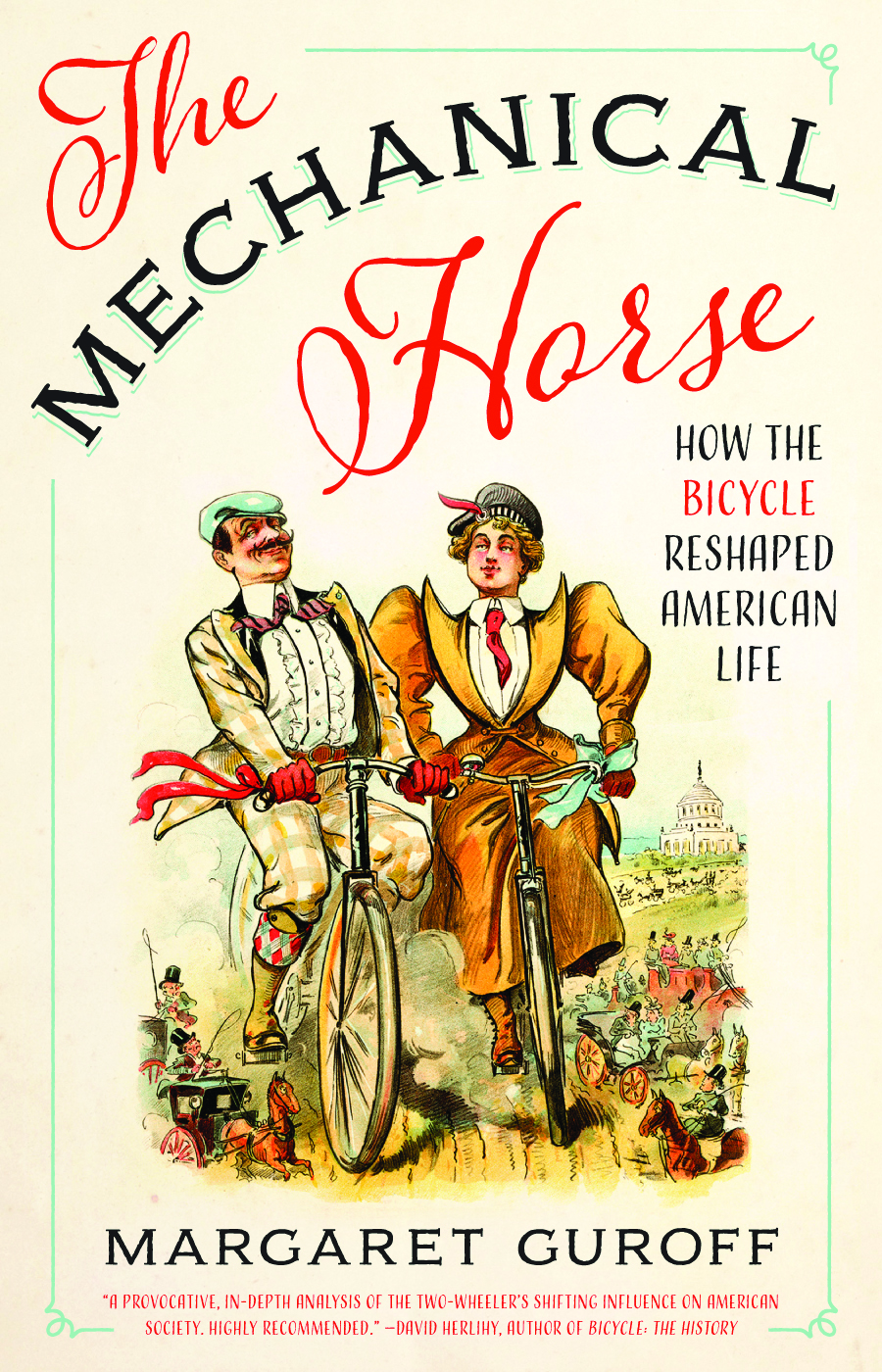
There are some common misconceptions relative to the bicycle in American society. First, way too much emphasis is placed on the "Bicycle Boom" of the mid to late 1890s, and this leads people to the belief that the rise of the automobile led to the collapse of the bicycle. While there is some truth to both beliefs, the problem becomes when people funnel the entire history of the bicycle through either one. The bicycle did pave the way for the automobile, providing a variety of technical and engineering innovations. Many early automobile manufacturers began with bicycles. (In the same vein, the bicycle ushered in the age of powered flight; the Wright Brothers used their bicycle expertise to build their Wright Flyer which went aloft in December, 1903.) In the late 1890s the number of bicycles manufactured and sold in the United States exploded and then collapsed, in part because the industry over built and because there was a growing availability of inexpensive used wheels on the market. While over time the majority of Americans did shift from bicycles to automobiles, millions of people continue to use the bicycle to travel, to commute to and from work, for exercise, or to take a leisurely ride through the neighborhood. Building on the idea proposed by Glenn Norcliffe, Guroff explores how the bicycle has paved the way for our modern scientific society. While it did not usher in the germ theory of medicine, it has proved the value of exercise for all people, regardless of age or condition.
There are many other connections between modern society and the bicycle which Guroff explores. In conjunction with the streetcar, the bicycle provided a means for middle class Americans to move to the more bucolic suburbs while continuing to work in the city. The bicycle also helped to usher Americans into becoming a consumer society. In the 1890s S. S. McClure, who began in publishing editing two bicycle magazines for Colonel A. A. Pope, revolutionized publishing when he launched McClures magazine at a cut rate price. McClure forced other popular publishers to cut their prices and rely on advertising to offset publication costs. Among the leading advertisers were bicycle manufacturers.
Guroff looks at bicycling from its early days to the present, offering fascinating insights that connect the earlier years with the present. As human beings always seem interested in speed, those who rode swiftly on the 19th century city streets earned the sobriquet of "scorcher," threatening the lives and limbs of urban pedestrians. Scorchers were predominantly young men (and occasionally women) who rode as rapidly as possible, usually in bent, aerodynamic posture that physicians feared would ruin their posture as well as their health. In an interesting comparison, Guroff brings together the late 19th century scorcher with the mid to late 20th century bicycle messenger. While Western Union employed boys (and sometimes girls) with bicycles to deliver telegrams from the 1890s until technology made them obsolete in the 1960s, bicycle messengers appeared as an anti-establishment cult society in the 1970s and 80s. Dressed for comfort and the weather, they ignored the rules and etiquette of urban, business society, yet until fax technology in the late 1970s and email attachments in the 1980s thinned their numbers dramatically, they moved critical, time sensitive information across the cityscape. Many of these individuals lived for the thrill the job offered.
Interest in bicycling in the United States has gone through boom and bust cycles, which continue to the present day. Two booms came together in the mid-1970s to dramatically expand bicycling's reach. Adventuresome young men in the greater San Francisco area began experimenting with older, heavy, balloon tire bicycles, known as "clunkers," riding them down hills off road, as fast as they could. They modified the bicycles by adding suspension, heavy duty brakes and derailleurs, creating the first mountain bikes. If used on paved roads they provided the rider with a cushioned ride in a more upright position. Though not as aerodynamic as the thin tired touring and racing bicycles they drew more people to bicycling. About the same time, Bikecentennial (now Adventure Cycling) appeared, encouraging two thousand people to ride across the United States, along with a few thousand more who rode part of the way. This led to an organization that continues to encourage long distance bicycle travel.
Today, the interest in the bicycle is again increasing. Academics are beginning to focus their attention on the bicycle and its role in society, both now and in the past. More bicycle lanes and paths are appearing in cities around the nation. Bike shares are on the rise in many cities, where for a modest cost people can rent a bicycle on the street, ride it across town and leave it there for the next user. Ebikes, with top speeds of twenty miles an hour, are available for aging baby boomers. Fixies with only one speed are the bicycle of choice for the urban hipsters who are striving for a radical form of rebellion. Cargo bikes are also among the newest fads in bicycle culture. While it may still be viewed as a child's toy, offering youngsters their first real taste of freedom, "the bike is finally living up to its original promise. … [T]he bicycle has become a reliable, affordable, socially acceptable mechanical horse, attainable by any [person] who wants one" (p162).
Guroff, Margaret. The Mechanical Horse: How the Bicycle Reshaped American Life. Austin: University of Texas Press, 2016. 295pp. Notes, bibliography, illustrations. $24.95
Copyright © 2016 by Duncan Jamieson