playing with the enemy
Reviewed by G. Louis Heath, Ph.D., Emeritus Professor, Ashford University
14 november 2016 archive
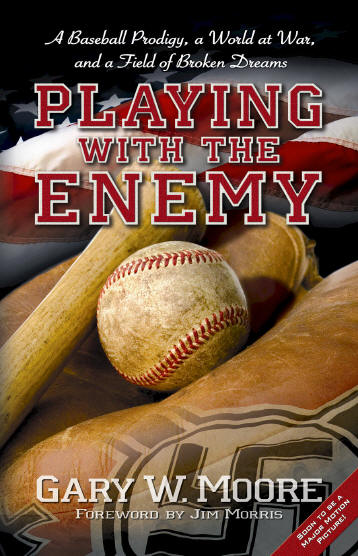
Gary W. Moore, the son of Gene Moore, an early 1940s MLB prospect from the tiny town of Sesser in southern Illinois, wrote this memoir of his Dad's career. Since his Dad did not speak at all of his career until the day before he died in 1983, the author wrote a kind of novel about his Dad, full of dialogue and action, transpiring in such places as Sesser, North Africa, and Ruston, Louisiana. To bring him to life with very little in the way of his Dad sharing his past and a sparse historical record (only a couple of letters from the Dodgers and a few local newspaper articles), Gary resorted to what I call the "true sport genre" of writing, a parallel to the more recognized "true crime genre." Except for Chapter 15 on the capture of the German submarine U-505 (now on display at the Chicago Museum of Science and Industry) and Chapter 17 on Gene's older brother Ward's WWII military service in Europe, the book reads like juvenile fiction, another layer of genre to lay onto this unique book. If you have a teen in the house, you should pass on this volume to him or her. It will not likely test your teen's reading comprehension level as it progresses through 42 short, well-crafted and enjoyable chapters.
As a 15-year-old, Gene Moore was the star catcher and captain for the town baseball team, the Egyptians, average age 27 (southern Illinois is known as "Little Egypt" for no particular reason. Certainly, some towns in the region bear Egyptian names, such as Cairo and Thebes.) Dodger Scout Frank Boudreau realized he was a true whiz kid and a potential great. So, with alacrity, he signed him. At age 16, Gene left Sesser and played the 1941 season for the St. Louis Granary, hitting 36 homeruns in the 80-game season and being named Rookie of the Year. He was waiting to hear where he should report for spring training for a Dodger Minor League farm club when, on December 7, 1941, the Japanese attacked Pearl Harbor. Daunting as this crisis was to his prospects and that of the nation, Gene was not overly concerned as he was sure the war would not last long and mostly because (despite his desire to join the fighting) the Dodgers arranged for him to become the catcher for the Navy's Exhibition Team. That squad's mission was to play the Army's Exhibition team regularly to entertain the fighting troops and keep up their morale. (Both teams' rosters were comprised of pro players or pro prospects.) The two teams played throughout lengthy, protracted fighting in North Africa, especially in Algeria and Tunisia. (During one game, the Navy's center fielder, Ron Callais, was blown to pieces by a German mortar shell.) Gene held down the starting catcher position at age 17. Once Field Marshal Erwin Rommel's Afrika Korps was routed, the Navy team shipped out to Norfolk, Virginia, thence to Ruston in northern Louisiana.
Here Chapter 15, about a U-boat, mortises with Gene Moore's life arc. On June 4, 1944 (two days before the Allied amphibious invasion of France), a carrier group (the USS Guadalcanal, five destroyers, and air support) captured the German submarine U-505, along with a working Enigma decoding machine and a complete set of current code books. The Americans prevented the scuttling of the sub. Then they towed it from off the coast of Africa to Bermuda. This dramatic turn of events became a state secret. We did not want the Germans to know we had the sub and her Enigma machine. The crew's families in Germany were left to presume their sons had gone down with their Unterseeboot. However, they had almost all survived and were transported to a POW camp in Ruston.
At Ruston, the Navy Exhibition Team was assigned to guard the U-505 prisoners with strict orders to say nothing about them and to keep them isolated from any contact with the outside world. To fill the void, Gene and his teammates begin to teach the Germans how to play our national game, the game we take with us everywhere we prosecute a war or undertake duties ancillary to war, such as guarding POWs. In a friendly baseball game against the Germans, Gene injured an ankle sliding into home plate. (For his injury, he received a Purple Heart and the small pension that went with it.) That injury would prove to be the beginning of the end for his MLB aspirations. The injury proved grave and permanent. The upshot was that, after the war, the Dodgers soon released him from his contract by registered mail. In a later mishap, in a 1949 second chance with a Pittsburgh Pirate farm club, his ankle bone snapped completely through, protruding through his skin. That fracture put the exclamation point to the end of his days in the game he loved.
Back in Sesser, Gene took to drowning his sorrows, becoming alcoholic. One evening, Judy, a kindly waitress pulled him from a facedown position on the bar floor and started him on the road to recovery. Judy and Gene soon married. To support his family, that soon included a son, Gene drove a bread delivery truck from 1954 to 1973, a boring job he detested. Then he sold vacuum cleaners for Filter Queen. He had such a passion for that work that he and Judy started their own Filter Queen distributorship in 1974. They were very successful. They had a great nine years before Gene died at age 57 of a heart attack on May 13, 1983. The day before, Gene spent several hours in a restaurant telling his son Gary for the first time the story that this book recounts. Perhaps he was simply ready to die after he unburdened himself of what he had kept from his son. Or, at some deep unconscious level, his 11th-hour deposition might have contributed to the timing of his death. If you read the book, you might devise your own reasons why the end came when it did.
Chapter 23, "The Friendship Game," is worth noting as it recounts the game where Gene injured his ankle in a slide home. In a perverse way, he was very proud of his injury and the Purple Heart that went with it. His older brother, Ward, had received the same medal after sustaining an injury during the Allied invasion of France. Clearly, sibling rivalry came into play here.
Heinrich Mueller, one of the German POWs Gene taught the game of baseball, returned to the US to help inspire him to overcome his alcoholism and move on with his life. That story alone is worth the read. You will get no spoiler here. Read the book.
This book was published over a decade ago. Though it is far from a new release, it is important that the SLA online book review journal Arete offer this review. Playing With The Enemy reports an important part of American history through the microcosm of baseball as represented in one brilliant, young player destined for a greatness that the evils of war would dash asunder. The book is also literature. The author has mastered the skills of a novelist to render his Dad to us in lively writing backed up by the eye-witness authority of a son's memoir-cum-sports history. Also, some very fine pencil-sketch drawings illustrate the book throughout. They very much enhanced my reading experience.
I highly recommend that members of the Sport Literature Association read this book. Libraries that have not already acquired Playing With The Enemy should do so at the earliest opportunity. Gary Moore's book does us all a great service by preserving a very unique and compelling American baseball story that came within one day of being lost forever. More importantly, it reminds us of the great sacrifices our nation made to remain free so that we can continue to play our national sport.
Gary W. Moore, Playing With The Enemy: A Baseball Prodigy, A World At War, And A Field Of Broken Dreams (El Dorado, California: Savas Beatie Publishing Co., 2006), 301 pages.
Copyright © 2016 by G. Louis Heath