pigskin rapture
Reviewed by G. Louis Heath, Ph.D., Emeritus Professor, Ashford University
4 october 2016 archive
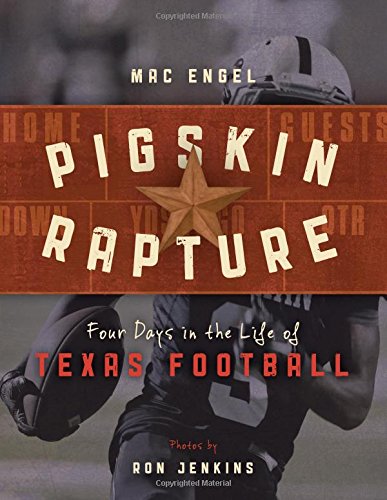
This large, coffee-table book is divided into quarters to correspond to four October football days in Texas. The first quarter features the Thursday, October 8, 2015, Indianapolis Colts versus the Houston Texans game in NRG Stadium. (The NRG dome dwarfs the once mighty Astrodome, now a grimy warehouse, in NRG's shadow.) This section proceeds as a log; for example, "5:13 pm, Coors Light Blue Lot 22," where tailgaters ate, drank, and made merry. That day, Texans' fans filled the stadium despite the general feeling their team was on the cusp of terrible. Throughout the detailed account of the game appear tidbits of football history, such as about Bum Phillips, the Oilers head coach, 1975-1980, whose franchise absconded to Tennessee in 1996, mad at Houston for declining to build a new stadium. There is also a full two-page photo spread on the Texans' cheer leaders gyrating their bums, dressed in knee-high, pink boots and not much more. The Colts and their QB, Andrew Luck, a graduate of Houston's Stratford High, won the game as expected, though the 27-20 score was closer than predicted.
The first quarter section ends with travel and dining log entries from the book's creators, Fort Worth Star-Telegram sports columnist, Mac Engel, and world-renowned photographer, Ron Jenkins.
The second quarter features the Friday, October 9 game between Midland Lee High School (Laura Bush's alma mater) and Odessa Permian High, perhaps the most famous U.S. high school, owing to Buzz Bissinger's book, Friday Night Lights, and its movie and TV renditions. This section presses home several points: The media covered the game like it was an NFL contest. And especially we learn that Texas is a proud blue-collar state that fiercely plays the blue-collar game of football with a very serious intent to win, the cost be damned. Wealthier Texas high schools have built "palaces" with price tags in the millions so their communities can watch games in true Texas-sized style. This reviewer was especially struck by the fact that Odessa Permian High School sports a $2 million indoor practice facility at a time the NFL Dallas Cowboys have none due to a 2009 storm that collapsed theirs.
Again, log entries are interspersed with large color photos, superbly composed. For example, "10:30 AM Midland Lee football locker room" (two-page, wide-angle, single photo spread of six lockers that includes skeletons hanging from lockers, representing the arch-rival Permian Panthers. Three of the lockers carry Hispanic names, a very compelling visual, highlighting the fact the area has become 39% Latino in recent years.) Texas high school marching bands receive substantial copy here, for they are a big part of Lone Star State football. Band directors earn salaries exceeding $100,000, comparable to those of the coaches whose halves they split and ears they din.
The favored Permian Panthers routed the Midland Lee Rebels on this night. The book's quarter ends with "Travel Log, Day 2" about the 4½ hour drive on Interstate 20 to the next venue, the Cotton Bowl ("an exercise in boredom").
The third quarter recounts the October 10, Saturday, Oklahoma vs. Texas super-arch-rivalry, annual "Red River Showdown" in the Cotton Bowl, located on the Texas State Fair grounds. "Burnt Orange Nation" was a big underdog. The fans were resigned to impending loss, but, true fans, they almost filled the 95,000-capacity stadium. Tailgate fare included, for some, breakfast tacos with chorizo (a type of pork sausage) and eggs, washed down with mimosas. (The book does a good job of portraying Texas's growing diversity with such details.) The University of Texas's first African American head coach and the state's highest-paid employee, Charlie Strong, was under pressure for a breakthrough win, but no one harbored much hope he would don the victor's hat, a golden replica of a ten-gallon Stetson.
This section continues the log format; for example, "4th quarter 6:05" and "4th quarter 2:50" remaining. "Smokey the Cannon" was fired after every Longhorn TD. Surprisingly, it fired enough for 1-4 Texas to defeat 4-0 Oklahoma, 24-17. The coach, the eyes of the University of Texas Board of Trustees upon him, won a game he desperately needed to keep his job. In a celebratory mood, many fans streamed onto the Midway to eat the must-do Texas State Fair food, Fletcher's Corny Dog.
To point up how big football is in Texas, the author notes the Lone Star state is home to 12 bowl division teams, 8 championship series teams, a combined 16 Division II and III teams, five junior college squads, and four in the NAIA, the National Association of Intercollegiate Athletics, the sports organization for very small colleges.
The book's fourth quarter game on Sunday, October 11 pitted the New England Patriots against the Dallas Cowboys at A T & T. Stadium in Arlington. We find the usual Mac Engel log entries, such as "2:03 P. M., Owner's Suite," to structure the narrative that supports Ron Jenkins's photos. Owner Jerry Jones inhabits "Jones's Perch" just above the suite where few have even visited, save for his two sons. The lavish, free party in the suite below for 48 invited celebrities and friends demonstrates the divide between fans and elite throughout the NFL. This part of the book gives a nod to glaring inequality. (The only other nod appears in the second section of the book, a page on a homeless man who spends his days on a municipal football field.)
Beyond Jones, what captures attention is the Dallas Cowboys' cheer-leading squad. They provide a gorgeous, sideline meat show to drive up the testosterone levels of many spectators. Little girls throughout the USA shake their pompoms, dreaming of joining these women who are athletes in their own right. Each signs a contract to not gain a pound, ever, or be dismissed. The cheer leader, Giselle, gets a cameo page here.
The stadium features a "party pass section" in each end zone, scores of exclusive clubs, lots of expensive modern art and sculpture, and an 11,393-square-foot Jumbotron that contains an elevator. Retail outlets abound, too, including a Victoria's Secret where the hottest sellers are thong panties with the Cowboy trademark blue star over the crotch.
And, oh yes indeed, I hasten to add that the Cowboys, whose last Super Bowl victory was 20 years ago, lost the game, 30-6.
This part of the book was very glitzy, imbued with a mood of nostalgia for glories past. The material comforts and circus splendor of A T & T Stadium seem to be in place to compensate for the Cowboys' failure to measure up to the iconic legacy of "America's Team."
Pigskin Rapture would make a fine acquisition for libraries as well as for fans and especially for waiting rooms of every sort. It is comprised mostly of photos with a bit more narrative than an issue of Sports Illustrated. It is a fast, authoritative, well-written, professionally photographed, enjoyable read and visual experience, free of burdensome footnotes and bibliography. For a large coffee-table, hardcover book with many photos, all in color, it carries a very modest price tag of $26.
Mac Engel (author) and Ron Jenkins (photographer), Pigskin Rapture: Four Days in the Life of Texas Football (Guilford, CT: Lone Star Books, 2016),
240 pages. Hardcover, $26.
Copyright © 2016 by G. Louis Heath