the eighth wonder of the world
Reviewed by G. Louis Heath, Ph.D., Emeritus Professor, Ashford University, Clinton, Iowa
2 september 2016 archive
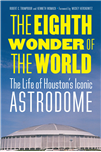
If you don't yet know what a lamella is, this book is for you. Hint: It figures in the trussed roof of the Astrodome. (See the 20 pages of archival, architectural photos, with text interpolated, between page 76 and page 77.) Although there is a good deal of edifying, technical detail here, such as lamellas, sports fans should not be daunted. Trumpbour and Womack offer us a genuinely superb read based on exhaustive research. Their work is an authoritative one, filled with the drama of a once backwater Southern city achieving global market importance as it seeks the accoutrements to match, including a domed stadium and a MLB team. Houston undertook a decades-long odyssey to do this, helmed by luminaries of the Houston civic culture.
Houston opened her Astrodome in 1965. The press soon dubbed the world's first indoor, air-conditioned, all-weather, multipurpose sports stadium, "The Eighth Wonder of the World." A bit of Texan-sized hyperbole perhaps, but certainly the big bubble that towered eighteen stories high invited expressions of awe.
The Dome achieved its first widespread fame in January, 1968, when the largest crowd ever to watch a college basketball game (52,693) viewed the University of Houston and Elvin Hayes end the record run of wins of UCLA and Lew Alcindor (later, Kareem Abdul-Jabbar). The structure's profile was further enhanced with the September, 1973 tennis "Battle of the Sexes" between 29-year-old Billie Jean King and 59-year-old male chauvinist huckster, Bobby Riggs. Other major celebrities over the years, including Muhammad Ali, Mickey Mantle, Earl Campbell, Howard Cosell, and Don Meredith, would add further luster to the bubble on high.
Roy Hofheinz, a judge, Houston mayor from 1953 to 1955, and political ally of President Lyndon Baines Johnson, dreamed of building a colossal Buckminster Fuller-style geodesic dome in his city. He first considered a Brobdingnagian, domed shopping mall before settling on the Astrodome (née the Harris County Dome Stadium). The hard-charging mayor was the force majeure most responsible for moving the Dome from idea to realization, and much more. A 1994 Sports Illustrated special issue cited him as important in "changing the sports environment in the 20th Century." His Dome shifted the emphasis of sports to casual fans who wanted to have a good time amid amenities. Air-conditioned comfort, cushioned seats, skyboxes, stadium clubs, the world's largest electronic, animated scoreboard, sidebar entertainments for kids and adults alike, and lots of food options, including restaurants, offered attendees a diverse and luxurious experience (stratified by social class), that may or may not include spectating the MLB game on the field.
This volume provides a wealth of detail on the financing of the Dome that features centrally the very important Houston Livestock Show and Rodeo (formerly the Fat Stock Show), which became a very big event after it moved to the multipurpose Astrodome. (Early on, it donated 230 acres in an effort to move the project off the drawing board. However, the Dome was not built on the acreage offered.) What was a showcase of livestock, whose grand champions fetched up to $250,000, became an extravaganza in the Astrodome.
The authors, both academics, provide an excellent history of the power-broker politics and bonded financing of the Astrodome as well as such epiphenomena as the necessity of creating AstroTurf. They write well, though they suffer a serious tic in their overuse of the verb "unfold." Their diction could have been varied to good effect.
The index is also flawed. Major financial player, oil executive Craig Cullinan, Sr., is listed for pages 59-97 but he does not appear till page 66. These 39 pages cover most importantly the flamboyant, irascible, hard-drinking, internationally prominent Houston sportswriter, George Turner Kirksey. After Mayor Hofheinz, he was arguably the most significant driving force for the Dome, a project comparable in magnitude and impact on the city as the Houston Ship Channel, completed in the 1920s.
This book is about death as well as birth, for the Dome closed in 1999, a victim of age, obsolescence, and the trend to single-purpose, tax-subsidized stadiums. But it had a fantastic youth and maturity, demonstrating how American technology and Houston leadership reshaped leisure and spectating, not just in Houston but across the world. The first domed stadium, a multipurpose venue for baseball, football, livestock shows, rodeos, trade shows, and more, gives us a window on the evolution of sports as entertainment and big business in the 20th Century. Trumpbour and Womack do an excellent job of giving us a very well-informed look through that window. Public and university libraries should acquire The Eighth Wonder of the World. Sports fans everywhere should read its compelling and important contents.
Robert C. Trumpbour and Kenneth Womack, The Eighth Wonder of the World: The Life of Houston's Iconic Astrodome (Lincoln, Nebraska: University of Nebraska Press, 2016), 223 pages.
Copyright © 2016 by G. Louis Heath