the best of peter finney
Reviewed by Matthew Teutsch
19 july 2016 archive
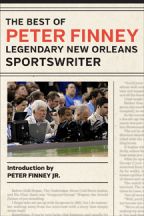
The Best of Peter Finney: Legendary New Orleans Sportswriter contains a multitude of articles from Peter Finney's sixty-eight year career as a sportswriter in New Orleans, first at the States-Item, then at the Times-Picayune. From 1945 through 2013, Finney covered everything from horse racing and boxing to the religious fervor surrounding college and professional football in the Crescent City and the Pelican State. Interspersed, there are articles about baseball, basketball, golf, and even the Olympics. However, the sport that consumes the majority of this collection is football, taking up over half of Finney's articles that appear in the book. Taken alongside Marty Mulé's Game Changers: The Rousing Legacy of Louisiana Sports (2013), Finney's collection provides a glimpse into the rich history of athletics in the "Sportsman's Paradise."
The lopsided inclusion of thirty-nine articles on college and professional football in relation to the thirty-six for all of the other sports combined should not come as a surprise to anyone, especially since football rules Louisiana and all other sports take a back seat to its dominant position. In the articles about the gridiron exploits of Archie Manning, Billy Cannon, Doug Williams, and others, Finney shines in the way he poetically writes, mirroring the ease with which John Gillman returned the opening kickoff 94 yards for a touchdown for the Saints in their first game at Tulane Stadium on September 17, 1967.
Throughout the sections on football, Finney shows his journalistic and literary accoutrements by deploying satire, humor, metaphors, and other tools while either describing the action on the field or providing readers with a glimpse into the lives of fans, actors, and athletes. The opening paragraph of "No. 1 Gamble: Power-I-Right, Tackle-Trap, Pass-Left" from January 1, 1974 highlights Finney's poetic skills as he describes the 1973 Sugar Bowl between No. 1 Alabama and No. 3 Notre Dame: "All evening long, those two celebrated faith healers, Ara and Bear, had been swapping miracles—extra points were being missed seemingly through a sorcerer's curse, fumbles were being shipped out of the air, a freshman was running 93 yards with a kickoff, a quarterback was catching a touchdown pass" (96).
Drawing upon the unique culture of New Orleans, Finney plays upon the city's cultural gumbo through his references to Voodoo, specifically in "Voodoo Man Takes a Shot at Montana" from September 10, 1990. Beginning with, "Voo-dat say gonna beat dem Saints!," Finney chronicles his trip to a voodoo priest to try and stop Joe Montana from picking the Saints apart on a Monday night game during the 1990 season. While maintaining a sports writer's focus on the game, Finney also provides his audience with insight into a voodoo ritual, becoming something like a chronicle. Montana beat the Saints 13-12, thus negating the priest's ceremony.
After Hurricane Katrina in 2005, the city nestled along the banks of the Mighty Mississippi feared that the Saints would pull up stakes and leave, heading for San Antonio. The articles that surround the tragic events of Katrina create, perhaps, the most cohesive narrative in the collection. Beginning with the immediate aftermath of the storm and running through to the proposed reopening of the Superdome, the four articles provide readers with an image of the tumultuous dealings surrounding the Saints post-Katrina and the role that the team played to fans like Finney and others in the city. Missing from these articles, though, is the September 25, 2006, reopening of the Superdome when Steve Gleason blocked a punt against the rival Atlanta Falcons to give the home team a seven to nothing lead in the opening minutes of the game. Even without this piece, though, the articles collected show the resilience of the city, specifically of the fans. This comes through in "Saints' Diehard Doing More than Lip Service" from January 12, 2007. The article focuses on David Thiele, a waiter, who served Drew Brees and his wife one night at Zea's Rotisserie and Grill. Thiele showed the couple his fleur de lis tattoo on the inside of his bottom lip, highlighting to number 9 the dedication of the Who Dat Nation.
While Finney's linguistic gymnastics can be seen when he describes what happened on the field, his most enduring pieces are those that focus on the athletes and coaches off the field. After the passing of Joe DiMaggio in 1999 and Ted Williams in 2002, Finney wrote articles about his interactions with the Hall of Fame players when they visited New Orleans for various events. In October 1978, Finney wrote about "Louisiana Lighting" Ron Guidry and his rise to the pinnacle of Major League Baseball as a starting pitcher for the world champion New York Yankees that year. Twenty-four years after Joe Louis defeated Max Schmeling, Finney briefly chronicled the career of the Brown Bomber. Before Muhammad Ali's 1978 fight with Leon Spinks, Finney spent a day with the boxer, listening to the self-proclaimed greatest of all time and up Ali's poetic one liners in print. Elsewhere, Finney delves into the relationship between former LSU basketball coach Press Maravich and his son, star LSU basketball player, Pete.
Overall, The Best of Peter Finney is just that, the best. How do you encapsulate sixty-eight years worth of writing into a two hundred and fifty page book? The simple answer is you take the highlights, making readers want more. As well, why even take the writings of a sportswriter from New Orleans, Louisiana, and collect them? What does New Orleans have to offer sports fans apart from a tourist destination for championship games at the Superdome? Perhaps Finney best sums this up in his master's thesis. There, Finney writes, "If there is anything that can surpass New Orleans' reputation as a gourmet's delight, it is her tradition as a sportsman's mecca—a tradition as brilliant as that of any city in the United States" (5). With that, grab a hurricane and some beignets, pull up a chair, and relive the past fifty plus years of sports in New Orleans through the eyes of Peter Finney.
The Best of Peter Finney: Legendary New Orleans Sportswriter. By Peter Finney. Baton Rouge: Louisiana State University Press, 2016. 312 pages.
$29.95. (Hardback).
Copyright © 2016 by Matthew Teutsch