sex testing
Reviewed by G. Louis Heath, Professor Emeritus, Ashford University, Clinton, Iowa
27 may 2016 archive
The word "policing" in the subtitle is a very apt choice for what was done to women in the heyday of sex testing. Sports officialdom, misguided by pseudo-science and cultural stereotypes, and fearful of women athletes seeking equality, sought to police the athletes under their sway. This book recounts a sad, sometimes hard-to-believe, story of how women who did not fill the official mold were required to prove they were women, and not men pretending to be women seeking to win an easy gold medal. At least, that was one of the justifications for the testing. There were others.
Professor Pieper clears the air regarding the fallacies undergirding the testing of women athletes to verify their sex. Over decades, the sex testing took a dark turn, devolving into a sub rosa test of women's femininity. The sex test became the gender test, opening a Pandora's Box of male expectations for distaff athletes. Pieper makes clear that the golden age of gender stereotyping, masquerading as science, enjoyed a longer shelf life in sports than in academe and certainly in much of the larger US culture.
Sex Testing underscores the compulsive dualism of Western culture that has mandated a sex/gender binary. Our culture is very unlike some Native American tribes that recognize more than one category, notably the berdache, a man with feminine traits. This identity is respected, even revered. The tribes conceptualize reality cyclically, with a greater openness to nuance than US/Western culture that construes it in discrete chronological units. This deep-seated mindset of units over nuance has led to a vast amount of prejudice and discrimination against females who threaten the binary divide.
Caveat: The Introduction to this book offers a highly technical discussion of chromosomes and sex identity that includes chromosomal mosaicism, androgen insensitivity syndrome, polymerase chain reactions, and Swyer, Klinefelter and Turner syndromes. Rest assured; get through this technical stuff and the read becomes a pleasure. Pieper writes very well.
Her book recounts how the IAAF, international Association of Athletics Federations, and the IOC, International Olympic Committee, once regarded women track and field athletes as man-like black swans. (Their view was women should stick to feminine events such as tennis and figure skating.) For example, 19-year-old Fulton, Missouri sprinter, Helen Stephens won the 100-meter race in the 1936 Berlin Olympics. The IAAF deemed her record-shattering 11.5 seconds as "too fast for a girl." Polish runner, Stanislawa Walasiewicz, who had held the record, finished second. The Polish newspaper, Kurrier Poranny, complained Walasiewicz "would have gained first place if she had competed against women." The IOC countered that Stephens had been given a physical exam prior to the Olympics. This began sex testing in the modern Olympic era.
The founder of the modern Olympics in 1896, Pierre de Coubertin, excluded women from the first games. His publicly expressed misogyny exerted an influence for decades, including the 1928 Amsterdam Olympics where Lina Radke (Germany), Hitomi Kinue (Japan), and Inga Gentzel (Sweden) all finished the 800-meter race in record-shattering times. Rather than celebrating this fantastic 1-2-3 finish, the New York Times reported, "At the finish all runners were completely exhausted and fell headlong to the ground." In reaction, the IOC voted in 1929 to drop all women's athletic events, citing the "collapse" as evidence women were no match for such heavy physical exertions. Public pressure prevented this plan from implementation.
The reader will find much more of the same. For example, in the 1932 LA Summer Olympics, Babe Didrikson, the "Texas Tomboy," set two world records in the 80-meter hurdles and the javelin. She was criticized for her muscular physique and flouting of conventional gender norms. What followed again was a serious movement to eliminate all women's events from the Olympics. It also failed.
In 1968, the IOC began requiring sex testing of all female athletes. One gets an insight into the real purpose of the testing through IOC president Avery Brundage's comment: "The women track and field competitors are ineffective and unpleasing on the track; their charms sink to less than zero." His point: Athletics masculinizes women. Ergo, let's make sure they are really women. The sex test sends the message to prospective women athletes: Don't apply here. If you choose to read this excellent book, you will encounter a good deal of this misogynist drivel, all of it well documented. Some of it made me gag.
What the IOC Medical Commission mandated for the 1968 Mexico City Summer Games was a chromosome test for female athletes (aka buccal smear test or Barr body test) despite the scientific community's opposition to the exclusive use of chromosomes in sex determination. With this test, the IOC permitted only 46,XX women into competition, reinforcing a sex binary, and thwarting the nuances of our natures. (Note: Women have 46 somatic chromosomes, including two X sex chromosomes. Men are designated as 46,XY to also indicate 46 somatic chromosomes, including one X and one Y sex chromosome. In both designations, biologists insert no space after the comma. These chromosome designations define the binary, ignoring other combinations.)
Professor Pieper examines the Cold War ideological conflict of the USA versus USSR in sport. The USA espoused traditional femininity whereas the USSR claimed to provide equality in physical labor. Consequently, the Soviet women built big muscles and won gold while the US women shunned muscles as unfeminine. The Ukraine's Press sisters, Irina and Tamara, who won many Olympic gold medals, are cited as examples of Soviet muscular women. By contrast, the "kitchen debate" of President Nixon versus Premier Khrushchev at the 1959 opening of the American National Exhibition at Sokolniki Park in Moscow underscores how US expectations hamstrung our women athletes.
France is noted at some length as buying into the model housewife syndrome under President Charles de Gaulle in the postwar era. The French emphasis on femininity features some parallels to the USA's. A very compelling section of the book.
The book does a fine job of documenting and explaining "East Germany's Mighty Sports Machine." The answer: steroids. In the 4x100-meter medley relay swimming finals, GDR swimmer Kornelia Ender touched the wall 6.6 seconds ahead of US sensation, Shirley Babashoff. Unfortunately, the IOC doping tests were inadequate to detect the GDR's cutting-edge regime of systematic doping. The question arose: How much anabolic steroid, a synthetic form of testosterone, can one inject and remain female? The GDR received much criticism and scrutiny despite the fact its athletes passed all sex testing.
The GDR and other Communist countries cheated in the Olympics to instill doubt in world opinion. If they could win a lot of medals, their nations must be good places to live. In truth, contentment, let alone happiness, was never possible in these totalitarian regimes that used their gifted female athletes for political purposes, doping them without their knowledge (vitamin supplements for you!), and later caring little for them.
Cleveland's Stella Walsh, who won the 100-meter race in 1932 as Poland's Stanislawa Walasiewicz, suffered the ultimate indignity: post-mortem sex testing. The coroner questioned her sex identity in his December 5, 1980 autopsy report ("abnormal genitalia") following her murder as she resisted the theft of her purse in a local convenience store parking lot. His report sparked a media circus. The binary had transited the death divide! Another most compelling section of the book.
Professor Pieper goes through various incidents related to sex testing in several Olympics. She informs the reader of important developments. (for example, "femininity testing" in the 1984 Sarajevo Olympics and "gender verification" in the 1988 Calgary Olympics).
A couple of chapters I found particularly compelling:
Chapter 6, "One of the Most Horrid Misuses of a Scientific Method": The Development of a Protest.
US swimmer Kirsten Wengler underwent the Y chromatin test at the Kobe, Japan, 1985 World University Games and failed (months later proven a false positive). The Japanese doctors did not issue her the "femininity certificate" she needed to compete. Unwilling to conduct a gynecological exam, they let her swim anyway as she in no way looked masculine but appeared very feminine to them (which rather spills the beans as to the real reason for the test). Other competitors featured in this chapter fared less well than Wengler. Read the book to see how the Y chromatin test destroyed careers and scarred psyches for life.
Chapter 7, "Gender Testing Per Se Is No Longer Necessary": The IAAF's and IOC's Continued Control.
Due to criticism of the inadequacy of the Y chromatin test, the IOC adopted the polymerase chain reaction (PCR) test. Yet, criticism continued, including over the purpose of verification (never well defined). The IOC varied in its reasons: a defense against male imposters, a deterrent to female doping, and a check on biological advantage were adduced most often. Most critics opposed lab-based testing but still wanted a test. (They favored a physical exam). Thus, even these critics supported a binary notion of sex/gender in defense of the traditional Western view of femininity.
The sex/gender binary faces a stiff headwind in the book's consideration of transgender athletes. For example, the United Kingdom's Mary Weston, who won the British Women's Athletic Association's shot-put titles in 1925 and 1928 and represented the UK in 1926 in the Women's World Games, began to doubt she was a woman when she had to shave. In 1934, she underwent surgery to become Mark. Critics cited this as evidence that athletic competition masculinized women. Read the book for much more on the issue.
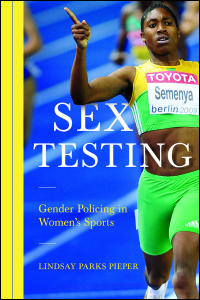
In 1999, the IOC got rid of genetic-based testing for all women athletes. But testing has not gone away. If the IOC is suspicious of a female athlete who strikes them as too manly, they test. To wit, in 2006, Indian middle-distance runner, Santhi Soundarajan, was subjected to a gender verification test after winning a big race. Uninformed why her blood was being extracted, she was shocked to learn later she had failed the test and been stripped of her medal and banned from future competition. In 2009, South African runner, Caster Semenya (her photo is on the front cover of this book), came under similar suspicion but faced no stripping or banning. Both these athletes have hefty physiques and high levels of naturally produced testosterone and speak in a low man-like register, traits that are part of a complex termed hyperandrogenism. This is the current limited sphere where male sports hegemony is imposing its control over female athletes. In 2012, the IOC and IAAF adopted hyperandrogenism policies. (pp. 184-186). Yet, these can be expanded at the whim of the IOC should the political winds allow. Stay tuned for future developments (perhaps Professor Pieper's next book). She should write another. This one is excellent, the first complete history of sex testing to date. Maybe a next volume will recount the final coup de grace of the beast.
This book got my dander up because sex testing reminds me of Jim Crow literacy tests for blacks in the South. Both were based on false science that share a common ideological past. Women athletes and Southern blacks were both tested to keep them in subordinate statuses. As a commissioner on the Human Rights Commission of my city, I am prone to see such parallels and want to see something done to remedy them.
Sex Testing is the first comprehensive account of the various sex and gender tests that sports authorities have devised from the 1930s on for female athletes. It offers great documentation of significant developments, well-written throughout, accompanied by incisive, penetrating insights as to what is going on below the surface in the world of women's sports. It is a stellar, informative read that public libraries should acquire. It is certainly, above all, a scholarly resource that colleges and universities should purchase.
Lindsay Parks Pieper, Sex Testing: Gender Policing in Women's Sports (Urbana: University of Illinois Press, 2016), 250 pages.
Copyright © 2016 by G. Louis Heath