playing with tigers
Reviewed by Richard C. Crepeau, History Department, University of Central Florida, Orlando, Florida
18 may 2016 archive
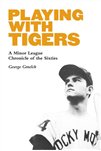
In the age of the tell-all baseball journal and memoir that began with Jim Bouton's Ball Four there have been many varieties over the decades. Since Bouton the Commissioner of Baseball has not tried to suppress or censor any of them and no duels have been fought over their revelations. The quality has varied with the recent work by Dirk Hayhurst being among the most interesting and well-written.
Playing With Tigers joins the top end of the list as George Gmelch recounts his years as a minor league player in the Detroit Tiger organization and in independent ball in Quebec during a time when society was undergoing considerable change and turmoil. Inside the game the impact of change was just beginning to be felt and not welcomed. The juxtaposition of world views produced tension and misunderstanding, but in point of fact the degree of resulting differences was less than met the eye. Internally baseball continued to be about the game on the field and the comradery of the locker room, not the issues of race and war that moved to center stage in America in the Sixties.
In fact one of the most interesting aspects of Gmelch's baseball life is his recognition that something was awry in the world surrounding the game, and how baseball helped him maintain his sense of separation from that world. This split diminished as Gmelch became more sensitized to the issues of the day and as a result more uncertain about his place within both the baseball and civilian worlds. This is accompanied by a growth and maturity exhibited even as the locker room and dugout pranks continued.
The two seasons that stand out are his second professional season in Daytona Beach, Florida, and the following season in Rocky Mount, North Carolina. No doubt my fascination with the Daytona season has to do with my life in Central Florida just a few years after Gmelich's tenure in Daytona. Many of his observations on the city, on the surrounding area, and particularly on the racial climate were familiar to me and a reminder of how much things changed racially between 1965 and 1972, the year I arrived in the Orlando area. Gmelch has a very good feel for that world which he conveys vividly.
The following season in North Carolina Gmelch encountered the racial realities of Southern life in a more direct and personal fashion. Gmelch had been writing accounts of his life in the minors for his hometown newspaper. While in Rocky Mount he became more aware and uneasy with the racial climate of the Jim Crow South and conveyed that unease in several articles. On the basis of information from a teammate who was from Rocky Mount, Gmelch wrote a story that ran under the headline, "Life In Rocky Mount With the Klan," in which he charged that the local police chief was a member of the Klan and his brother was the Grand Dragon. In the pre-internet age Gmelch did not anticipate that anyone in Rocky Mount would ever see the article.
It took about two weeks before the story circled back on Gmelch. The chief of police read the article and complaints were made to the Detroit Tiger organization. In the end it cost Gmelch his professional baseball career. It was a tough lesson in cultural conflict for the future anthropologist.
The stories of the baseball life are numerous and humorous, many a testament to the immaturity of the young men pursing the American dream of athletic stardom. Gmelch holds very little back and there are some hilarious as well as sad stories that he tells. In addition he is self-critical and at some points a bit too hard on himself. He reveals his feelings and emotions, his achievements and his blunders, and indeed his lack of self-awareness, a quality quite common in the young.
At one point he discusses his choice of women. He was more a one woman man than a one night stand man. The two women he had the longest and most intense relationships with didn't care all that much about baseball, relegating it to the toy department of life, and preferring more serious activities. Gmelch wonders if in some way they reflected his own inner doubts about the life choice he had made.
The tales of his teammates are entertaining and for the most part we get to know what became of them in their lives after baseball. Gmelch conveys a sense of the joys, frustrations, and the tedium of playing day after day after day with no days off. Life is baseball and very little else. Yet it was fun as well and a choice that in the end George Gmelch is happy he made. It is also a choice that allows us to share with a degree of intimacy in this life we all in some ways dreamed for ourselves in the misty and long gone past.
George Gmelch. Playing With Tigers: A Minor League Chronicle of the Sixties. Lincoln: University of Nebraska Press, 2016. 263 pp. $26.95 (hardcover).
Copyright © 2016 by Richard C. Crepeau