the self-propelled voyager
Reviewed by Dave Buchanan, English, MacEwan University
17 may 2016 archive
"You can ramble and roam more easily on a bicycle than by any other conveyance."
—Winfred Garrison (1900)
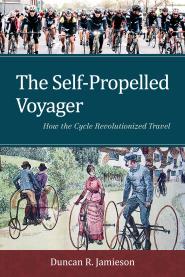
Duncan R. Jamieson's The Self-Propelled Voyager: How the Cycle Revolutionized Travel (Rowan and Littlefield, 2015) is the first serious, historical, book-length study of cycle travel and its literature, from the origins of the bicycle in the mid-nineteenth century up to the present. The book's aim is to trace the "rise and development of long-distance bicycle travel through the narratives of those who travelled." Jamieson brings an academic thoroughness to this research project while managing to strike a completely accessible—and, at times, surprisingly personal—tone. As he explains in his engaging preface, the book sets out to capture how long-distance-cycling writers have, over the course of about 150 years, articulated the particular "joy of self-propelled mobility." And it succeeds in this regard, wonderfully.
I first encountered Jamieson's work in this field through his extensive chronological bibliography of cycling and cycle-touring literature, which he kindly made available online for years. That bibliography got me thinking that cycle-travel literature is a legitimate field of study, and I've been chipping away at that list for years now, though barely making a dent, it seems.
Jamieson, however, seems to have read everything in that bibliography and the book does a fine job of not just summarizing the most important of these texts but providing vivid anecdotes, telling details, and short quotations that convey the tone and spirit of the works. We read, for instance, of how Thomas Stevens, the first to ride a bicycle around the world in the 1880s, spent an entire day cycling in Eastern Europe without uttering a sound other than whistling "Yankee Doodle." Elsewhere, we are treated to Erika Warmbrunn's evocative description, from Where the Pavement Ends (2001), of "the flying abandon of a bicycle, legs pumping, body and wheels skimming above the land, cycling for the sake of cycling."
True, a lot of the content of this book is descriptive, as opposed to analytical, and some academic readers may take issue with that. But not me. The academic study of cycle-travel literature is relatively new, and one of the first steps in exploring a new field is making primary texts accessible. Jamieson's book begins that process. It's a survey, essentially, and it provides a taste of many of the most important texts in this emerging field of study. Reading the book, I compiled my own list of works that I plan to go out and explore more thoroughly. If that's the primary effect of this book, then it will accomplish much.
The tone of this book is academic but unpretentious—the prose straightforward and, in places, refreshingly personal. Jamieson, who is himself a seasoned long-distance cyclist, talks about his own experiences in the preface and sprinkles in personal anecdotes in the notes at the end of each chapter. (For instance, in a discussion of how many cycle-travellers like to name their bikes, he informs us that his own bikes are named Par, Whitey, and Stevens). You don't often see these kinds of personal asides in an academic book, but I liked them—they're perfectly relevant and often funny. Academia could use more of this.
The first half of the book is devoted to literature from before 1900, which may seem strange but actually makes sense, given how copious, rich, and generally ignored the cycling literature is from the 1880s and 90s especially, with its compelling stories of early cycling journeys by figures such as Charles Pratt, George Thayer, Frank Lenz, and Annie Londonderry.
I have a particular interest in the cycle-travel writing of Philadelphian Elizabeth Robins Pennell and her husband Joseph Pennell, two of the most prolific and accomplished cycle-travel writers in the late nineteenth century. So I was curious to see what Jamieson would have to say about them. The answer is plenty. Too often in discussions of cycle travel in the 1880s, the Pennells get second billing to Thomas Stevens and his Around the World on a Bicycle. The thing is, as Jamieson rightly points out, Stevens was a one-hit wonder when it came to cycling, while the Pennells travelled by cycle and wrote about it for twenty years.
I did notice a couple of minor factual errors in Jamieson's account of the Pennells' travel awheel (related to the timeline of their many journeys), but these are small potatoes, even to a Pennell nerd. Overall, Jamieson offers the most extensive and illuminating discussion of the Pennells' contributions to cycle travel literature that I've encountered. I even learned a few things. For instance, I loved the detail about Elizabeth adopting an English accent when she lived in London. I thought I'd read everything about the Pennells but this lovely anecdote came from an article that was new to me.
My only quibble with the early chapters has to do with Jamieson's omission of any serious discussion of Karl Kron (aka Lyman Hotchkiss Bagg), the eccentric author of Ten Thousand Miles on a Bicycle (1887). True, Kron was an oddball, and his massive book (900 pages of tiny type) is somewhat bizarre in its obsession with statistics and indices, but Kron probably wrote more about the first generation of long-distance-cycling than anyone, aside from the Pennells. Yet Jamieson only mentions Kron in passing a couple of times in the book. I'm not sure why. Jamieson has clearly read everything in the field, including Kron's strange tome, I'm sure, but he chooses not to say much about one of the most significant early voices in self-propelled voyage literature.
The second half of the book is devoted mostly to consideration of cycle-travel narratives from the twentieth century. In this part, Jamieson takes us swiftly through some broad historical periods, providing insightful commentary on key figures such as Bernard Newman ("the most prolific cycle author"), Dervla Murphy, Bettina Selby, and Barbara Savage. Incidentally, Jamieson does an admirable job of addressing the gender divide in cycle-travel literature, where, interestingly, male authors dominate in quantity, but female authors more than hold their own in quality.
The final chapter, "Renaissance 1961-," feels a little piecemeal, divided up into short sections on trends or sub-themes in cycle-travel narratives, from "Pilgrimages" to books about cycling in Vietnam, specifically. Each is interesting in its own way, but the sections feel a little disconnected. Jamieson deftly pulls it all together in the "Conclusion," however, and offers some insightful observations on the continuing appeal of self-propelled journeys on two (or three) wheels.
None of which has really changed in 150 years, Jamieson points out. As Elizabeth Robins Pennell puts it, to quote from Jamieson's own wrap up, "The world is one great book of beauty and romance; and on your cycle you can gradually master it, chapter by chapter, volume by volume." Think of Jamieson's book as an essential primer to the vast catalogue of books written by self-propelled ramblers, roamers, and readers.
Jamieson, Duncan. The Self-Propelled Voyager: How the Cycle Revolutionized Travel. Rowman & Littlefield Publishers.
Pages: 232. Hardback, September 2015. $80.00
Copyright © 2016 by Dave Buchanan