the hockey scribbler
Reviewed by Jason Blake, University of Ljubljana (Slovenia)
27 april 2016 archive
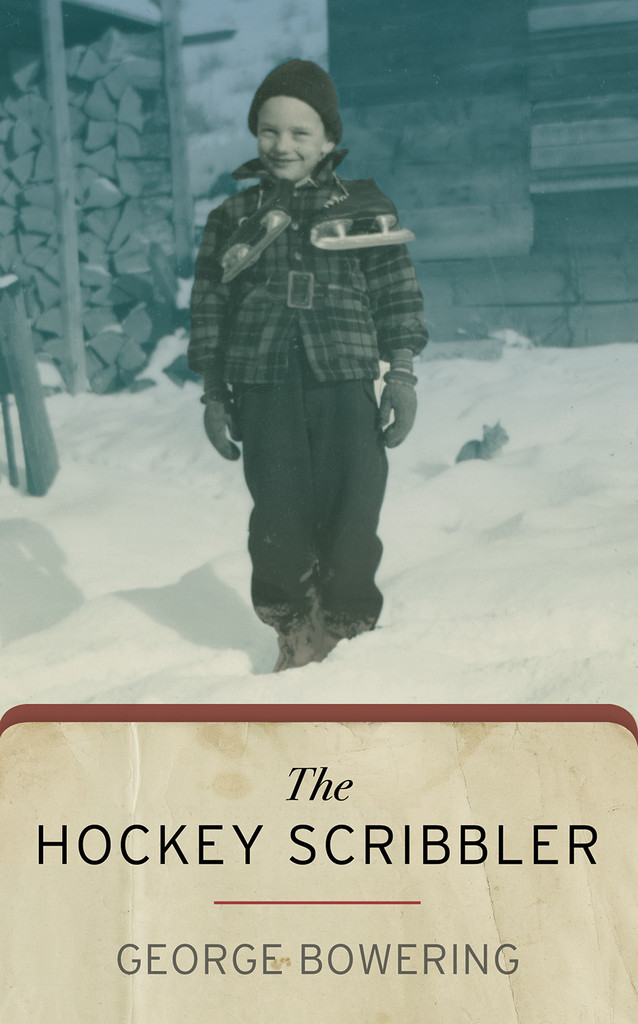
Hockey is George Bowering's sporting mistress. Baseball is his real game and he remains faithful to what he deems the more graceful and the smarter sport. Provocatively for a work called The Hockey Scribbler, he asks "How can you tell that baseball players are smarter than hockey players? Baseball teams never get penalized for having too many players on the field."
In fact, hockey isn't even Bowering's winter sport of choice – basketball is the winner there.
Bowering grew up in the balmy climes of British Columbia's "iceless Okanagan Valley" and he admits it was "some years before I would smell the ice of a hockey rink." He played ice hockey as a young boy, but only on those rarest of occasions when the local pond actually iced over. The 'real' hockey players of his youth were imports from the prairies, "kids who used to skate in their own back yards in Saskatchewan … Taking on a kid from Saskatchewan at hockey would be like trying to out-swim a seal." Bowering may seem to be touting thin hockey credentials, but more likely he's stealthily setting up what will be an often critical take on a Canadian obsession.
Since Bowering is a former poet laureate of Canada (among many, many other things literary) the hockey lit crowd should be glad for The Hockey Scribbler. Departing from Oliver, BC, to Montreal, Vancouver, while many making hockey stops in between, Bowering revisits such familiar terrain as the 1972 Summit Series between Canada and the USSR, the rise of the World Hockey Association, the appearance of the Broad Street Bullies, and the Todd Bertuzzi affair.
More interesting than stories we all know are Bowering's musings and riffs on hockey names, hockey uniforms, hockey in strange places ("there is now a branch of the Okanagan Hockey School in a nice town named St. Pölten in Austria. Don't ask."), and hockey fiction and poetry, including close readings of Hanford Woods' story "The Drubbing of Nesterenko" and Al Purdy's poem "Hockey Players."
Bowering is frank about his complicated relationship to the game and equally upfront about a fact that should be (but isn't) obvious to all: "hockey's purpose is not to build a Canadian community." His is an on-again-off-again affair, sometimes tempestuous, sometimes tepid. At one time a season ticket holder for the Vancouver Canucks, he gave that up decades ago. The short-lived WHA Blazers, meanwhile, gave up on Bowering and moved to Calgary before he could convince poet Robin Blaser to attend a Blazers game.
"I quit watching hockey," Bowering writes, "partly because I could no longer sit though games in which the whistle is blowing to bring the game to a halt while insensitive louts try to disfigure one another." In other words, he couldn't come to grips with the violence in the sport – a topic that, when handled deftly, makes for fascinating reading because to enjoy professional hockey means occasionally courting violence.
Some of Bowering's theories on hockey violence are old hat. Not this one: "But what do ice hockey players wear? I have a theory there is a lot of fighting in hockey games because of what these young men have to wear, what with garter belts and the like." That's a new one, delivered tongue-in-cheek and without the lexical ballast of "hegemonic masculinity" or other abstractions properly absent from a popular memoir. And yet, by questioning hockey attire and gear, Bowering subtly establishes a connection between outdated ideas of masculinity and compensatory violence. Elsewhere, Bowering sees brawling minor leaguers as "enacting what they thought being a young male was all about …" Still elsewhere, he pokes fun at hockey dads whose pickup trucks are a little too heavy.
Bowering's tone is breezy. A good many paragraphs lead off with "Okay, …" or "Anyway, …" or "Well, …" – as in "Okay, we were living in a nice little house in Kitsilano in the summer of 1971" or "Anyway, in January 1983 …" or "Well, some of my poet friends did play hockey …" It's as if Bowering is chatting with you at the pub. Adding to this sense of comradery or intimacy are the many direct addresses, such as "You will have noticed…" and "You know that I have been leading up to the best uniform in the NHL …" Another frequent verbal tag is "I don't remember …" Bowering makes sure you realize this is personal memoir, not carved-in-stone history.
The banter is breezy but not always collegial. Bowering can dismiss and dis, among others, people who don't read, clumsy sportswriting, and fans and commentators who don't like the Europhile author's style of hockey.
Which brings us to Don Cherry, the ______________ (insert your adjective) hockey commentator who has been delighting and schooling fans for over thirty years with his funky suits, pro-fight stance and old-time-hockey credo. Bowering doesn't like Cherry's bravado, much less that he "spouts right-wing opinions in substandard English." And Bowering is not above going ad hominem. When an eighty-one-year-old calls an eighty-two-year-old "rather rotund," it feels like a schoolyard spat. That said, name-calling is a fun and refreshing change on the usual anti-Cherry critiques because there's no veneer of civility.
Bowering also comes up with an anti-Cherry salvo I've never seen before. "Here is what I am pretty sure of: if you make a complaint that this guy in the clown suit with the corrective collar is rude, ignorant, prejudiced, loud, crude and insensitive, he will respond by telling you how rich and popular he is." Bowering may be "pretty sure of" that gut feeling, but I'm not convinced. For Cherry to deny that he is "popular" would be a fat lie; that "will respond" to criticism by bragging about "how rich … he is" is a dubious claim.
For the reader in me, the best part of the book is when Bowering recalls going to games with writers Hanford Woods ("The Drubbing of Nesterenko"), Brian Fawcett ("My Career with the Leafs") and Hugh Hood (Strength down Centre: The Jean Beliveau Story), among others. At rinkside these men of words behave like witty louts, shouting inventive support at the louts on the ice. Being poets, they tend to puns – "You can have the shower, but we want our [Orland] Kurtenbach" – or other "comical and well-rehearsed shouts" often based on little more than an exotic looking name on a line-up.
A scene recalled and related early in the book perhaps epitomises the ambivalence of the game, including the game that has disappeared. Bowering travels to an arena with his father to watch real hockey: "A puck came into the crowd and my dad nimbly snatched it out of the air. … Then what did he do? He tossed the puck back onto the ice before play could resume. That's the kind of guy he was, and that is the way sport was in his day. I thought, 'You goof!' And I loved him for doing what he did."
George Bowering, The Hockey Scribbler. Toronto: ECW Press, 2016. 245 pp.
Copyright © 2016 by Jason Blake