team chemistry
Reviewed by G. Louis Heath, Ashford University
9 april 2016 archive
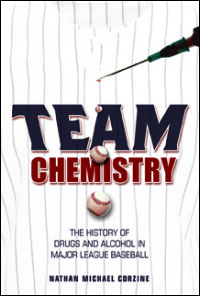
This book ought to be a book club selection. It deserves a very wide readership for it is a well-written, gripping page turner about a very riveting topic, alcohol and drug abuse in Major League Baseball. The more I read, the more enthused I became, and envious, too. This Corzine guy can really write. Unfortunately, he labors in the minor leagues of academe as a history instructor at Coastal Carolina Community College. He deserves to be called up to The Bigs.
What Team Chemistry delivers for the first time is linkage to a long-time MLB culture of alcohol and drug abuse that goes back to the origins of the league. What we are witnessing today is of a piece with a drug culture in pro baseball that hearkens back to 1876 and the founding of MLB. The recently much reported drug scandals occupy addled space on a continuum spanning from the 19th century to today. And that is the biggest point of this book: Drugs in the MLB are not a new issue; they are an old, old issue.
Corzine cites many examples. In 1880, Pud Galvin experimented with a testosterone-derived "elixir" to enable him to pitch some of his 646 complete games. In 1899, Louis Sockalexis, the first Native American in MLB, had one great season of power hitting before the bottle diminished his powers, causing his career to fade quickly. In 1903, Big Ed Delahanty, one of the finest hitters of the 19th century wandered, after a bout of drinking, onto a railroad bridge and fell into a river, drowning at age 35. He was hitting .333 that season. Of all the icons of the MLB pantheon, the reference to my childhood hero, Babe Ruth, as a frequent drunk, cut by the Yankees at the young age of 34, underscored dramatically the risks of alcohol for me.
Mickey Mantle and the Yankees of the 1950s drank hard as a team before they played hard on the diamond. Mantle, Ryne Duren, and several other Yankees battled addictions to alcohol that impaired or destroyed their careers. (Mantle, due to his celebrity, received a liver transplant that extended his life a few months when it could have saved someone less renowned for decades).
Corzine's section on African Americans especially caught my attention. Elton Howard, the first black Yankee, coped with the stress of his groundbreaking role with alcohol. Don Newcombe, the third black player in MLB, drank heavily, causing both his career and his marriage to fail. Jackie Robinson did not drink but he came perilously close to a nervous breakdown owing to the racist slurs and slights he endured.
This is the second book I have reviewed for the Sport Literature Association where a high school friend from my hometown, Oroville, California, Cincinnati Reds pitcher Gary Nolan, has made an appearance. That previous book was The Big Eight, about the Big Red Machine of the 1970s. In Chapter 2, in this book, on page 39, Nolan is quoted from a 1977 SI article, "Chaws," about the MLB tobacco-chewing tradition. He notes "There is a little kick" in a good chew. Certainly much of the MLB enjoys that kick in a revered oral tradition. Unfortunately, many have paid a heavy price for their mouthful of pleasure with cancers that have ravaged their mouths and deprived them of speech. Once essential to preparing a spitball (now banned), players who chew believe it enhances their performance. It does not but spitting contests do ease the boredom in dugout and bullpen. An American Medical Association study, cited on pages 51-52, documents the widespread use of chewing tobacco in pro baseball.
Of course, Chapter 2 also covers cigarettes and cigars. Some players once played a role in advertising them. Early superstars, Ty Cobb and Christy Matthews, lent their names to the selling of cigarettes. But Babe Ruth towered over them with his endorsements. He endorsed all manner of tobacco products, some of which he used, including a lot of daily cigars. Lou Gehrig and Joe DiMaggio were both featured in Camels ads. Chesterfield even named its own annual all-star roster of MLB players who smoked their brand. These ads became controversial in the 1950s and '60s as medical research linked smoking with cancers that killed Curt Flood and Roger Maris. Yet, today, despite the known risks, many MLB players still smoke. Read the book for further details.
Chapters 3 through 6 address the drugs that have in recent history comprised the larger and more visible problem for MLB. In chapter 3, Corzine cites Tiger Reno Bertoia, who had fallen to a .182 batting average as a MLB rookie, yet soared to .380 in 1957 on the wings of the tranquilizers Equanil and Sedayml. Players returning from World War II brought home their amphetamine addictions. Soon clubhouses throughout MLB featured two coffee pots, one regular and one with "speed." In the 1960s, always in great pain from injury, Hall of Fame pitcher Sandy Koufax ingested a range of drugs, including codeine, Coumadin, fibrinolysin, Ilidar, and Priscoline, to make his run of greatness possible. One of Koufax's contemporaries, Jim Brosnan, first parted the veil on such performance-enhancing drugs in his 1962 book Pennant Race that detailed players' use of the barbiturate phenobarbital and the barbiturate-amphetamine downer-upper pill Dexamyl as well as a variety of addictive painkillers. Seven years later, Jim Bouton's Ball Four completely ripped the veil off the MLB's long history of feigned innocence and clinical denial.
Chapter 4 focusses on MLB efforts to avoid controversy on the drug issue, essentially to keep things quiet at all costs. To wit, Corzine examines Commissioner Bowie Kuhn's dictatorial efforts in the 1970s to link his efforts to rule drugs out of the MLB to the larger national war on drugs. Kuhn, who believed baseball should never change was challenged by former Astros pitcher, author Jim Bouton, who wanted Kuhn to acknowledge a new reality. However, Kuhn insisted that drugs were not a significant problem for pro baseball primarily because his sport was not as violent as football. Other prime examples of the new reality were Kansas City Royals' pitcher Vida Blue who invited teammates to cocaine parties and the Montreal Expos' Tim Raines who used coke to stay awake on the bench (see page 115 for juiced-up details).
Chapter 5 focusses on Commissioner Peter Ueberroth's efforts to deal with drugs in the NL and AL. In 1986 he suspended seven Pittsburgh Pirates for drug offenses followed by the introduction of mandatory random drug testing. The case of Los Angeles reliever Steve Howe points up a highly publicized failure of MLB anti-drug efforts. Despite several second chances and much rehab, drug abuse ultimately ended Howe's career in the mid-1990s. Arguably, the MLB's war on drugs was no more successful than the national war on drugs.
Chapter 6 focusses on how anabolic steroids created the behemoth physiques of Mark McGwire and Barry Bonds that enabled them to break Hank Aaron's 714 homerun record by substantial margins. The final tally gave Bonds the asterisked record but has kept him out of Cooperstown (McGwire, also). Corzine delves into the Bay Area Laboratory Cooperative (cited as the Bay Area Laboratory Company in the index, an obvious typo) as the alleged supplier of anabolic steroids to Bonds. San Diego infielder Ken Caminiti's admission of steroid use in 1996 is detailed. The final end of MLB innocence in the public's eye is documented here with the publication of Jose Canseco's 2005 autobiography, Juiced.
The Epilogue discusses Alex Rodriguez's one year suspension for using PEDs, the role of Commissioner Bud Selig, and the entire issue of PEDs as a microcosm of drug use in the general U. S. population.
For this Sociologist who teaches the course Sociology of Sport, Team Chemistry proved very informative. I must admit, however, I relied on several cups of the PED strong black coffee to write this review over several hours.
Please note that this book features a very useful 15 page bibliography.
A final note: Not much has gone right in Illinois higher education of late. This book is a great feat, an immense contribution to sports literature. I give the staff at the University of Illinois Press huge kudos for bringing us the work of Nathan Michael Corzine. You did Illinois higher ed proud, gentlemen.
Nathan Michael Corzine, Team Chemistry: The History of Drugs and Alcohol in Major League Baseball (Urbana, Illinois: University of Illinois Press, 2016), 229 pages.
Copyright © 2016 by G. Louis Heath