sportsmanship
Reviewed by G. Louis Heath, Ashford University
7 april 2016 archive
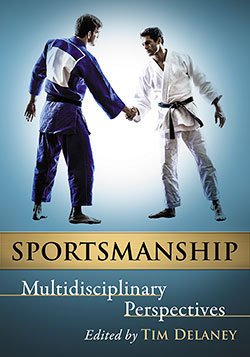
The idea for this cross-cultural, interdisciplinary book originated in Professor Tim Delaney's annual Sportsmanship Day Symposium at SUNY-Oswego. Over years of symposia, he found that the diverse participants defined the word sportsmanship in a variety of ways that often did not fit into his tidy, academic paradigm for the word. Most importantly here, he came to realize that no book was available to teach this diversity. He decided to remedy that deficiency with this book.
Twenty-six scholars from five nations (Ireland, England, Denmark, Canada, US), representing a variety of disciplines, contributed essays. Topics include: Ideals of Sportsmanship Throughout History, Ethics and Character Formation, Leisure and Recreation, Cheating, Doping, Irish Sportsmanship, Sportsmanship Among Brazilian Ju-Jitsu Practitioners, A Coaching Perspective, A Referee's Perspective, Amateurism and Professionalism, Gender and Sportsmanship, Sports Journalism, Commercialization, Sportsmanship in Golf, Race and Sportsmanship, and the Future of Sportsmanship. The editor, Tim Delaney, wrote an introductory article that provides an overall sociological perspective to the collection. And he concludes the book with the last article that discusses "Sportsmanship and the Future."
The 26 scholars all have sports backgrounds of one sort or other, especially playing in their younger years and coaching as they got older. They convey a lot of knowledge garnered through their careers of teaching and research. However, their 26 unique perspectives confront me with the challenge of trying to haze 26 academic dogies that have never been branded. To meet that challenge, I have chosen the round-up as my format. Below is a corral of some of the main points and ideas in the book. I have synthesized a lot of material in them to drive home what the book is about. Following these 15 items, I will point to some more of its features as well as discuss the overall value of this volume:
- The win-at-all-costs mindset typifies societies that value winning very highly. This inevitably fosters poor sportsmanship including the use of PEDs, betting on games, late hits, taunting, taking a dive, illegal contact with the ball.
- Athletic programs can build good character traits in participants if the athletic programs (including the roles of coaches, administrators and parents) are designed to enhance the ethical development of athletes.
- A principal goal of sports should be to develop positive character traits such as fair play, caring, respect, trustworthiness and self-discipline.
- Sportsmanship is linked to cultural standards of morality, norms and values.
- Sports competition at the collegiate level blends the ideals of sportsmanship with an emphasis on winning.
- The NCAA Division III policy on sportsmanship focusses on what sportsmanship is while Division I simply warns against acting badly.
- The story of Lauren Hill, a 19-year-old college basketball player diagnosed with inoperable brain cancer, who played a few seconds in her first and only game before dying a few months later in April, 2015, is used effectively to make a poignant point about sportsmanship. The opposing team, Hiram College, allowed her to score two baskets.
- Drug use has been a part of sports for decades, yet only sanctioned since the 1960s. The book explores the why and who of this evolution in clear, easily teachable language.
- Sportsmanship in sports can and does occur in prisons and jails where over 2 million are incarcerated. In fact, rehabilitation should include a requirement of sportsmanship in athletic programs behind walls. The story of a civilian softball team that played a medium-security prison team underscores this point.
- Aristotle's concept of arête (Greek for excellence), Kant's duty-based ethics, and Nietzsche's agon (struggle) are applied to sport in a clear, compelling way.
- The research on the development of pro-social behaviors through athletic programs is cumulative and ongoing, yielding thus far mixed results.
- Youth sport participants learn by experiencing moral dilemmas that they are encouraged to resolve in a group setting.
- The long-term trend toward organized youth programming away from informal play features privatization of youth sports and the specialization for individual athletes.
- Achievement Goal Theory can be effectively applied to youth in sports competitions.
- Many children have been coached by coaches who have no formal training. This has militated against good moral development.
I hope these 15 points give a good handle on the sort of material this book offers. The writing quality is very good, including the articles that consider philosophies and values. The inclusion of the articles "Irish Sportsmanship and Irish Identity" and "Sparring Norms and Sportsmanship Among Brazilian Ju-Jitsu Practitioners" enhance the cross-cultural offerings. "The Economics of Sportsmanship," "Sportsmanship and Sports Journalism" and "Sportsmanship and Cognitive Psychology" add to the interdisciplinary character of the volume. (CBT or Cognitive Behavioral Therapy has been effectively practiced for decades now. I applaud its appearance in a non-clinical, applied form to the significant social task of inculcating sportsmanship in our young athletes.)
Sportsmanship: Interdisciplinary Perspectives will make an excellent acquisition for public and higher education libraries. Athletes, young and older, should have access to it. As for the most important market, sports-related classes of all types, I highly recommend Sportsmanship. I commend McFarland for publishing this much needed book. It will work well in the classroom.
I teach the Sociology of Sport class at Ashford University in Clinton, Iowa. I would adopt this book for Fall, 2016 except I am retiring in May. That's about as strong an endorsement I can give as, like old professors everywhere, I begin to fade away. I too was once a young athlete, a 12-year old on the Oroville, California All-Star Little League team that advanced to the state championship playoffs in Santa Monica in August, 1957. I know how valuable a good athletic program is for young athletes and their developing values. This book does a fine job of reinforcing that view.
Tim Delaney, Sportsmanship: Multidisciplinary Perspectives (Jefferson, N.C.: McFarland, 2016), 290 pages.
Copyright © 2016 by G. Louis Heath