invincible
Reviewed by Philip Wedge, University of Kansas
4 march 2016 archive
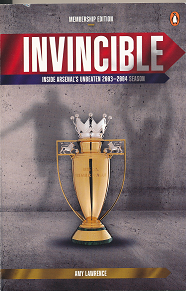
To go unbeaten for a whole season in a professional league is a remarkable feat in any sport. No team has come close in the MLB or NBA. Even in the NFL, only four teams have done it in the regular season, most recently New England in 2007. 23 years after England's Premier League was founded, only the 2003-2004 Arsenal football club played all 38 league matches without a loss (26 wins, 12 draws), thus earning the name "the Invincibles." In fact, Arsenal's unbeaten streak in league matches, including overlapping seasons, reached 49 (May 2003-Oct. 2004), surpassing the record streaks of the NBA LA Lakers (33 in 71-72) and the MLB New York Giants (26 in 1916). It didn't hurt Arsenal that Thierry Henry was having probably his best season as a striker, with 30 league goals, 6th all-time total for a season.
Amy Lawrence's retrospective, Invincible, not only recounts Arsenal's remarkable season, which she covered as a reporter for The Observer, but it also examines the background personalities and events that led to the formation of the Invincible squad and its season, from long-time manager Arsene Wenger's first visit to Highbury in 1989 through the undefeated season and beyond. Invincible is divided into three fairly equal sections (Part I: January 1989-November 2003; Part II: November 2003-April 2004; Part III: April 2004-May 2014), but despite what the dates imply, the book as a whole focuses, as it should, on the incredible accomplishment of 2003-2004, the undefeated season, primarily through interviews with former Arsenal players, coaches and staff.
After Arsenal had won the league in 2001-2002 and before the next season began, Arsene Wenger stated "the ideal target" for 2002-2003 was "an unbeaten season" (iii). That season, not only did Arsenal fail to go unbeaten, but they also failed to repeat as title winners, losing out to Manchester United. And in only their sixth game the following season, Arsenal faced the likelihood of missing out again on Wenger's "perfect season" when they conceded a penalty to, of all teams, defending champion Man United, in stoppage time. But Van Nistelrooy's penalty kick, though striking the crossbar, failed to go in, and Arsenal's invincible season was still a possibility. As Lawrence reflects on that missed penalty,
Who knew at that precise moment when the ball made the woodwork jolt—neither a fraction too high to miss it altogether, nor a fraction too low to skim beneath the goal—the significance would reverberate for days, weeks, months to come? … Nobody knew, because frankly nobody bothered wasting many thoughts on something as outlandish as completing an entire league season with an unblemished record. (8)
I like Lawrence's honest reflection on such moments in the season. The team, after all, was focused on winning trophies, especially the league championship, not on going undefeated, and yet the team's will to win—and lucky bounces such as Van Nistelrooy's missed pen—drove them towards what defender Martin Keown had told Wenger before the season was "the impossible" (iii).
By April 2004, Arsenal remained unbeaten but in a stumbling week had been knocked out of two cup competitions and then found themselves down 2-1 at home against Liverpool. The second half became a pivotal moment for the whole season in terms of winning the league, as Thierry Henry put the Gunners ahead with a phenomenal goal:
When Gilberto flicks the ball to Henry, level with the centre circle, there is an obstacle course of players in front of him. Ten Liverpool players are lined up between him and the goal. Ten opponents waiting, ready to disrupt. Henry revs up. Didi Hamann chases, stretches, tackles thin air and falls over. Henry surges on, into the box. He dummies, this way and that. Jamie Carragher is bamboozled, off balance. Henry sprints on. By now the cavalry have arrived and he has Pires to his left, Ljungberg to his right. His two teammates become decoys as Henry finishes his virtuoso salsa with flourish, bending his shot past Jerzy Dudek. He wheels away screaming. His teammates run after him but he is in his own world and appears not to see them. Inside Highbury a cork is popped, and all around are fizzing, exploding individuals simultaneously letting out so much pent-up tension. (111-112)
As Fever Pitch author Nick Hornby comments, that Henry goal was "the single most important moment of the season" (112). By game's end Henry had completed a hat-trick and Arsenal was driving toward clinching a second championship in three seasons. But even once they'd clinched the championship, could they live up to their gaffer's definition of perfection, an invincible season?
As Lawrence discovers in interviewing the players, they questioned themselves and the significance of never losing, especially after clinching the league. Henry remembers, "the boss coming every morning and saying, 'Guys you are maybe going to be able to do something amazing. …' And we were like, We are champions." To Henry the Invincible season was an "invisible prize" (177). No trophy or medal to be won. Yet ever since Arsenal did accomplish Wenger's definition of perfection, going undefeated, the Invincible team has been resurrected year after year in football commentaries and in Arsenal fan expectations, each team falling short by comparison to the ones who won a golden trophy, perhaps especially because Arsenal has not won another league title since.
Overall, I found Amy Lawrence's Invincible a compelling read, and not just because my Arsenal fandom dates from that era of Henry, Bergkamp and Vieira. With chapters such as "Wengerball" and "The Composer," Lawrence discusses the style of play Arsene Wenger brought to Arsenal, eventually changing the way Premier league football was played; she also reflects on the manager who has outlasted all others of his era and remained at one club while weathering the financial restrictions of replacing Highbury with the state-of-the-art Emirates Stadium. Invincible chronicles a phenomenal undefeated season, but it also reflects on an era under "Professor" Wenger, who even today is in the midst of chasing another championship title for the Arsenal.
Lawrence, Amy. Invincible: Inside Arsenal's Unbeaten 2003-2004 Season (Penguin, 2015).
Copyright © 2016 by Philip Wedge