redskins
Reviewed by G. Louis Heath
19 february 2016 archive
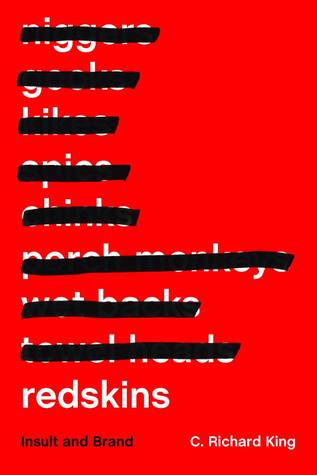
We have here a scholarly book by a professor denouncing the "r-word" (sotto voce, "redskins") as employed by the NFL's D. C. franchise and as deployed as a demeaning vernacular term. I give large kudos to Prof King for a depth and breadth of documentation that are impressive. His book navigates the reams of evidence on an odious NFL moniker increasingly tainted in the public eye. Several newspapers and other media outlets now refuse to even print or speak the r-word. This is progress, says King. I agree.
Since the courts cannot strike down "Redskins" in daily free speech or as a matter of group libel, Native American plaintiffs have relied on wiggle room in the commercial speech statutes that allow for bringing suit in the area of trademarks. In Blackhorse et al. v. Pro Football, Inc., they have recently succeeded (as described by King) in stripping the NFL Redskins of several of its federal trademarks (though the team is appealing). Yet, the team name itself seems to be resilient to lawsuit, thereby restricting future efforts to a conscientization campaign to try to achieve a critical mass of the public to realize that the r-word is a "racial slur." Dr. King's book does a yeoman's job of documenting this campaign to date and prognosticating its future, including a possible end point of terminating the team name but keeping the logo and attendant historic team spirit that crystallized around the historic antics of mascot Chief Zee and the marching band's rendition of "Hail to the Redskins!" as fans painted in "redface," some wearing feathers and under the influence of Mad Dog 20/20 and Everclear, vociferously sang along. This result would be akin to establishing a brand similar to the NHL's Chicago Blackhawks. Not satisfactory, says the author. This is because a minor change in nomenclature does not address historical racism. An NHL game with Chicago as the opponent routinely includes fans who dress as Indians and engage in cartoonish antics dehumanizing to Native Americans.
The progress made so far has come through pressure from Native Americans (including notably, Suzan Shown Harjo, President of the Morning Star Institute, a national Indian rights organization), academics (including especially Prof Charles Springwood of Illinois Wesleyan University) and a range of anti-racist organizations, esp. the National Congress of American Indians (of which Harjo served as Executive Director, 1984-1989). Yet, mirabile dictu, still no change of team name to the Washington Patawomecks, a tribe whose land D.C. is built on. This is because the owners and many Redskins fans simply don't get it. They persist in claiming, some obliviously and innocently, that the r-word honors Indians.
So, why the long-term resistance to desist in using a racial slur? The book explores the question in eleven well researched chapters backed up by 12 pages of notes and a 26-page bibliography (over 18% of the book, excluding the index). The chapter titles include: Origins, Uses, Erasure, Sentiment, Ownership, Opinion, Change, and Ends. The author emphasizes "Redskins" is a slur that objectifies Indians. It is a word that harks back to a practice of taking scalps and bounties. He notes: "The Washington professional football team established its brand in an era at ease with stereotyping and in love with Indian-styled things …" (p. 38). He goes on to cite many current examples of prejudice. To wit, the team's 2014 fund-raising event to raise money for a camp for kids with cancer, titled "Scalp Out Cancer." The event's coordinator, Michael Kennedy, denied "scalp" was an insult, certainly not meant to offend. Hard to believe. But maybe not. Racism is a nuanced, pernicious critter once inside the white skull. And get this: a group of ardent fans, the Extremeskins, organized the event. This and many other examples are adduced to document the cognitive-cum-cultural processes that produce such far-out insensitivity, aka "erasure." (title of Chapter 4)
Prof King points to an underlying problem. The vast majority of Americans don't know about Native American "domestic dependent sovereignty" as spelled out in the 1831 Supreme Court decision, Cherokee Nation v. Georgia. They are unaware of the binding quality of the many treaties that the 566 federally recognized tribes signed, relinquishing most their land for hunting, fishing, and gathering rights on a much reduced land base. This ignorance of U.S. history—a failure extraordinaire of our schools and higher educational institutions!—makes acceptable to the public the naming of an NFL team with a racial slur.
Prof King argues that fans wearing Redskins apparel are unable to see themselves as stooping to racism. In their view, racist behavior is today reserved for a few KKK and neo-Nazis, and is, nevertheless, mostly a figment of the Jim Crow past. Yet, racism, however nuanced and unconscious, is alive and well in Redskins Land. The very r-word depresses Indian self-esteem, impacting aspiration and achievement. The book cites several university studies supporting this assertion.
The Redskins logo is one of the "trophies of conquest" (p. 48) along with much larger ones such as the Mississippi River, Iowa, and Pocahontas County, Iowa as well as myriad Squaw Creeks (a good number have been re-named with neutral appellations) and indigene-linked names for schools and universities. The NFL franchise, "R*dskins," to use Prof King's asterisked euphemism, is but a salient in the long effluvium of anti-Indian slurs in the American lexicon that has washed up as the "erasure of indigenous humanity." (p. 52).
Prof King uses "disappears" as a verb transitive, with Indians as the direct object, the first such use I've encountered in a US context. It is an apt usage. Here "los desaparecidos" are the autochthons made to disappear by the colonial white settler phantasmagoric, febrile imagination, post-Wounded Knee. This twisted process fixes Native Americans in teepees, buckskins and headdresses, frozen in time. For example, Suzan Shown Harjo (Cheyenne and Hodulgee Muscogee), had to leave a Redskins game before even taking a seat, due to the morbid curiosity of fans who persisted in examining her hair and clothes, unconvinced that she was a real Indian (p. 71). At a panel discussion at Illinois Wesleyan University, she later said of that untoward behavior, "It hurt."
C. Richard King, Redskins: Insult and Brand (Lincoln, Nebraska: University of Nebraska Press, 2016), 228 pages. $24.95 U.S.
Copyright © 2016 by G. Louis Heath