the cubs book of rap
Reviewed by Mark D. Noe, Penn College
23 december 2015 archive
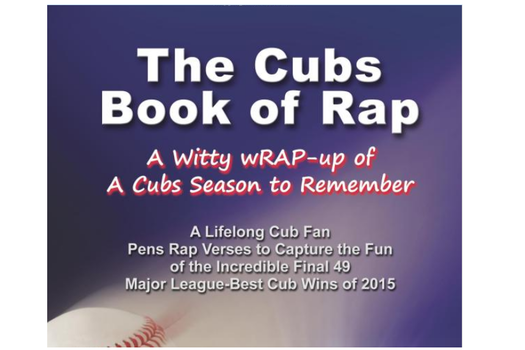
I won't suggest I'm the first person in this organization who should be assigned to critique a book of poetry. That fact, however, doesn't disqualify me from critiquing this … collection. Indeed, Bud Stedronsky makes no pretense to being a poet or to calling this poetry. Though he refers to the material as "'rap' verses," he doesn't even make a strong argument that they qualify as rap. That term here is at best a gimmick. The pieces are merely a vehicle the septuagenarian used to share with his three grandsons his unabashed joy over the turn the Cubs' season made after this year's All-Star break. Stedronsky's knowledge of sport poetry is, in fact, so limited that he claims he selected the term "raps" to identify these writings "because everyone knows that baseball and poetry don't normally go hand in hand." (I do hope the Aethlon poetry editor Ron Smith is secured by a sufficiently stout chain. Sit, Ron!) No, I'm not going to glorify this collection by applying formal literary terms, because they simply don't fit. This is not great poetry. It's not even poetry.
But what this is … is fun. If you're a Cub fan, still reveling in the recent season and dreaming about what might come, reading these 50 verses has to be a pleasant way to recall the season Joe Maddon's crew broke the mold. Stedronsky picks up his task on July 29, the one hundredth game of the season, a game the Cubs won, a game that began a winning streak of six games and fifteen of sixteen in a row and a 45-18 finish to a Wild Card entry into the post-season. Every win that followed, including the Wild Card game and the Division Series games—along with one loss: the day that sealed the Wild Card slot despite a Cub loss—gets its own set of stanzas, from two or three quatrains early on to a full dozen for that final victory over St. Louis in Wrigley Field on October 13.
That very first quatrain in the first rap reads thus: "Jon Lester struck out / fourteen men in eight / A brilliant performance— / his pitching was great." A reader can see where this goes. It's obviously not literary. And yet, four stanzas later, at the end of this first … rap, with the Cubs leading 3-2 and Lester on the bench, we get this: "To save it in the ninth / came Hector Rondón / First time in a month— / would not give 'em a bone." Again, not literature. But it celebrates a big win, for Lester and for Rondón and, yes, for the Cubbies and their fans. And the joy of that win simply compounds, as subsequent wins pile on, wreaking havoc with the league standings.
I feel obliged to address a few technicalities and quote a few example lines. I'll wear the critic's hat first. For instance, let me admit that meter is not the writer's strong suit. Neither is rhyme. The unadulterated happiness blends with occasional—or perhaps more than occasional—problems. Problems, say, with scansion: "With the tying run on / our closer came through / Our fifth win in a row / over Milwaukee's Brew Crew." Or with rhyme: "Oh Starlin Castro / where have you been? / In the lineup today / you drive six runs in." Or even (two for one here) with factual detail (sorry, Kyle) and unfortunate imagery: "Carl Schwarber deserves / our raves and our chants / He homered in the 7th / and I nearly wet my pants." Yes, there can be pain. Serious pain.
I'll put my Cub hat on next, though, as I relish the verses here that celebrate gems. These help to ameliorate the pain. The August 23rd piece opens, "Wrigley was buzzing / with our balls flying out / There were five home runs— / five reasons to shout," and we can recall that power fest over Atlanta. (Though our recollection may not have included the unfortunate double entendre in the second line.) A week later, in Los Angeles, Jake Arrieta threw his no-hitter, and Stedronsky goes so far as to suggest that Jake might have earned himself a new job: "That's seventeen wins / for our great player / Shouldn't we be putting / him up for mayor?" (In retrospect, does any self-respecting Cub fan want to saddle the man with that job?) And in the very last stanza in this rap, concluding the final Division Series win over the Cards, Stedronsky goes even further, perhaps challenging the Fates and jinxing the National League Championship Series in the process, but also saying something we old Cub fans are determined to see become true, whether this season's success can be said to meet the criteria: "I know this for sure / That curse so long carried— / the curse of the billy goat / is now dead and buried!"
Premature? Okay, maybe he speaks too soon. And, again, other stanzas can be painful. But remember—these are the Cubs we're talking about. Pain is no stranger. For those Cub fans among us of a certain age, Cub fans who managed their pain in years gone by with Old Style and Ernie and Vince & Lou on clear-channel AM 720 (back when clear-channel radio had nothing to do with a corporate name), Stedronsky's sets of doggerel are a wonderful way to enjoy again the season that was. And, until Carl Sandburg (or maybe Ryne Sandberg) gets around to giving us his own wrap of the 2015 season in rap, this one will do quite fine, thank you.
Stedronsky, Frank. The Cubs Book of Rap: A Witty wRAP-up of A Cubs Season to Remember. North Barrington, Illinois: CreateSpace Independent Publishing Platform, 2015. 74 pp. $12.95.
Copyright © 2015 by Mark D. Noe