forever red
Reviewed by G. Louis Heath, Ph. D., Sociology Department, Ashford University, Clinton, Iowa
8 october 2015 archive
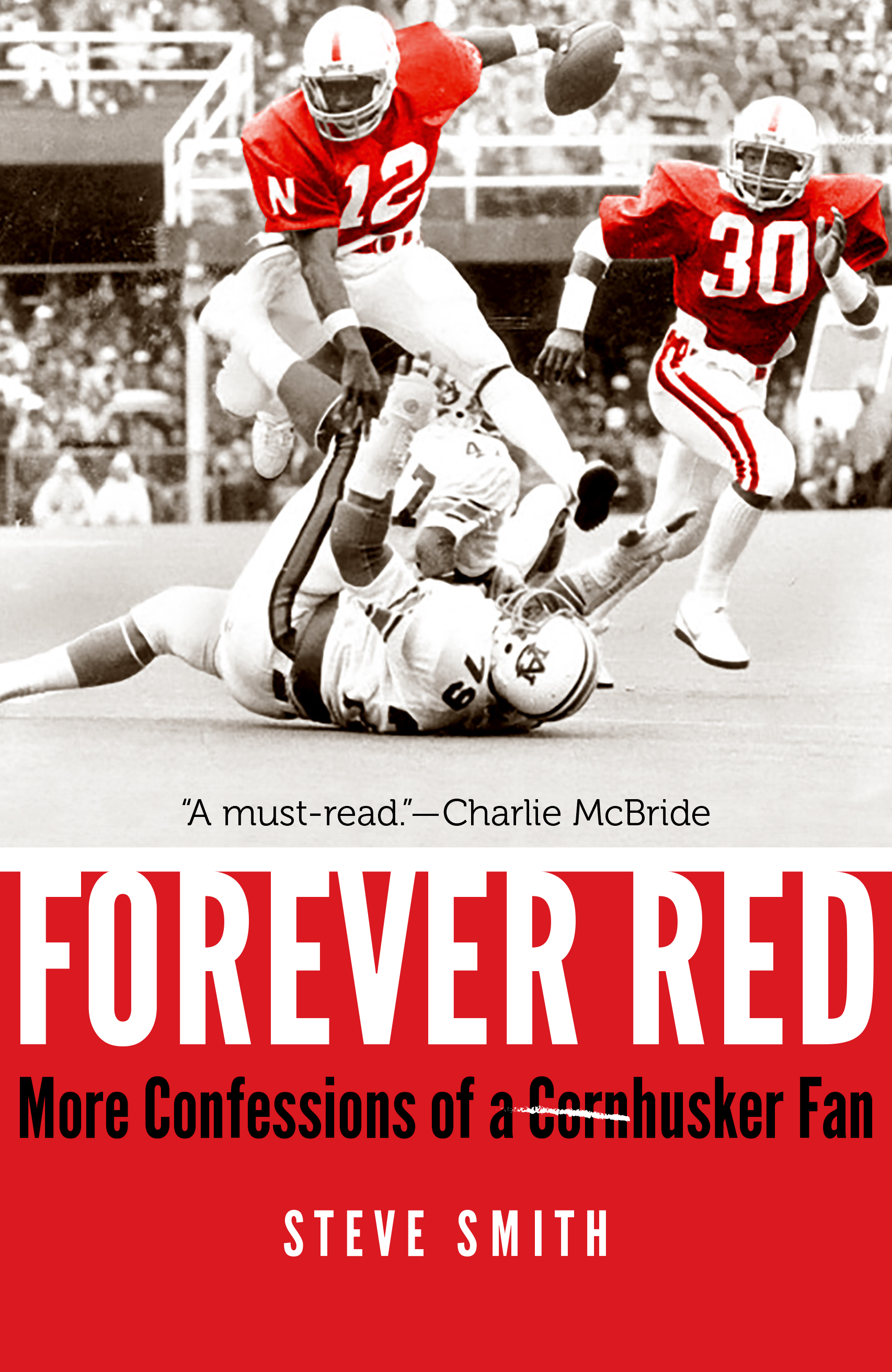
This book is a revised, updated and expanded iteration of the 2005 edition. The author, Steve Smith, is an obsessive fan who perhaps doesn't fit clinically into any category defined in the Diagnostic and Statistical Manual of the American Psychiatric Association but his symptoms may merit consideration. He confesses to liking the Scorsese film, Casino, because the movie's final eight seconds feature, in the blurry background and totally unrelated to the plot, a TV airing a Nebraska game. His obsession began on September 20, 1980 with Big Red's 57-0 defeat of Iowa. Since, he has witnessed many Cornhusker victories, and some losses, and purchased enough jerseys, sweat shirts, commemorative videos and season tickets to strain his family budget.
Though one fan's memoir, the entire book underscores how collectively important the Nebraska football team is to the State's identity and self-esteem. Husker fans from all walks of life anchor a part of their egos in the team. The Big Red roster constitutes their pantheon of helmeted heroes, their demigod warriors. A few, like the author, go beyond this level of passion. For Smith, the 1980s coach, Tom Osborne, was a messiah whose disciples won football games.
The author titles the first section of his book, consisting of 11 short chapters, "Rosalie," after the name of his Nebraska hometown of 200. He recounts the Saturday trips his family took to games at Memorial Stadium, beginning in 1980 when his sister enrolled in the University. His Dad closed his gas station on Highway 77 (a big financial loss) in order to take his family to the games. Those trips incubated Mr. Smith's entry into diehard Cornhusker fandom. Nebraskans who live in the shadow of a solitary grain silo, in hamlets whose only commercial outlets are a bar and gas station (as well as their small town and city counterparts), have found an earnest way to express their sense of rootedness via their flagship university's football team. The fortunes of their team provide grist for wrap-around-porch conversation. Along with the weather and crop reports, Big Red news comprises the lingua franca of Nebraska.
Smith's second section, titled "University," consists of eight short chapters. (As with the entire book, each begins with the score of a Nebraska victory.) This section covers Nebraska football during the author's student years, beginning in 1989. Smith observes that the student section is the least rowdy one in Memorial Stadium on game day. It's the bankers, farmers, housewives, and insurance people who engage in most the obnoxious behavior: They are "busy projecting their unhappiness and worry onto the field" while the students are mostly enjoying themselves.
"Away," the third section of 11 chapters, begins with "Iowegia," of especial interest to this long-time Iowan for its large quantity of derogatory comments about my Hawkeyes. For example: "The Hawks were predestined to be a gridiron ham-n-egger, a middle-of-the-pack plain Jane."
Or behold these two broadsides, written to ignite a border war on the Missouri:
- "Maybe Iowa followers were the type of people you sometimes heard about who stuck with the team through thick and thin—in this case, mostly thin."
- Iowa fans "slip into Hawkeye gear week after week fully knowing your club was as relevant as a hip-hop artist holding a musical instrument." Well, Mr. Smith, today, Saturday, October 3, 2015, Iowa defeated nationally ranked Wisconsin to go 5-0 on the season. And, indeed, we'll be looking to sack Big Red in the near future!
The "Home" section (10 chapters) features the author and his wife returning to Lincoln in 2001 after years away. "We knew we were in Nebraska when we saw no one else our age without children." They attended a game where suddenly, a heavyset man seated nearby, bolted up and "loudly proclaimed to our section he'd seen enough garbage for one day, and headed for the exit, shaking his head." The "garbage" was Nebraska milking the clock in the waning minutes of a game they led 21-7 over TCU.
The reader will find many such folksy anecdotes in this book.
The last section, "Back," offers five chapters extending from page 209 to the end of the book on page 238. This section addresses the fall from football glory that the Nebraska football program has endured since the Tom Osborne heyday. Uneven results have kept Big Red out of "college football's rare air." When the team defeated Arizona 33-0 on December 30, 2009 in the Holiday Bowl (a bowl game that my school, Ashford University, sponsored), the young coach, Bill Callahan, exclaimed, "Nebraska's back!"
But it wasn't back. Unfortunately for Husker fandom, the dominance of the SEC has marginalized their team "on the edges of this southern-fried landscape." However, we continue "to trudge through a generation-long search for a way to re-establish our right to national importance."
Smith concludes: "These days, imperfect though they may be, are still a lot of fun." Which, come to think of it, is what college football is supposed to be about anyway: homo ludens over homo faber.
I highly recommend Forever Red. The writing is crisp and engaging, replete with participant-observer anecdotes redolent of the Nebraska prairie, that speak candidly about the Nebraskan people and the team they cherish. After reading this book, I understand why the author, who now calls Lincoln home, has won awards as a communications professional.
Football fans everywhere will enjoy this book. It is a very good read. Certainly, library patrons should have access to it.
Steve Smith, Forever Red: More Confessions of a Cornhusker Fan (Lincoln, Nebraska: University of Nebraska Press, 2015), 238 pages.
Copyright © 2015 by G. Louis Heath