jackie & campy
Reviewed by Michele Schiavone, Marshall University
1 october 2015 archive
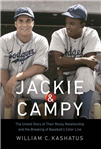
Jackie & Campy, though it goes over familiar ground in the story of the Brooklyn Dodgers, contains enlightening chapters on the relationship between Jackie Robinson and Roy Campanella, which was affected by their radically different ways of responding to racism. Along the way, William Kashatus's examination of the two baseball pioneers reveals some of Robinson's less sterling qualities, which many Robinson scholars gloss over.
Kashatus's Introduction places the stories of Robinson and Campanella in the context of racism and the quest for civil rights. He parallels the athletes' approaches to racism with those of W.E.B. DuBois and Booker T. Washington, the two most significant black leaders after Frederick Douglass. DuBois, who believed that African-Americans should demand their civil rights, and Washington, who advocated a patient, more passive manner, have long personified two main approaches to racism in the United States.
Chapters 1 and 2 deal with the early history of the Dodgers and the decision by Branch Rickey to integrate the Dodgers. Kashatus claims that knowing the history of the Brooklyn team is necessary to our understanding the two players' differences and their effect on the team. However, most readers of this book would likely be well-versed in the building of Ebbets Field, the image of the Dodgers as lovable losers in the 1920s and 30s, and the emotional attachment of Brooklynites to their team, and the connection between the history of the team and the roles of the two black players is not entirely clear.
Chapter 3 recounts the backgrounds of Jackie and Campy. Robinson, who grew up in Pasadena, California, was raised by a single mother and attended UCLA, where he was a star in four sports. Campanella, son of an African-American mother and Italian-American father, grew up in an intact family, and at fifteen was playing professional baseball. For this reader, the details of the family and early years of Campanella were more interesting, mainly because Jackie Robinson's background, while compelling, is so well known. Chapter 4, "Breaking the Color Line," recounts Robinson's minor league experience in Montreal and his first season in Brooklyn.
Chapters 5 through 8, the heart of the book, trace the relationship of Robinson and Campanella from the time they first became teammates, to their conflicts, and finally to their estrangement. How the two players vied as team leaders, differed in their ways of mentoring younger black players, and, of course, how they conducted themselves in the face of racism is truly fascinating. Starting from 1949, when Robinson was given permission to express himself on the field, his manner was fiery and he would not let anything he perceived as racist go unchallenged. Campanella, on the other hand, could "survey a potentially volatile situation and defuse it with a quip and a smile" (p. 57). While Robinson had conflicts with owner O'Malley and sportswriters, Campanella became their favorite, partly due to his talent, but also to his "don't rock the boat" attitude. Even some of the players Robinson mentored thought he went too far; pitcher Don Newcombe, for one, "didn't appreciate Jackie's attitude" (p. 158). In turn, Robinson had no patience with black players who weren't as fiery as he. Kashatus also reports that Robinson could be caustic with younger players he was mentoring.
The epilogue details their life after baseball, which wasn't easy for either of them; both suffered personal and family tragedies. Robinson's son, Jackie Jr., died young and Robinson's diabetes led to blindness; Campanella became paralyzed from a car crash in 1958. Interestingly, Campy came closer to Robinson's view, feeling "disillusionment with the lack of progress in civil rights" (p. 184), and the two men did reconcile in 1964.
The book would have benefited from more editing. In both the dedication and the Acknowledgments, which start the book, Kashatus declares his admiration for two of his history professors, one of whom had encouraged him to pursue a doctorate in history. Thus it was disappointing to read on page 1 the term "Magna Charta" rather than "Carta," and on page 67 Kashatus gives the wrong years for the Philadelphia Athletics' pennant wins. He also misuses the word "penultimate" when he writes "Robinson would later consider the trade [to the Giants] O'Malley's penultimate insult" (p. 175).
Despite these quibbles, however, Kashatus' focus on Robinson and Campanella, their relationship and differing points of view, makes for a fascinating story.
William C. Kashatus. Jackie & Campy: The Untold Story of Their Rocky Relationship and the Breaking of Baseball's Color Line. Lincoln: U of Nebraska P, 2014. 234 pp. Notes, Bibliography, Illustrations, Index.
Copyright © 2015 by Michele Schiavone