mashi
Reviewed by Richard C. Crepeau, University of Central Florida
14 september 2015 archive
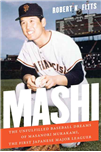
This is not the first venture by Robert K. Fitts into Japanese baseball, and particularly into the relationship between Japanese and American baseball. The hope is that it will not be his last. Fitts' award winning 2012 publication, Banzai Babe Ruth, told the fascinating story of the 1934 Major League baseball tour of Japan with all of the intrigue and diplomacy surrounding this high profile international venture.
In Mashi, Fitts has jumped forward three decades to tell the story of Masanori Murakami, the first Japanese player to reach the major leagues in the United States. As in his earlier work Fitts brings his knowledge of Japanese culture and Japanese baseball culture, his sharp writing skills, and his diligent research to the project. The result is another entertaining and instructive piece of baseball history.
In many ways this is Mashi's story. Fitts follows him from childhood to his post-American experience. Mashi's relationship with his father is a difficult one and Fitts details the way in which Mashi navigated that relationship to overcome his father's strong opposition to his son's baseball ambitions and desire to play in the United States major leagues.
Fitts explains the pressures on Murakami as he navigates between the traditions of Japanese culture, and his own ambitions. Murakami had strong loyalties and obligations to his Japanese team and especially his coach. These put limits on Murakami's desires and ambitions as he remained faithful to his cultural roots. Fitts is able to not only explain these cultural forces acting on Mashi, but explores the nuances of human behavior and motivation that shaped Mashi's life.
As with anyone who moves from one culture to another, and especially for someone unable to speak the language of their new home, Murakami faced any number of difficulties in his day to day life. As a major league baseball player, and as the first Japanese player in the majors, this young man faced the demands of the press in a language he did not speak without much help from an interpreter. When he was first called up to the majors from Fresno Murakami was given a plane ticket and sent off on his own for the airport. He had to navigate a plane change in Los Angeles, fly to New York alone, was not met at the airport, had to get to the team hotel, and on arriving there he found no room reservations existed for him. Welcome to the big leagues where players are pampered and all of their desires are fulfilled!
All of this may seem more than a bit insensitive by today's standards, but Mashi's perils were nearly identical with those of Latin players. Ordering food when eating out was a formidable task, relating to teammates was not easy, and of course the problem of loneliness born of isolation could add to the difficulties. Taking instruction or direction from coaches and fellow players was often problematic.
For the most part Mashi did not seem to have been the victim of harassment and he got on very well with teammates, many of whom came to love him for his easy going ways and pleasant personality. In San Francisco, as indeed in Fresno, Mashi was embraced by the Japanese American community and that eased his cultural adjustment.
On field performance is of course the ultimate test and with some exceptions, often caused by pain in his elbow or shoulder, his pitching was of a high quality. From the beginning the fans in Fresno and San Francisco embraced him. Still and all it was a difficult life, made more so by the controversy that developed over his contracts with the Giants, with the Hawks in Japan, and between the Giants and the Hawks. For Mashi these conflicts were complicated further by the cultural norms in Japan and his loyalty to them.
The confusion over contracts layered with cultural misperceptions on the part of both Japanese and American baseball executives is quite interesting and instructive. The Giants assumed that Mashi was their property if they wanted him, and that the reserve clause applied in his case. The Japanese viewed things quite differently. Mashi was caught in the middle. This offers a contrast with the current "Posting system" of bidding for the right to negotiate before any negotiations take place with the player.
In the end this is a an excellent baseball story, a story of cultural adaptation and conflict, and above all the story of one man's opportunity and the obstacles he overcame to make the most of that opportunity. It is however also the story of the unfulfilled dreams of a major league career cut short, but still a life fulfilled by loyalty to ones values and family.
And it is a good read.
Robert K. Fitts, Mashi: The Unfulfilled Baseball Dreams of Masanori Murakami,The First Japanese Major Leaguer (Lincoln and London: University of Nebraska Press, 2014), 256 pages, $28.95, hardcover.
Copyright © 2015 by Richard C. Crepeau