facing america's team
Reviewed by Tim Morris, University of Texas at Arlington
22 august 2015 archive
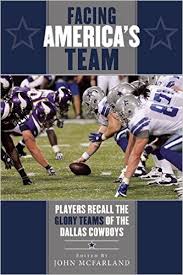
John McFarland's Facing America's Team was on offer for review to the entire Sport Literature Association for weeks on end with no takers. It is just possible that the Dallas Cowboys are not America's Team after all. They are my team, and the team of a few million other North Texans, but they occupy a specially despised place in American sports culture alongside the New York Yankees and the Boston Celtics. They're worse than the New England Patriots; the Patriots are merely reprehensible, but the Cowboys are completely insufferable.
So it's fitting that there should be a book about people trying to beat the Thanksgiving stuffing out of the Cowboys. John McFarland's book was thrust upon me as retribution for my obnoxious Cowboys fandom. And I loved it! It's a simple, unassuming volume. The observations that McFarland collects from 78 men who played against several generations of Cowboys are not always couched in deathless prose. To be honest, they are occasionally generic and frequently uninformative. But you can skip those entries and linger on the energetic and quirky bits of oral history that make up the bulk of the book. I got laughs and I learned things from Facing America's Team, and what more do you want from August reading in Texas?
Any collection of memories from aging ballplayers is going to contain a certain percentage of invitations to leave the speakers' lawns. "Today, pass blocking is so different," says Hall of Fame offensive lineman Tom Mack:
You're basically being paid to grab the guy and pull him to you, like a Sumo wrestler. They reach out and grab the defender and it looks like two guys dancing.Claude Humphrey, another Cantonite, opines that back when, "unlike today, guys weren't so overweight that in the fourth quarter they couldn't play."
Sometimes this retrospective bravado verges on insensitiveness. Joe Theismann, the Washington quarterback who is the book's snarkiest observer, says "We practiced hitting, which is contrary to the philosophy today." Joe, that's no longer considered a thing to boast about. In fact, several of the veterans remark with rueful horror on the violence that characterized the game in the 1960s and '70s. Mere blocking and tackling was not considered productive enough of concussions; line play BITD seems to have consisted of repeated slaps to the head.
Violent as it is, American football is also a complex intellectual exercise. (Although Mark Collins remarks that "football is not a chess match. It's a game of checkers, because the moves come quick.") The players in Facing America's Team speak of the intelligence of their opponents: Bob Lilly, Mel Renfro, Ed Jones. Smarts distinguished the great skill players on the three-time champions of the 1990s: Emmit Smith, Troy Aikman, and Michael Irvin were physically gifted, of course, but also unusually thoughtful checkers players.
That was the team that Jimmy Johnson assembled just after I arrived in Texas, and it remains my favorite; I will admit that I was a latecomer and grew up (in Chicago and later near Philadelphia) not liking the Tom Landry Cowboys very much. It's fashionable in online sports talk to run down Troy Aikman as a mediocre quarterback who just happened to luck into the best teammates ever. He did have the best teammates ever, but the comments that McFarland selects greatly respect Aikman's precise play. It may have looked easy to throw that same little pass to Jay Novacek over and over and over for the identical eleven yards every time, but the guys who played against Aikman agree that it sort of wasn't.
One staple of reflective books about football is that line play is a lot more interesting than events in the open field. The most personal commentary comes from linemen and linebackers who conducted personal duels with individual opponents on every play. Bill Lueck and Conrad Dobler, offensive guards of the early era, offer sharp insights into their duels with Lilly and linebackers Lee Roy Jordan and Chuck Howley. By contrast, the defenders that McFarland interviews don't have much to say about Roger Staubach. Unlike Aikman, defenders rarely touched Staubach, and seem to have thought of him as an ethereal visitor from a higher realm. Staubach has the same public profile in Dallas today.
Facing America's Team is very well-produced. Without intruding on the voices, John McFarland is careful to let the reader know exactly who's speaking, and offers just the right amount of context for their memories. The patchwork of commentary is very skillfully sewn.
It's odd, of course, that a book about the Cowboys lets us hear from none of the Cowboys. If you want oral history from the Dallas side themselves, get Peter Golenbock's Cowboys Have Always Been My Heroes, a massive, rueful, hilarious collection. Facing America's Team is less substantial and much milder in tone, except for the remarkably bitter Joe Theismann.
They were great athletes, but they had these shiny little pants. You know, they just irritated you. It's like the kid that pulled up with the sweater that was tied around his neck when you were in high school. We truly did not like them. They didn't like us. I didn't play golf with Roger Staubach in the off-season. There was absolutely no love lost.That's my 'boys.
McFarland, John, ed. Facing America's Team: Players Recall the Glory Years of the Dallas Cowboys. New York: Sports Publishing [Skyhorse], 2015. 236 pp. Hardcover, $24.99.
Copyright © 2015 by Tim Morris