not a game
Reviewed by Brian Burmeister, Program Chair of English and Communication, Ashford University
18 august 2015 archive
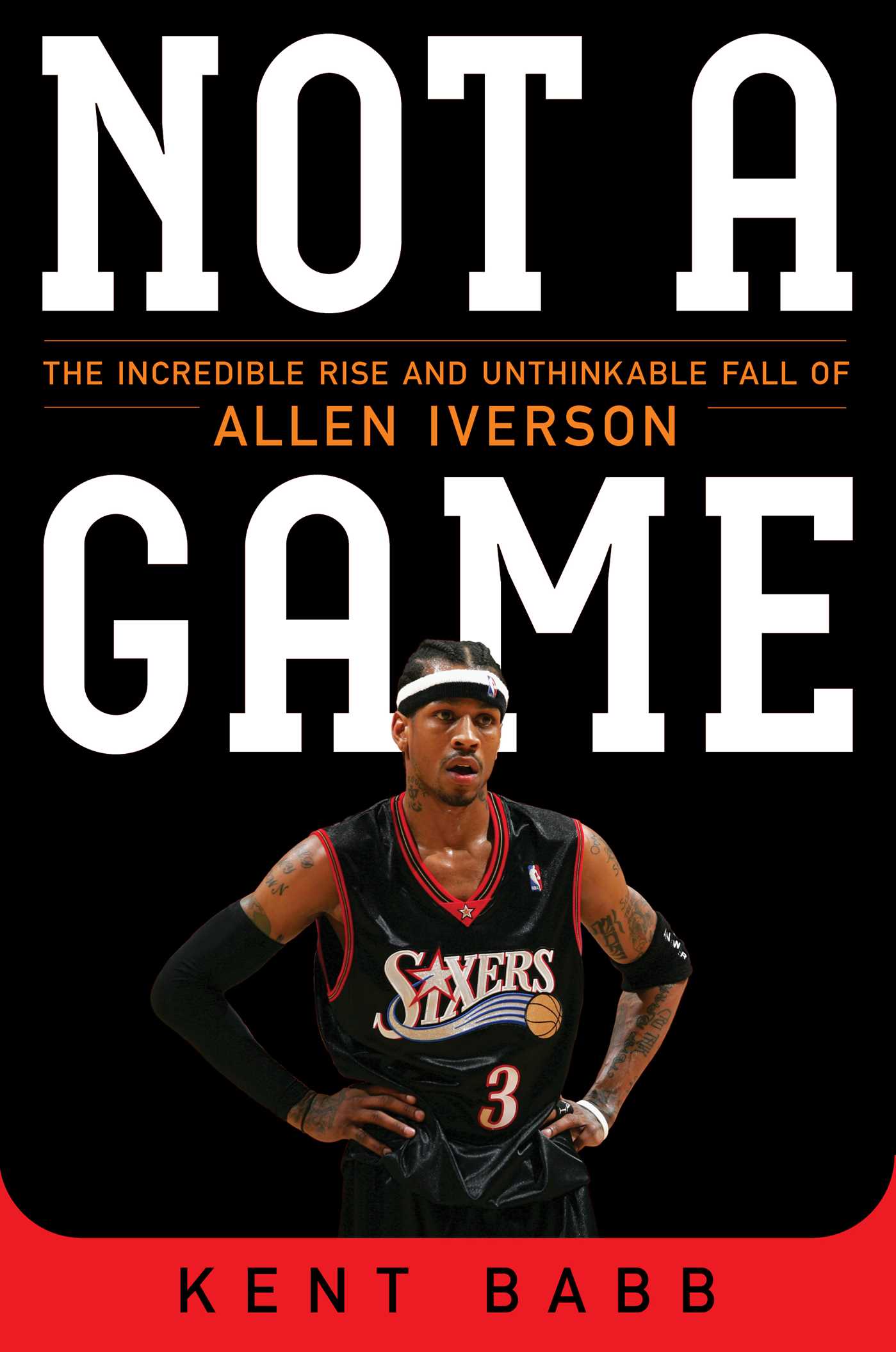
Five years after his final NBA game, Allen Iverson's legacy endures. One of the most exciting basketball players or his or any other era, the former league MVP impacted the way players play, the way players look, and what we think of when we hear the word "practice."
In Not a Game: The Incredible Rise and Unthinkable Fall of Allen Iverson, Washington Post sports writer Kent Babb explores this legacy, as well as Iverson's often troubled, always complicated private life.
Drawn from several hundred pages of court records, hundreds of news accounts, and over one hundred on-the-record interviews, the book ambitiously covers Iverson's life over more than two decades. From the infamous bowling alley brawl in Hampton, Virginia that ignited racial tensions in his home-town and for which Iverson would spend four-months in prison to the courtroom drama of Iverson's 2013 divorce from his high-school sweetheart and mother of their five children, Tawanna, Not a Game presents Iverson as a sometimes sympathetic, sometimes frustrating man who had it all, but seemed determined to throw it all away.
This dual-nature of Iverson is truly at the center of the book's message. From a very young age, Iverson was an almost unfathomably talented athlete. As a high-school junior, he was widely considered the best high school basketball player in the nation while simultaneously being considered one of the nation's best high school football players. Despite his on-the-court, on-the-field successes, Iverson's personal life was problematic: he had no father in his life, a mother who would party all hours of the night, leaving Allen to watch his younger siblings well into the mornings, often forcing him to miss part of school, all the while living in an unsafe community in which he would see eight of his friends die in the span of one summer. But legitimate difficulties lead to the creation of damaging behaviors. In one year of high school, Iverson would miss 69 days of school, as well as many practices, and when he would show up, he would almost always arrive late. These patterns of behavior would not be something Iverson would grow out of, never truly deterring from them during the next twenty years, becoming an annoyance for each of his coaches, and even making his dismissiveness of the merits of practice an unforgettable part of his legacy.
Iverson's rise to NBA superstardom came quickly, playing only two years of college basketball at Georgetown before being selected number one in the 1996 NBA draft. His impact on the league was immediate: averaging over 23 points a game his rookie season, as well as famously crossing over Michael Jordan on his way to nailing a jump shot. It was also during his first year in the league that Iverson began to influence style and fashion as much as he did the game of basketball. During All-Star Weekend's rookie challenge, Iverson debuted the cornrows that would become forever associated with his image and further propel him as a celebrity. As Babb writes, "In the late 1990s, America was undergoing an interesting cultural shift. Its heroes were no longer men who wore ties and obeyed the rules." The cornrows were the first of many style choices that would separate Iverson from the clean-cut image set forth by the Michael Jordans and Magic Johnsons of the world. With Iverson's cornrows also came tattoos, then more tattoos. Through it all, Iverson became a style icon. "He wore oversized white T-shirts and held up his sagging pants, just like they did on the streets of every city in America. Several thick chains bounced as he walked, and he mumbled and cursed during interviews and news conferences."
This image would in turn shape Iverson's lifestyle, and the young, highly praised, highly compensated basketball player began to live like a hip-hop star, partying almost every night and spending money as though it were an infinite resource. Mansions, cars, and jewelry, Iverson bought it all. Everywhere he went he would arrive with a large entourage, and he was always happy to cover the bills. Everywhere. Every time.
But as much money as Iverson was making, the spending always seemed to outpace it. Even when he was still making millions of dollars each year, Iverson would fail to honor all of his debts, and would be forced to sell the family's home at auction, jewelry he had bought his wife, and memorabilia he had collected and stockpiled in a storage facility (because he failed to pay the rental fees.) Yet, money was hardly the worst of his troubles.
Over the span of years, Iverson's relationship with his wife was filled with turmoil. Accentuated by a severe alcohol addiction he developed after entering the NBA, Iverson had a track record of being a disinterested, absent father to their children. As a husband, he was distrustful and abusive. His and Tawanna's love-hate relationship was perpetuated because he would make "promises, usually believing that things would be different, before he grew too comfortable and paranoid and destructive, leading to yet another explosion." He would constantly accuse Tawanna of cheating on him, the arguments sometimes escalating to the point of him threatening her. Her life was only worth $5,000, she would testify in their divorce proceedings was something he had told her on multiple occasions, for that was how much it would cost him to hire someone to end it.
This dark side of Iverson is scary to read about. Fueled by jealousy, a lifetime in which he was rarely held accountable for his actions, and a crippling alcohol addiction, Iverson's life quickly unraveled.
As his marriage was ending, so to was his playing career. An aging Iverson with little motivation to train, a well-known, well-deserved reputation as a distraction and nuisance, who still believed he was worth top-dollar and a starting position, was a hard sell for any NBA team to want to sign to a contract. At the not-so-old age of 34, Iverson, the former MVP and four-time scoring champion, was no longer welcome in the league.
As a long-time fan of Iverson the basketball player, learning more about Iverson the man makes for unhappy, but incredibly fascinating reading. Iverson's story, the rise of a young man from a bad situation to the highest of successes, and his ultimate fall from those heights is both confusing and unsettling. One cannot read the book and not think: Didn't he know how good he had it? Why couldn't he just put forth a little more effort in his career and with his family? Yet, despite all of Iverson's exposed faults, Not a Game does not read like a hit piece. Babb successfully balances Iverson's undeniable talent, charisma, and softer side with the gritty reality of his destructive behaviors and the problems he often made for himself. As Babb writes in his epilogue, "The point was not that he was one or the other: a friend or a headache, a caring family man or an overgrown child without regard for responsibility, an astonishing success or a man who lost it all. He was both." And that reality is what makes Iverson's story in Not a Game such a compelling read.
Babb, Kent. Not a Game: The Incredible Rise and Unthinkable Fall of Allen Iverson. New York: Atria Books, 2015. 311 pp. Hardcover, $26.00.
Copyright © 2015 by Brian Burmeister