a game of their own
Reviewed by Ellyn Bartges, Ph.D., St. Cloud State University
26 july 2015 archive
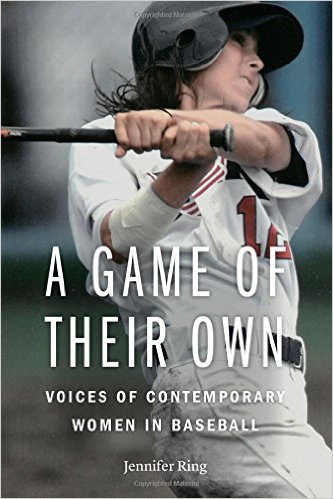
Dr. Jennifer Ring is a political science professor at the University of Nevada Reno with a successful history of writing about baseball (Stolen Bases: Why American Girls Don't Play Baseball, University of Illinois Press, 2009), and how women have been summarily shut out of the game. Her summary of the 14th and 15th Amendments and how the combined legal structure of Reconstruction, the 1964 Civil Rights Act, Title IV, Title VII and ultimately Title IX all play into the historical context of why this book needs written. The book is more personal, if not cathartic for her than her previous work for several reasons. Ring states in the acknowledgments, the "Book is a work of love." (xvii) She is very close to her topic, the USA Baseball Women's National Team (BWNT), so close one of the women on the 2010 BWNT is her daughter Lilly Jacobson. Lilly played on the 2006, 2008, and 2010 BWNT. Lilly's story is very similar to the other women's tales with two exceptions; being the daughter of the author and having to deal with the unexpected loss of her father during her freshman year in college at Vassar making Mom the primary emotional support and encouragement for continuing in baseball. This must have been difficult, but Dr. Ring pulls the work off without overtly focusing on her daughter. The collection of oral histories leading to the creation of this book were honored with enshrinement in the Major League Baseball Hall of Fame in Cooperstown. This recognition is quite an accomplishment.
Methodology involved choosing the best ten players, one from each position on the field (9), a relief pitcher, and a player who was not on the 2010 team but had played with her daughter Lilly on the 2006 and 2008 teams, who was interviewed by Lilly Jacobson, creating the only teammate-to-teammate interview in the collection. The interview was to focus on their journey through baseball and for their "Established athletic excellence on Team USA." (xii) Additionally, Dr. Ring sets the historical context for the work, determines how to access players spread across the United States (she interviewed geographically), and the organization of the stories making each interview a separate chapter. The last three chapters are important in what they tell us from the coaching perspective and for the potential future of women's baseball in the United States. The appendices include a list of the questions asked of each interviewee and rosters of past and current USA Baseball Women's National Teams. Clearly Dr. Ring understands the value of asking follow-up questions, thereby bringing more out of some of the interviewees and thus more depth to their stories. There is a useful suggested readings list, which is appreciated as a means of measuring depth in sport research and potentially knowledge of the culture of sport and athletics that many writers lack first-hand experience in or exposure to. One negative from my perspective is the endnotes. I hate endnotes, I am a footnote addict. I like to see the sources and comments right when I am reading something, but I understand not all disciplines use Chicago Manual of Style.
Through oral histories, the book documents the stories of the 2010 USA Baseball Women's National Team. While I was aware of the USA BWNT, I was hard pressed to think of the last time I heard of them in the national media. I ascertained it was more than twenty years ago in the spring of 1994 when I learned about the Colorado Silver Bullets women's baseball team that was touring the Southeastern United States. They were coached by former major leaguer Phil Niekro who was a feared knuckleball pitcher for Atlanta for many seasons and a certain future Hall of Famer. I was excited to take the Division 1 softball team I coached to a game to illustrate the scope of opportunities expanding for female athletes. This was a rare chance to see professional female athletes who weren't golfers, or tennis players; maybe they could provide motivation to our team? The game was interesting … if you like baseball. Several of our players had stories of their own Little League experience, which was the first time I'd heard anything about them playing in Little League. As Dr. Ring consistently points out in the book, the assumption that softball players are interested in baseball or that girl baseball players are interested in softball are specious arguments. She also introduces an interesting concept on the topic, postulating softball is perceived as a more "Obedient game, you do what you are told" than baseball (116). Therefore, baseball purists and gatekeepers view softball as more suitable for girls and women than baseball, a game with a "culture of thinking and independence of the athlete." (117)
The interview sample size consists of eleven players, a relatively small sample, but all of them noted obstacles in staying in baseball. Major issues include the ability to access travel teams, coaching, training facilities and competitive schedules which are rarely available past the age of twelve or thirteen when Little League players move up to Babe Ruth League. The move from Little League to Babe Ruth League is the point the physical playing field is expanded, made larger and more to scale of the college and professional games, causing most teenage girls and many similarly situated teenaged boys to drop out of baseball and pursue other sports. One of the most consistent themes in the book is how young girls, even with access to Little League experiences, are mostly doomed to very short baseball careers for a variety of reasons. Gender identity (not sexual identity), isolation, pressure to conform to softball, the exclusive nature of baseball, lack of playing opportunities and plain ignorance are all part of the equation at some point.
For girls the intensity of pressure is increased to drop out at the Babe Ruth level because of the existence of softball. Reading the transitional stories of a group of interviewees who either made the choice to switch or decided they had no desire to be forced out of developmental, competitive baseball, I was left wondering if the Phenom pitcher of the 2014 Little League World Series (LLWS), Mo'ne Davis would fall prey to this barrier as well. Post LLWS when Davis was the media darling for a few weeks (which she handled very, very well and with grace), she articulated an uncertainty about pursuing baseball, to the point I saw her at a WNBA Lynx game in Minneapolis that September where when asked what her future held, she boldly stated that she wanted to earn a basketball scholarship to perennial powerhouse Connecticut. No mention of playing baseball for the Huskies though. Perhaps she has already read the tea leaves?
As a first-hand witness to the challenges girls and women face remaining in the sport, not succumbing to the pressure to drop baseball and adopt softball instead, Ring constructs a tight framework through the outline of her questions and then using a rather simple way of sifting the experiences of the players into three categories: Veterans, Softball and Baseball players, and Baseball Girls, all of whom recounted stories Ring wove into her premise of sex segregation and inequality promulgated through baseball. It is in the final portions of the book her background in political science became clearly evident and the established scholar takes over. The earlier chapters in the book are the voices of the subjects, not the author although she does control some of the tone through the questions she asks. Like any oral history, the author can't predict where the subject goes with their response. She can only set the table.
All books need to come to a conclusion and this one does so neatly in Part 5 titled Gender-Segregation, Equality, and Women's Baseball. Comprised of three chapters – America's Team, Grassroots Women's Baseball, and USA Baseball – these chapters create and give voice to problems; coaches and organization; and future of the sport. Jim Glennie, who is referred to throughout the book, and "Acted as a clearing house for little girls who wanted to play baseball" (275) is finally interviewed and provides a creation story of sorts, as well as witness to his eventual realization he was no longer needed or wanted by USA Baseball. He and the author are critical of how the National Women's Team is treated and ignored. They find the treatment contrary to the United States Baseball Federations role as the National Governing Body (NGB) of baseball since 1978 when the Amateur Sports Act was passed (293), "As outlined in their constitution and bylaws is to develop, foster, and encourage interest and participation in baseball throughout the United States … to provide equitable support and encouragement for participation by women where separate programs for men and women athletics are conducted on a National or International basis." (294) Reading the previous 293 pages will illustrate this is not an accomplishment of the organization and while "Funding, recognition, and some stability has been achieved recently, there has been a concurrent loss of autonomy and leadership" which Dr. Ring characterizes as a "loss of soul and direction." (297).
I found the book very readable and I had no trouble believing or understanding the accounts of the interviewees. I appreciated the historical contexts as well as some of the legal framework discussed in later chapters. I found the author naive several times, especially when she talked about the resources available to Division 1 athletes at major institutions and how youth sports works or does not work for grooming athletes for scholarships. Her statement about the interview group all receiving some sort of athletic or academic scholarship money could be misleading to those not familiar with higher education in general and athletics in particular in my view. The study group of athletes is obviously highly skilled and select athletes, so in this day and age of public focus on high tuition rates, it is much more common for students to be awarded various monetary amounts in terms of scholarships. This is done to entice them to attend and pay the rest of the tuition costs on their own, through financial aid, work study, or their parents' accounts while still being able to say they are on a scholarship.
I would recommend the book to those interested in baseball, sport history, gender and women's studies but also to those who are interested in culture and sociology and how one sport in particular which could easily be open to girls and boys, has managed to discriminate against girls and women for decades through tight control, culture, and legacy. Even after the passage of Title IX, designed to provide access to, benefits of and participation in educational activities, baseball continues to sex segregate by providing a simple, consistent message to girls to "Get out" (144). As Sarah Gascon, one of the interviewees stated when asked what she wanted to be when she grew up, responded, "An athlete." She was told, "You can't do that." To which she asked, "Why not." The answer? "Because girls aren't athletes, only boys are."(138) This sends a pretty powerful message to those less decided on which sport they wish to play.
A Game of Their Own: Voices of Contemporary Women in Baseball by Jennifer Ring. University of Nebraska Press, 2015. 353 pages with illustrations, appendices, end notes, suggested readings and index.
Copyright © 2015 by Ellyn Bartges