marvin miller
Reviewed by Bob Epling
6 june 2015 archive
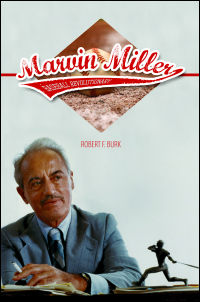
More than any American sport, baseball lends itself to historical debate and contemplation. When such musings arise regarding the most influential people in the game's history, Marvin Miller belongs in the opening argument. As executive director of the Major League Baseball Players Association from 1966 to 1982, Miller transformed a lethargic and insignificant union into arguably the most powerful and successful labor organization in the world. He did so as an insurgent, dragging an entrenched and stubborn industry away from its 19th century employment attitudes into a modern era of tremendous prosperity for players and club owners alike.
Robert F. Burk divides Marvin Miller: Baseball Revolutionaryinto three parts. The first chronicles Miller's youth in depression-era Brooklyn, through World War II and post-war stints in government positions and union leadership roles, to the eve of his ascension to lead the MLBPA. The second traces Miller's assault on baseball's old guard during his time as executive director. The third follows Miller into his advancing years as a preeminent – if sometimes cantankerous – elder statesman, defender of the faith for the rights of the players, and guardian of his own legacy. Burk displays exceptional command of all three segments of Miller's life, with the early and late periods likely providing serious students of baseball the most new insights. The entire book is terrific, with exemplary sourcing, an engaging style, and consistently meaningful material.
Miller arrived as MLBPA executive director fully, and perhaps uniquely, qualified for the job. He grew up a baseball fan and sports fanatic, overcoming a withered right arm to participate vigorously in neighborhood games and contests as a boy. The physical disability resulted from Miller's birth, when the delivering physician wrenched the baby's right shoulder, causing permanent nerve damage. As an adult, Miller became an excellent tennis player, a pursuit he enjoyed well into old-age. While a love of sport in general, and baseball in particular, provided Miller an admirable aptitude for his eventual position, his professional experiences prepared him specifically for future labor battles.
After bouncing around from job to job a bit in the early 1940s, Miller found his footing and his calling with the War Labor Board, first as a researcher and then as a hearings officer responsible for adjudicating disputes between labor and industry representatives from a variety of fields. The experience suited Miller, who possessed a deep and quick intellect, a calm demeanor, and a sense of open honesty usually recognized by opponents on both sides of labor-industry conflicts. Hearing both sides of a problem left Miller steeped in the nuances and policies of such clashes, training that would serve him well a couple of decades later.
Miller's own sentiments leaned strongly to labor. He and wife Terry tended nearly toward radicalism at times in their younger years, supporting the Henry Wallace campaign for president in 1948, and at least mildly sympathizing with communist doctrine. When the nation lurched rightward after WWII, Miller left the federal government and joined the labor movement. He eventually landed at the powerful United Steelworkers of America (USWA) union in 1950, where he stayed until landing the MLBPA post in 1966, working his way to national prominence as a union spokesperson and key member of various negotiating committees. Burk exhibits a thorough and comfortable grasp of business and labor issues in the section of the book, clearly demonstrating the formative influence of Miller's time with USWA. The lessons Miller learned battling the management of big steel would soon pay huge dividends for major league baseball players.
When Marvin Miller took over as executive director of the MLBPA in 1966, the average annual player salary was around $19,000 and the baseball industry's revenue was $50 million. Player pensions were pitiful or non-existent. Club owners kept players bound to their teams into perpetuity (or until the owners traded or released them) due to an interpretation of a standard reserve clause in all contracts that allowed franchises to control the contract rights of players even after said contracts expired. The owners treated players paternalistically, often well-meaning but always in a controlling (and frequently in a condescending) fashion.
By the time of Miller's death in 2012, the average annual salary topped $3 million and baseball generated more than $7 billion. Players enjoyed (and continue to enjoy) the most lucrative pension and health insurance benefits among workers in any union anywhere. Most famously, players gained the freedom to explore their value on the open market via free agency. While some owners still showed disdain for the MLBPA on occasion after Miller's retirement, since 1982 baseball management and labor have faced each other on relatively even terms when collaborating on (or contesting) collective bargaining agreements.
Marvin Miller coerced those gains for the players. Others played roles, but Miller deserves recognition as the driving force. Burk rightly shows how Miller and the MLBPA achieved such accomplishments through relentless pressure, relatively steadfast solidarity during strikes and strife, shrewd negotiating, and simply being right on the biggest issues. It also helped that Miller was smarter than most of his counterparts. He realized these changes were not only good for his union members, but good for the sport of baseball as a whole.
In retirement, Miller remained a champion of the players, even when his positions landed him on the wrong side of public opinion and the tides of contemporary controversies. Burk obviously admires Miller, but shows commendable balance in pointing out the former executive director's questionable stances and comments on topics ranging from performance-enhancing drugs to drug testing to Pete Rose to Miller's surly and somewhat mean-spirited remarks toward former adversaries (most notably Bart Giamatti). Still, Miller's consistency and beliefs never waned.
Burk provides ample discussion near the end of the book on the inexcusable absence of Marvin Miller from the Baseball Hall of Fame. Miller got within one vote of election in 2011, but his prospects for election appear dim (he will not be eligible again until the 2017 voting cycle). While the slight stung Miller considerably, the old labor warhorse remained feisty until the very end of his 95 years, commenting in July of 2012 on the most recent Hall snub in typical acerbic fashion, "considering who runs the place, not being part of it gives me credibility as a union leader."
Whether he ever gets into the Hall of Fame, Marvin Miller revolutionized the business of sport. Along with Jackie Robinson and Branch Rickey, Kenesaw Mountain Landis and Babe Ruth, Miller belongs among the handful of true baseball immortals. No one transformed the national pastime more significantly. Robert F. Burk provides a book worthy of its subject.
Robert F. Burk. Marvin Miller: Baseball Revolutionary. University of Illinois Press: Urbana, Chicago, and Springfield, 2015. 352 pp; Preface;
Acknowledgements; 16 Black and White Photographs; Notes; Selected
Bibliography; Index; $35.00 (hardcover)
Copyright © 2015 by Bob Epling