my fight / your fight
Reviewed by Brian Burmeister, Ashford University
4 june 2015 archive
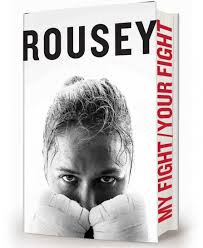
Recently named Sports Illustrated's most dominant athlete in the world, Ronda Rousey, the Ultimate Fighting Championship's women's bantamweight champion, has quite the story to tell and message to share in her autobiography, My Fight/Your Fight.
The book chronicles the challenges Rousey has faced and overcome personally and athletically. Throughout each of its chapters, My Fight/Your Fight aims to inspire readers to set high goals, persevere, and know that with enough determination success can always be attained. If you're looking for an exercise manual or a guide on how to be a mixed martial arts (MMA) fighter, you won't find that here. Instead, you'll find a book that hopes to make you think about your own goals and motivates you to achieve them, even when faced with difficult challenges.
While the inspirational message at the core of My Fight/Your Fight is a great one, the book itself is not for everyone. Banned from Wal-Mart stores nationwide, Rousey's language is frequently explicit, she speaks openly of her hatred of other fighters, and she appears to advocate violence against bullies. Additionally, while the stories of overcoming adversity are relatable, her level of determination is most certainly not: at one point she writes that she would rather be dead or paralyzed than lose a fight. One will either find Rousey's drive for success to be admirable or foolish. I found it refreshing.
From the very first page, Rousey self-identifies as a fighter (something anyone who has watched her fight will have no trouble believing). Born with the umbilical cord wrapped around her neck and receiving the lowest possible Apgar score (a scale which measures the health of newborns), Rousey believes she had no choice but to fight from her very first breath. The challenges of childhood don't end there: throughout her first few years she struggles with a significant language disorder which makes it difficult to communicate even with her own family. It is also during these childhood years that family tragedy strikes. Rousey's father suffers severe head trauma while sledding with Rousey and her sisters. He spends the next five months in a hospital. After his release, his health steadily declines, and when Rousey is only eight years old he commits suicide.
Over the next few years Rousey finds purpose in her life in the pursuit of judo. Rousey's mother, the first American to become a world champion in judo, introduces her young daughter to the sport. Through the stories that Rousey shares it becomes clear that her mother looms largely over the bulk of her life. Rousey's mother, an incredibly accomplished woman in her own right (in addition to her judo accolades, she has both an MBA and PhD), never has anything but the highest of expectations for her daughter. While good-intentioned, Rousey's mother's actions often and arguably overstep the bounds from caring to controlling to cruel, leading a reader to draw comparisons to such fictional athlete-parents as He Got Game's Jake Shuttlesworth or One Tree Hill's Dan Scott.
At sixteen, Rousey leaves her family in California to live and train in the Boston area with some of the nation's finest judo coaches. This begins an interesting sequence of events in which Rousey, while still just a teen, moves from one communal living situation to the next, each allowing her to maintain a singular focus on achieving her Olympic dreams.
During the years leading up to her Olympic competitions in 2004 and 2008, times are anything but easy. In this section of the book, she appears very human. She discusses the hardships of tearing her ACL just months ahead of her international debut, having to work three jobs just to make ends meet, struggling with an eating disorder, and, on top of it all, entangling herself exclusively with terrible romantic partners.
Completely convinced she would win gold in the 2008 Olympic Games, Rousey's bronze medal finish takes a giant mental toll. Judo, the sport she has spent so many years of her life devoted to, isn't making her happy. Rousey opens up to her reader about how trying to find that happiness leads her down a dark road. She sugar coats nothing: in the year that follows the 2008 Olympics, Rousey completely abandons training and begins abusing alcohol and drugs.
Her story could have ended there.
What makes the difference for Rousey is the return of the fire she had for competition and success. The ambition which previously consumed her life reappears, but now for a different sport. After a night of fun with friends in which she watches Gina Carano and Julie Kedzie fight during an MMA event on Showtime, Rousey thinks to herself, I could beat these women.
That starts the ball rolling.
Rousey cleans up her life and begins training in mixed martial arts, working on boxing and jiu-jitsu in addition to judo. From the very beginning, her judo skill set makes her nearly untouchable. She breezes through fight after fight, quickly moving from amateur status to professional, then from professional to the "big leagues." In less than nineteen months, Rousey goes from her first MMA fight as an amateur to becoming the world champion. From there, she becomes the first female athlete to sign with the UFC.
All the hard work, all the sacrifice, all the determination ultimately prove worth it for Rousey. The woman who writes of falling asleep at the wheel as she drives from one of her three jobs to the next and of living in a 12-foot by 12-foot apartment that frequently leaks sewage, is the same woman who writes about making movies with Sylvester Stallone and winning UFC championship fights in under 30 seconds.
In this book's pages Rousey establishes herself as the pinnacle of hard-working, self-determined, and confident. My Fight/Your Fight is an uplifting, entertaining read. Rousey tries and tries (and usually succeeds) to show the reader that anything is possible, that if each of us would view ourselves as fighters and put complete faith in ourselves there would be no fights we couldn't win.
Rousey, Ronda. My Fight/Your Fight. New York: Regan Arts, 2015. 320 pp. Hardcover, $27.95.
Copyright © 2015 by Brian Burmeister