before the ivy
Reviewed by Mark Noe
24 may 2015 archive
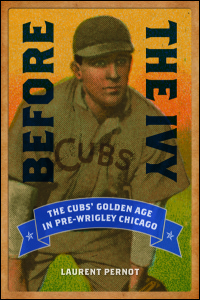
The Cubs are infectious. Despite their recent history, they do draw the fans. Laurent Pernot is one. Born in France, he was an exchange student in Chicagoland in the late eighties when he caught the fever. His case was so serious he came back to the Windy City to stay. Now a senior administrator at City Colleges of Chicago, he has immersed himself in Cub history, studying their early days, those days when Al Spalding and Cap Anson made the Cubs the toast of the National League. The result is an impressive primer on Cub-fandom.
Pernot's early focus is on the role of the Cubs in establishing baseball as the National Pastime. He briefly traces the game's antebellum origin through the initial professionalization in the immediate post-war years, highlighting the role of the Chicago team. Before 1870, Chicago's White Stockings were already beginning to rival the Cincinnati Red Stockings when the Chicago ballpark burned in the Great Fire at the end of the 1871 season. It took several years for the team to rise from those ashes, but it did so impressively. Pernot gives much press to the underappreciated (until recently) William Hulbert, who was instrumental in rebuilding the team and in guiding both the team and the fledgling league through the growth spurts and challenges of adolescence.
The middle of the story is that of the Spalding & Anson show, with a major supporting role played by King Kelly. Those were the days of the Cubs-as-winners, followed closely by the Cubs-as-lovable-losers (not something new only to the middle of the 20th century). They were also a peripatetic period, as the Cubs drifted around Chicago for a dozen years after the fire, before finally settling at West Side Park in 1885. They reigned there for a few years, then sold their stars for cash. During the last decade of the 19th century, the team became the Colts (those lovable losers), having given up the veteran players who had made the team frequent champions, now instead staffed by a young, untried collection of players. By the end of the decade, Charles Comiskey, running a successful team on the South Side, absconded with the name White Stockings. When the Colts rebuilt their roster as the century turned, they also rebranded to become the Cubs. And then along came Brown.
That is, Mordecai "Three Finger" Brown, along with Tinker, Evers, Chance, Steinfeldt, and the others who would make up those stupendous five years (from 1906 to 1910) when the Cubs racked up a .693 winning percentage and last won a world you-know-what. (In honor of baseball's famed superstitiousness, I hesitate to mention the specific term, in case, in the next few years, they might, well …) By then, of course, they were playing in West Side Park, what is now in the midst of the campus of the University of Illinois, Chicago. They continued there through 1915, while the Chicago entry in the upstart Federal League, under Charles Weeghman, played in a newly built field that would, in 1916, become the Cubs' home and, in 1927, finally be christened Wrigley Field.
That half century, from the Civil War era to the nineteen-teens, Pernot captures in short, pithy chapters. Along the way, he looks at racial issues, at blue laws, at temperance, and at baseball lingo. He follows the team on a world tour during late 1888 and early 1889, from Australia to South Asia and Africa and finally across Europe. He discusses not only the myth of the Tinker-to-Evers-to-Chance infield, but also that of its predecessor, the Stonewall infield of the middle 1880s (Burns-to-Pfeffer-to-Anson, with Williamson at third; and, no, that moniker doesn't roll off the tongue in the same way as that of its better-known successor).
This brief study packs a great deal of the history of the game, as well as the history of the team that would become the Cubs, into its 150-odd pages of text. Quite readable, though at times repetitive, the book provides a grounding for fans of baseball, but especially for those of the Cubs. Pernot does not ultimately suggest there is a cure for Cub fever, but he certainly gives us the basis for a better understanding of the phenomenon.
Pernot, Laurent. Before the Ivy: The Cubs' Golden Age in Pre-Wrigley Chicago. Urbana: U of Illinois P, 2015. 198 pp. Illus., with notes & index. $16.95 paper.
Copyright © 2015 by Mark Noe