tony oliva
Reviewed by Richard C. Crepeau, University of Central Florida
17 april 2015 archive
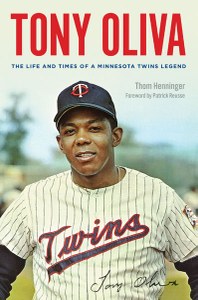
In mid-December of last year Tony Oliva, reacting to President Obama's announcement of a normalization of relations with Cuba, told ESPN's "Outside the Lines" that it was "the best thing that can happen for the United States and Cuba and will help both countries." Oliva is now 76 years old and has three sisters and two brothers who live in Cuba. He said that he has been waiting for this moment in U.S.-Cuban relations for fifty years.
Thom Henninger, a columnist for newspapers in the Twin Cities and a number of other baseball publications, has written an informative biography and a revealing portrait of one of the greatest players in Twins history, and one of the greatest players of his generation. Rookie of the Year in 1964, Oliva won batting titles in his first two seasons as a Twin.
Oliva's baseball saga extended out for over 50 years with the first high drama coming before his rookie season, first as boy in Cuba when he was still known as Pedro Jr., and then in his first several years in the United States pursuing the baseball dream. Henninger offers a brief look at Oliva's childhood in rural Cuba and his opportunity to come to the United States for spring training in Fernandina Beach, Florida in 1961.
What will surprise many baseball fans is the fact that when training camp ended Tony was not assigned to any team in the Twins organization. It no doubt also surprised Oliva who found himself in the United States in a difficult predicament. Further compounding things for Oliva and many other Cuban baseball players, Washington severed diplomatic relations with Cuba. The Bay of Pigs followed a few months later. For all of these players a return to Cuba would cut them off from any return to baseball in the United States. For those players in Cuba they could either return to the United States and in the process cut themselves off from family and friends, or they could stay on the island and end their American baseball dreams. Henninger tells this part of the story particularly well and explores the implications of this diplomatic development for Oliva and other Cuban players.
Without any knowledge of the language, with no job in baseball, living in a racist and segregated world for the first time, Oliva faced a major life decision. Tony was taken in by the general manager in Charlotte, Phil Howser, who along with veteran player Minnie Mendoza, persuaded the young player to stay in the U.S. Howser was able to place Oliva in the Appalachian League in June where he proceeded to hit .410 and raised more than a few eyebrows across baseball and in the Senators/Twins organization.
From this point on the baseball part of the story is fairly well known as Oliva moved up the system arriving in Minnesota in 1964 where the honors and achievements began to pile up. In some ways the more interesting story concerned Tony's struggle with the language, with an unfamiliar culture, and loneliness. More than once Oliva was ready to give it all up and return home only to be talked out of such a drastic action by his teammates.
The complexity of Oliva's life in the United States and that of other Cuban and Latin players is well documented by Henninger. Portraits of Tony's friends and teammates are scattered throughout the book, as is his adjustment to life on the frozen tundra. He lived in a predominantly white world of snow and people as the Twin Cities had a miniscule black population.
Oliva met a young woman from the farmland of South Dakota, Gordette DuBois. The story of their relationship is remarkable, and after a long distance courtship they married and had three children, two boys and a girl. Tony had another son by a previous relationship. Their daughter, Anita, provides a strong voice in this book as she offers insight into the lives of this baseball family.
In the end this is not just a biography of Tony Oliva but it is rather the story of those who were part of his life in baseball. The observations of teammates and other Cuban players are a major part of the narrative and they make this a worthwhile read for baseball fans and baseball historians.
For all those in and from Minnesota who have been Twins fans from the birth of this franchise as I was, and for those of us who have fond memories of Oliva, Carew, Tovar, Versailles, Killebrew, Allison, Pascual, Kaat, and so many others, like I do, this book is a treat, despite its flaws.
For those who think Tony Oliva belongs in the Hall of Fame. Henninger offers plenty of evidence to support such a view in a final chapter devoted to that topic.
Despite the tendency of Henninger to lose focus and wander off on tangents that do not always seem relevant, this is a story that was worth telling and one that is in many ways well told.
Thom Henninger, Tony Oliva: The Life and Times of a Minnesota Twins Legend. Minneapolis: University of Minnesota Press, 2015. $25.95 cloth. 280 pp.
Copyright © 2015 by Richard C. Crepeau