the game before the money
Reviewed by Bob Epling
2 march 2015 archive
We all have our fifteen minutes of fame, and it'll be gone. All you have is the memories, and you try to make as many good ones as you can. — Louie Kelcher (p. 325)
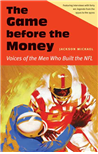
Jackson Michael's book is full of memories from players who influenced the growth and development of the National Football League from the 1930s forward. In his introduction, Michael compares the relatively barren written history of professional football with the more robust attention given major league baseball. He does not specifically mention Lawrence Ritter's The Glory of Their Times, but this effort certainly brings to mind that pioneering work. As did Ritter, the author allows the players themselves to tell the story in their own words. The Game Before the Money should appeal to the casual and serious student of football history alike.
The book is comprised of the transcripts of forty interviews with former NFL players. Michael divides the interviews into what he designates as four quarters. Those players who began their careers before 1950 make up the first quarter (seven players), those who started their careers during the 1950s are grouped into the second quarter (ten players), those beginning in the 1960s fill the third quarter (fifteen players), and players from the 1970s constitute the fourth quarter (eight players). Before each section (or "quarter") of the book, Michael provides a narrative introduction to the time period, a timeline of significant events from the era, and a notes section of references.
A primary appeal of The Game before the Money is its authentic tone. The author simply allows the players words to carry the book. Some are expansive; former Pittsburgh Steeler running back Rocky Bleier provides twenty pages of material, including a matter-of-fact, but still riveting, account of the Vietnam firefight and grenade explosion that injured him severely and resulted in his earning a Purple Heart decoration and Bronze Star medal. Charlie Trippi, the great former Georgia Bulldog and Chicago Cardinal, is much more succinct. His words barely run three pages, and he sums up his Hall of Fame career with the words "Sometimes you just get lucky." Whether loquacious or reticent, every one of the forty former players comes across as authentic, thus providing real insights into the game as it was during their careers.
Another significant aspect of the book came as a bit of a surprise. While the title suggests a focus on the NFL, the men actually detail a lot of information about their college careers too. So, the reader learns a great deal about college football from an earlier era, especially from the older players. While the campus game has a more established history than the professional level, the sheer amount of happenstance that led so many of these great players to different schools indicates a sport far different than today's polished, pseudo-professional game.
Several themes run through the players' comments. As the title suggests, one was financial. While current professional football players still earn less than their NBA and MLB contemporaries, their income simply dwarfs the salaries of even the greatest players from these earlier decades. Virtually every player interviewed took on a second (or third – or fourth) job during the off-season. Some of the jobs evolved into careers that made the men financially secure (the aforementioned Trippi became successful in commercial real estate for example), but most did not become wealthy. To read that the great Don Maynard, Super Bowl winning wide receiver with the famed New York Jets of 1968 and Pro Football Hall of Fame member, has a pension of $428 per month is a jolting reminder that the game was so different no so long ago. While many of the former players mention the financial differences of yesteryear and today, none comes across as bitter.
Health and helmets are other common themes in the interviews. Most of those from the 1950s and earlier list various ailments attributable to age and to their physically rough profession. Hips, knees, joint pains, shoulders, and fingers are among the afflictions mentioned. A noticeable absence from the citation of maladies are brain and head trauma. Those concerns are brought up more often by players who began their careers in the 1960s and 1970s. Many of the older players specifically disdained the modern, hard-shell plastic helmets that became prominent in the mid-1950s. They believed the plastic helmets sometimes became a weapon, as compared to the old leather helmets which (while leaving players susceptible to facial injuries) were by nature only a protective device.
For the serious sport history fan or scholar, the most enjoyable aspect of the book is likely to be getting to know players who are not so well known. Most casual football fans will recognize famous players such as Frank Gifford, Bart Starr, Paul Hornung, and Bob Griese. However, even football historians might learn a few things by reading the recollections of Chuck Cherundolo, Nolan Luhn, Tony Lorick, and Cotton Davidson. They are a treat.
Finally, the players often provide insights into life beyond the field. Whether it is a former Green Bay Packer applying the lessons of Vince Lombardi, or George Taliaferro (one of the earliest African Americans to play in the NFL – and the first black player to be drafted by the league) chastising Don Shula about Shula's greatest coaching attribute (his skin color according to Taliaferro), nearly every player linked success on the field to success in life through anecdotes and insightful stories.
Jackson Michael's The Game before the Money is an admirable football complement to baseball's The Glory of Their Times by Lawrence Ritter. While Michael's work is unlikely to reach the benchmark status of Ritter's classic (and that is probably not a fair comparison to make with any contemporary book), it is a worthwhile effort on a relatively neglected topic, and allows these football pioneers to tell about the game they knew – in their own words.
Jackson Michael. The Game before the Money: Voices of the Men Who Built the NFL. Lincoln and London: University of Nebraska Press, 2014. XI-XIII
+ 368 pp; Illustrations, Afterword, Acknowledgements, Appendix, Author's
Note, Index. $29.95 (Hardcover)
Copyright © 2015 by Bob Epling