bush league boys
Reviewed by Amy Essington
27 february 2015 archive
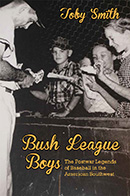
Toby Smith recreates the world of minor league baseball in the American Southwest after World War II. Focusing on four leagues, the West Texas-New Mexico League, the Southwestern League, the Longhorn League, and the Sophomore League, between 1946 and 1961, Smith delves into and focuses on the lives on the individuals. Each of the ten chapters focuses on a different aspect of baseball life in New Mexico or West Texas. The author presents the topic through narration, and then includes excerpts from two, and in one chapter three, oral histories. Through oral histories, which include players, umpires, fans, sportswriters, and team officials, Toby Smith brings the reader into the world of minor league players in the Southwest.
The first chapter opens with two legends of minor league baseball, Joe Bauman and Bob Crues. In 1948, while playing for the Amarillo Gold Sox, Bob Crues tied the minor league homerun record with 69 and drove in 254 RBI in 140 games, a record that stands today. In 1954, Joe Bauman set a new record with 72 homeruns in 138 games for the Roswell Rockets, setting a single season record for all levels of baseball that remained until 2001, when Barry Bonds hit 73 homeruns.
Despite years of effort, most minor league players will never reach the major leagues. On baseball diamonds across the wind-swept, dusty towns of eastern New Mexico and West Texas, young men grew up, fell in love, and started families hoping to achieve their professional dream. Some of their stories become local legend. On August 11, 1959, the homerun ball, which Chuck Tidwell saw hit over the outfield wall of Montgomery Field, home of the Carlsbad Potashers, into the adjoining neighborhood, was never seen again. Legends like this tied the baseball players to the communities in which they played. Baseball players in the southwest had to contend with extreme weather including heat, dust storms, blizzards, lightning, and tornados. On May 11, 1953, a tornado created a path of destruction in and around San Angelo, Texas.
In a chapter titled "Invisible Men," Smith describes the experiences of the first players of color who join the leagues of the Southwest. In March 1951, Jay Haney, the manager of the Lamesa Lobos, offered a blacks-only tryout camp. Haney had established that black players who joined the teams would not break down the social barriers of Texas and would live and eat separately from the white players. Two players came to the tryout and John W. Wingate integrated the Lobos. Some teams would challenge segregation and not patronize a restaurant that would not also serve any black players on the team. Future Hall of Famer Willie Stargell played in the Sophomore League. Smith quotes Stargell as describing the league as having rampant racism. Stargell could not find a place to live and stayed on the local Air Force base. In an unusual criticism of the veracity of the player's memories, Smith challenges the accuracy of Stargell's memories by noting his factual errors. Toby Smith includes many aspects of players' lives from illness and death to love and marriage. Young men died of polio, car accidents, and leukemia. Teams raised money to help families. Some choose to marry on the baseball diamond on which they played. Sportswriters, usually just one-man operations for the local paper, recorded all of it.
One by one, the leagues of the Southwest collapsed. On August 29, 1961, the Hobbs Pirates played the Albuquerque Dukes for the last time and the Sophomore League ended. Leagues had come and gone over the decades, but the fans preferred to watch major league games on television or see movies at the drive-in theater.
Bush League Boys is a glimpse into a time and place. This book is not a comprehensive look at the leagues, but it does not claim to be one. The individual player is at the center of the story of the four leagues that Toby Smith researched. A number of black and white photos accompany the text. There is a bibliography for further reading and an index. The oral historians, the strength of the book, are not listed in the sources. A detailed accounting of those interviewed would have been a useful addition. Most professional baseball players spent their careers in the minor leagues. Toby Smith presents a window into the previously undescribed world of those who spent their summers on baseball diamonds of the Southwest.
Toby Smith. Bush League Boys: The Postwar Legends of Baseball in the American Southwest. Albuquerque, NM: University of New Mexico Press, 2014.
216pp. $24.95.
Copyright © 2015 by Amy Essington