rozelle
Reviewed by Richard Crepeau, University of Central Florida
15 january 2015 archive
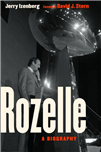
This is the third major work on the late Commissioner of the National Football League, Pete Rozelle. The most comprehensive to date is by Jeff Davis, Rozelle: Czar of the NFL. John Fortunato's, Commissioner: The Legacy of Pete Rozelle is a professional career biography. Jerry Izenberg's new book, Rozelle: A Biography, is somewhere between these two in terms of coverage. Izenberg focuses on the professional life of Pete Rozelle with an eye on those more personal biographic details that illuminate Rozelle's career and character.
There are numerous other studies of the NFL and memoirs of league participants that offer some depth of analysis of the achievements of the Commissioner, as well as his strengths and weaknesses. Some of these are laudatory, while others tend towards the critical. Others are mix of both, and I would include my own history of the NFL in this latter group. I come to this latest study of Commissioner Rozelle with well formed views on him, and I offer that as a caution to those who read this review.
Jerry Izenberg spent his professional career as a sportswriter and is highly respected in the profession, having been honored with the Red Smith Award from the Associated Press Sports Editors. He was inducted into the National Sportscasters and Sportswriters Hall of Fame in 2000. He spent over a half century covering sports for the Newark Star-Ledger and is one of only two writers to have covered every Super Bowl. In addition he has written, produced, or narrated thirty-five network television productions. This is his thirteenth book.
It is clear from the narrative that Izenberg was close to Rozelle at more than a professional level, and that like anyone who works in one field over a stretch of time Izenberg was well connected. His descriptions of episodes in Rozelle's personal life are well drawn and connected to the Commissioner's career trajectory. The number of interviews conducted by Izenberg that contributed to this biography is staggering and he did not neglect other sources, although there are no references to any of the major histories of the NFL or the previous biographical work on Rozelle.
One strength of this biography, as one might expect, is the many inside stories and quotes from the major figures in and around the NFL. I would have been pleased to use many of them in my own work. Izenberg illuminates the motives driving Rozelle's important decisions and the personal misgivings and emotional conflict that, at times, tempered his actions.
In the end Izenberg confirms the basic view of Rozelle as a public relations genius, a strong and persuasive leader, and the most significant figure contributing to the building of the NFL. Of particular note is Rozelle's understanding of the emerging television industry and its relationship to the NFL which he, more than any other, was the architect. As with most successful people Rozelle found himself in the right place at the right time, and as Izenberg points out part of Rozelle's genius is that he knew what to do in every one of those times and places.
In Izenberg's eyes Pete Rozelle was a man's man, a man of principle who guided the NFL to its dominance over the American sporting scene. It is not clear what those principles were beyond the control of his universe and a willingness to do anything to promote the league.
What is largely ignored is Rozelle's often illegal or unethical treatment of players, owners, and other business partners who he used to his own ends. He had an ability to dissemble with the best of them when he felt it was necessary or expedient.
The centerpiece of the struggle between the NFL and its players was free agency. Izenberg treats the labor struggles rather oddly and without clear focus. The Mackey Case is never referred to by name, nor is there a clear discussion of its significance and subsequent history. Izenberg does deal with a number of court cases but the linkage of all these cases, strikes, and lockouts seems to elude him, and there is seldom if ever any mention of the numerous violations of labor law by the NFL. The players are described as ungrateful and the Commissioner as a man of integrity who looks out for their interests.
The issue of drug use gets a curious treatment. Rozelle is portrayed as the concerned father figure worried about the health of the players over the long term. An alternative interpretation is that the extent of drug use in the NFL was covered up by the Commissioner and that as with most issues, he saw drugs as primarily a public relations problem. The fact that Rozelle did not discover that steroids were a problem in the NFL until 1988 seemed astounding to many.
In the battles between Rozelle and the other owners, especially Al Davis, the Commissioner is adorned with a white hat by Izenberg. Davis is always the heavy. Or course he often was the heavy, but as bad as Davis was, he should be given credit when credit is due.
There is minimal treatment of the manipulation of politicians and communities by the NFL, particularly when dangling expansion teams in front of them. When Izenberg does deal with it, Rozelle is never at fault.
These shortcomings are disappointing because clearly Izenberg had access to valuable information concerning key events in the history of the league and in Pete Rozelle's life. Even a slightly critical eye could have made this a much more valuable addition to the growing body of work on Pete Rozelle. is as much about the men who lived and died as it is the sociocultural experience of the war. In aggregate, the thirteen stories collected in the work are invaluable for their ability to put a sublimely human face on these broad topics of history.
Izenberg, Jerry. Rozelle: A Biography. Lincoln: University of Nebraska Press, 2014. XI-XV + 305 pp. Illustrations, Notes, Index. $29.95.
Copyright © 2015 by Richard Crepeau