when baseball went white
Reviewed by Duncan R. Jamieson
3 january 2015 archive
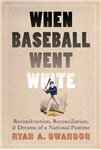
While historians have produced plenty of books on Jackie Robinson's breaking major league baseball's color line, little has been written regarding the necessity for baseball's integration. Specifically, how and why did baseball become segregated? Ryan Swanson at the University of New Mexico argues persuasively that the desire for reconciliation following the Civil War outweighed any interest in equal rights for the freedmen. Focusing on Washington, D. C., Richmond, Virginia and Philadelphia, Pennsylvania, three cities with large African American populations, he uncovers a systematic effort to deny blacks access to the national pastime at its highest level. The book's title is designed to appeal to sports historians generally and baseball aficionados specifically; the sub-title more specifically addresses how baseball mirrors the failure of reconstruction to establish an integrated society.
Swanson chose his three cities because of the size of their African American populations. Because Philadelphia and Washington D. C. had a longer history with baseball than Richmond, intercity play usually went against the Virginians. Further, Richmond's interest in baseball did not equal the more traditional Southern sports of shooting or horse racing. While the North encouraged baseball in the South as a means of national reconciliation, the South maintained its interest in the Lost Cause and resisted inclusion. Southern teams celebrated the Confederacy and all it stood for. They outfitted their teams in grey uniforms, and chose names honoring Confederate heroes. The major Richmond teams included the Ashby Base Ball Club (named for Confederate general Turner Ashby), Stonewall, Robert E. Lee, Stuart (named for Cavalry General J. E. B. Stuart) and Mosby (named for Colonel John S. Mosby). Other teams included Secesh, Dixie, Old Dominion and South Star, reinforcing the South's separate identity. Northern baseball men who wanted to create a professional game that appealed to white Americans regardless of location did not push integration.
One might expect that neither Washington D. C. nor Richmond, both Southern cities, had much interest in integration, but Swanson points to Philadelphia, "the city of brotherly love," as an interesting case of race separation and exclusion. Its dominant white baseball team was the Athletic Club. Thomas Fitzgerald, the teams' founder and president, was a popular playwright, member of the Executive Board of the Philadelphia Public Schools and editor/publisher of the City Item. Because of his strong support of integration and the 1866 Civil Rights Act, the Athletic Club expelled him for his views on race. On the other side of the color line, Octavius Catto, a veteran of the Union Army, a teacher at the Banneker institute and an active political organizer, led the Phythians, the city's leading black team. As they did not have the funds to acquire their own playing field, they had to rely on the generosity of the Athletic Club, which granted the Phythians access. As in other cities, blacks who played baseball on black teams were more interested in equality than integration. While attempting to vote in the city's 1871 election, two years after passage of 15th Amendment guaranteeing African American males the right to vote, a riot broke out and a white "peacekeeper" murdered Catto. In the subsequent trial an all-white jury found Catto's assailant innocent on all charges, despite evidence to the contrary.
Another example of the North's reluctance to embrace the Radical Republican goal of integration can be seen in the action of the predecessor to the National League. The National Association of Professional Base Ball Players (NABBP) wanted to expand baseball's reach, admitting more clubs to membership, and to do so it followed the decisions of the state organizations. With this in mind Philadelphia's black club, the Pythians, sent its vice president to the state meeting in Harrisburg requesting membership in the Pennsylvania Association of Base Ball Players. Despite proficient play and gentlemanly conduct, the Association refused to acknowledge their request. The National Association followed suit so as not to upset the South, thus putting "one of the country's first interstate Jim Crow 'laws' (albeit a baseball law) on record."
White newspapers began ignoring the black contests. When they did appear in print, the papers focused more on the potential for riot and disorder than on box scores, despite the level of play among the black clubs, and despite the reality that they played as gentlemanly as their white counterparts. Despite the level of play among the black clubs, and despite the reality that they played as gentlemanly as their white counterparts. With the black players and teams being increasingly marginalized, professional baseball became white, though at the amateur level there continued to be some integrated play. The creation of the National League in 1876 simply continued the segregation of baseball, it did not create it. Had Fitzgerald and Catto been more successful with their baseball careers, Jackie Robinson might not have been such a seminal figure.
Swanson, Ryan A. When Baseball Went White. Lincoln: University of Nebraska Press, 2014. XX + 250 pp. Illustrations, Notes, Bibliography.
$29.95.
Copyright © 2015 by Duncan R. Jamieson